Bathroom remodeling contractor in Rescue, El Dorado County - modern shower design and renovation by Oakwood Remodeling Group

El Dorado County

Foothill Estate Bathroom Remodel in Rescue, CA

Rescue Foothill Estate Bathroom Specialists. Custom Home Renovation, Well Water Expertise for Green Valley Road, Deer Valley, Bass Lake Road & All Rescue Areas.

  • 5-Star Rated
  • Lic #1125321
  • 0% Financing Available
5.0on Google
License #1125321
Warranty on All Work
0% Financing Available
(916) 907-8782
Serving ZIP Codes:95672

Rescue, CA · El Dorado County

Rescue Bathroom Remodeling at a Glance

Rescue is an unincorporated El Dorado County community, listed by USGS as a populated place, 2.7 miles north of Shingle Springs at about 1,206 feet, with two California Historical Landmarks. It has no Census boundary. Fifteen of 25 map points around it are in El Dorado Irrigation District's soft-water service area, the rest outside any public system, and El Dorado County issues permits. Oakwood Remodeling Group remodels bathrooms only, license #1125321.

15 of 25
Test points in EID’s mapped service area

State water-system map

13 mg/L
EID Main system water hardness

Soft · 2025 report

Nos. 747 & 703
California Historical Landmarks at Rescue

Office of Historic Preservation

$24,000 – $86,500+
Primary bathroom remodel

Engine-derived range

What does a Rescue bathroom remodel cost?

Rescue engine ranges: shower $8,000 – $34,500+, primary suite $24,000 – $86,500+, tub-to-shower conversion $7,000 – $28,500+, full bathroom $13,000 – $51,500+.

Is Rescue on EID water or wells?

Both occur. The hamlet point and 15 of 25 points we checked about 2 km apart are inside El Dorado Irrigation District's mapped service area; the other 10, mostly to the northwest, are outside any public system.

Is EID water hard?

No. EID's 2025 report puts Main system hardness at 10–14 mg/L, averaging 13, which is soft. That report does not cover private wells, so test one before choosing finishes.

Does Rescue have state landmarks?

Two. "Coloma Road-Rescue" was listed as California Historical Landmark No. 747 in 1960, and No. 703, "Pleasant Grove House Overland Pony Express Route in California," in 1959.

Who issues bathroom permits in Rescue?

Rescue is unincorporated, so permits come from El Dorado County’s Planning and Building Department.

Which nearby communities do you serve?

Shingle Springs, Cameron Park, El Dorado Hills, Placerville and Coloma.

Reviewed against USGS place names and elevation data, state historic-landmark listings, state water-system, Census boundary and FEMA maps tested at 25 points, El Dorado Irrigation District's 2025 water quality report, and NOAA climate normals. Pricing and permits: Oakwood Remodeling Group, license #1125321.

Landmarks & map

Rescue: Two State Landmarks and No Census Boundary

Layer checkedAt the hamlet point25 surrounding points
Public water systemEID Main15 EID Main · 10 none
FEMA flood zoneZone X24 Zone X · 1 Zone D
Census placeNone3 Cameron Park · 2 Shingle Springs · 20 none
Elevation1,206 ft1,008–1,638 ft across the grid

Rescue is a small unincorporated community in El Dorado County sitting at 1,206 ft, roughly 2.7 miles from Shingle Springs to the west and 3.2 miles from Cameron Park to the southwest. El Dorado Hills lies 5.9 miles further. The hamlet occupies the old Pony Express route along what is now Rescue Road, and that history is why two California Historical Landmarks fall within its immediate vicinity: the Coloma Road-Rescue marker (No. 747, designated 1960) and the Pleasant Grove House that served as a Pony Express station (No. 703, designated 1959).

Because the Census Bureau does not define a Rescue CDP, there are no official population or housing figures to cite. We instead checked 25 geographic points across the community's footprint. Of those, 3 fall inside the Cameron Park CDP boundary and 2 inside the Shingle Springs CDP boundary, which reflects how Rescue grades naturally into both communities at its edges. The remaining 20 points sit in the unincorporated pocket that most residents and neighbors simply call Rescue.

Flood risk at Rescue is low in most of the area. Of the 25 points we checked, 24 are in FEMA Zone X (minimal flood hazard) and just 1 is in Zone D, meaning that one small portion of Rescue has not yet been studied by FEMA and flood risk there is undetermined rather than minimal. The grade relief across the community is meaningful: elevation runs from 1,008 ft at lower creek drainages to 1,638 ft on the higher ridgelines, a spread that affects both drainage and microclimate.

Housing in the Rescue area is predominantly single-family, built mostly between the 1970s and 1990s on acreage lots. The rural character is part of why homeowners here stay long-term and eventually invest in primary suite renovations rather than moving. With no Census data to lean on, every site visit tells us more than any aggregate number would. Primary-bath design references that apply to Rescue foothill homes: layout options for large bathrooms and converting a garden tub to a shower.

EID or well

Rescue Water: Soft EID Supply, Private Wells in Places

SourceHardnessNotes
EID Main (2025)10–14 mg/L, avg 13Jenkinson Lake, Forebay Reservoir, Folsom Lake
Private wellVaries — test firstTest hardness, iron, manganese, pump pressure

EID's 2025 report puts Main system hardness in the 10–14 mg/L range, averaging 13 mg/L. That is soft by any standard classification. For EID customers in Rescue, finish choice is effectively unrestricted: polished chrome, clear frameless glass, natural stone, and cement grout all perform well without elevated cleaning effort or premature spotting. You do not need coated fixtures, treated glass, or any hard-water accommodation.

The picture changes for the 10 grid points with no mapped public system. In El Dorado County's foothill geology — granitic and metavolcanic formations across much of the Rescue area — private well hardness varies considerably depending on which formation the well is drilled into, how deep it goes, and the local groundwater chemistry. A private-well owner considering a remodel should test before specifying fixtures. That test should include hardness, iron, and manganese at minimum, plus whatever pressure the pump delivers at peak use.

Climate adds a secondary water concern: with 30 freeze nights per year at 1,206 ft (based on NOAA normals 1991–2020 at the Placerville station, 6.9 miles east), supply lines that pass through an exterior wall or an uninsulated crawl space are a frost risk. We insulate or re-route those runs when framing is open. On the summer end, 74 days at or above 90°F means a ducted exhaust fan matters — both for comfort during a shower and for moisture management year-round.

Flood exposure at Rescue is low. The single Zone D point means a small portion of the community has unstudied rather than demonstrated flood risk; all other mapped points are Zone X. Flood zone does not directly affect bathroom waterproofing practice — we use membrane systems behind cement board regardless — but it matters for insurance and permits. Related finish-selection reading: choosing a showerhead and frameless vs. semi-frameless shower glass.

Questions? Talk to a bathroom remodeling expert today.

(916) 907-8782

Showers

Shower Remodeling in Rescue

Rescue Shower Overview

Timeline

About two weeks on site

Price band

$8,000 – $34,500+

First check

EID or well supply

The dominant housing era in the Rescue area — 1970s through 1990s El Dorado County foothill construction — means most showers are original single-piece fiberglass surrounds or three-piece kits, sometimes 40 to 50 years old. Surround seams open, pan flexes, and the caulk joint at the pan lip cycles through wet-dry stress until water migrates behind the wall. The rebuild sequence is straightforward: remove the surround and pan, probe the framing and subfloor for rot, replace any damaged wood, apply a sheet membrane from the floor drain up the walls past the valve height, install cement board, tile or large-format porcelain, grout, and a frameless or semi-frameless glass enclosure.

For EID-served homes, finish choice is unrestricted. Clear frameless glass shows off tile work without visual breaks. Polished chrome stays bright with ordinary care at 13 mg/L — there is not enough mineral load to etch or cloud the surface in normal use. Natural stone — marble, quartzite, travertine — performs well too, though sealing is still recommended to guard against soap and product residue rather than water hardness. Cement grout works fine; large-format tiles with minimal grout joints are also popular because they reduce cleaning surface.

Private-well homes are the opposite case: we want to know what the water actually is before specifying. A test that comes back at 25 mg/L or below is functionally similar to EID. Above 50 mg/L, brushed or matte fixture finishes and a coated or treated glass option are worth the conversation. Above 100 mg/L, acrylic panels eliminate the grout joint entirely and tolerate mineral film better than stone or cement. We do not guess at well hardness — the test costs very little compared to a regrout or a fixture swap a year into a remodel.

Climate context for shower sizing and ventilation: 74 days at or above 90°F means a Rescue shower runs hard in summer. Size the exhaust fan for the actual volume, not the minimum code figure, and locate it at the ceiling directly above or adjacent to the shower head. Related guides: shower design options and tile and waterproofing.

Tub-to-shower

Tub-to-Shower Conversions in Rescue

Foothill acreage homes in the Rescue area often have bathrooms that are proportionally larger than comparable valley tract homes built in the same decade. A primary bath from the late 1980s or early 1990s might hold a 60-inch garden tub on one wall, a separate shower stall across the room, and a double vanity — a layout that made sense when soaking tubs were a selling point but that most homeowners today rarely use as intended. Converting the tub alcove into a larger walk-in shower is the most common primary bath request we receive in the El Dorado County foothill corridor.

The conversion sequence in a wood-frame foothill home starts with verifying the drain stack location. A cast-iron stack in a 1975 home may be in a different position than a PVC stack in a 1992 home, and moving the drain more than a few inches typically requires opening the subfloor. If the existing tub drain aligns reasonably with a new shower drain location, the project stays tight. We confirm framing direction, floor joist spacing, and whether any structural element sits in the proposed shower footprint. In homes with a crawl space — common on acreage parcels with grade variation — drain access is straightforward.

At 1,206 ft with 30 freeze nights per year, grab-bar blocking is standard practice when framing is open. Blocking — typically 2×8 or 2×10 lumber set between studs at the right height — adds nothing to the visible finish but means a grab bar can be added anywhere along that wall later without opening the tile. We set blocking at the entry wall, the back wall near a bench, and the side wall opposite the showerhead. A bench, whether built-in stone or a fold-down teak unit, pairs naturally with the grab-bar layout.

For EID customers in Rescue, the new shower finish can be anything: polished chrome, matte black, brushed nickel, clear glass, rain head, hand shower on a slide bar. None of these choices are constrained by water chemistry at 13 mg/L. Private-well customers should bring the test results to the estimate appointment; we will match the specification to the actual water. Further reading: whether to replace a bathtub and jetted tub to walk-in shower.

Walk-in

Walk-In Showers in Rescue

Rural foothill communities like Rescue attract homeowners who intend to stay for decades. Acreage lots, mature landscaping, and the community character are not easy to replicate, so aging in place is a common goal rather than an afterthought. A primary suite walk-in shower designed for accessibility from the start — curbless entry, linear drain, bench, hand shower on a slider bar, and blocking for future grab bars — costs almost nothing more than a conventional shower when planned during the remodel, and it is substantially less expensive to install correctly at this stage than to retrofit later.

In a wood-frame Rescue home on a crawl space, a curbless entry requires dropping the shower floor relative to the bathroom floor so a linear drain can sit at the correct pitch. That is a straightforward framing modification when the subfloor is open. On a slab-on-grade — less common in the acreage foothill market but present in some 1980s homes — a curbless conversion may require cutting the slab to relocate the drain. We assess the floor system at the estimate and give you an honest account of what the transition requires and what it costs.

Grab-bar blocking at the entry, bench wall, and back wall is set in the framing phase. We use kiln-dried dimensional lumber at the stud bays that align with the expected bar heights — both at the standard ADA reference positions and at the positions the homeowner actually wants given their height and how they use the shower. A comfort-height toilet (typically 17 to 19 inches to the seat) pairs logically with a walk-in shower in an aging-in-place layout; we can include it in the scope if the toilet is being replaced anyway.

EID's soft water means that frameless glass on a walk-in shower — the most accessible entry format — stays clean without specialized treatment. A single wipe after each use keeps spotting minimal at 13 mg/L. Well customers with higher hardness may prefer a semi-frameless configuration with a treated glass coating, which gives similar accessibility with more tolerance for mineral film. Related: aging-in-place bathrooms and going curbless.

Primary suites

Primary Suite Remodels in Rescue

A full primary suite remodel in a Rescue foothill home typically involves the shower, the tub (replace, convert, or keep), the double vanity and mirrors, the toilet, the floor, and sometimes the ceiling. The scope tends to be larger than a valley tract home because the rooms are larger and because the original 1970s–90s finishes are well past their useful life. Tile that was installed in 1988 is now 38 years old; chrome faucets from 1992 are corroded at the valve seats; cast-iron tubs with enamel worn through the base are staining grout.

Pre-1980 homes in the Rescue area may have galvanized supply pipe. Galvanized corrodes from the inside out; water pressure drops, discoloration appears at the tap, and the interior diameter narrows over decades. A shower valve replacement on corroded galvanized pipe often reveals the problem: flow at the new valve is insufficient because the supply branch cannot deliver adequate volume. If we find galvanized supply in the bathroom walls during framing, we will flag it. Replacing from the main shutoff or at least from the branch takeoff to the bath fixtures is the correct fix — not working around it.

EID's soft water gives Rescue homeowners real latitude in the finish specification. Polished chrome or unlacquered brass on the faucet, clear glass on the shower, Carrara marble or a large-format natural stone on the floor and walls — all of these directions are practical at 13 mg/L without special maintenance. The design conversation in a soft-water home is entirely about aesthetic preference and budget, not about working around mineral chemistry.

Private-well homes require a test result before finish specification. The foothill geology around Rescue is variable — some wells draw from relatively soft granitic aquifer zones, others from formations that yield harder water with iron or manganese. Once we have the test, we can match fixture finish, glass type, and grout chemistry to the actual water rather than guessing. Planning resources: primary suite cost guide and replacing a double vanity.

Ready to transform your Rescue bathroom?

Pricing

Rescue Bathroom Remodel Costs

Rescue projectEngine rangeTime on site
Primary suite$24,000 – $86,500+3–4 weeks
Whole bathroom$13,000 – $51,500+About 3 weeks
Shower$8,000 – $34,500+About 2 weeks
Tub conversion$7,000 – $28,500+2 weeks or so
Compact bath$10,000 – $43,500+Around 2 weeks

Engine ranges reflect a typical room and finish tier in the El Dorado County foothill market. They do not include well treatment, water softener installation, galvanized pipe replacement, or rot repair — all of which are estimated separately once we assess the actual conditions. Delivery to Rescue from our staging area is straightforward given the community's proximity to the Highway 50 corridor.

El Dorado County permit fees are separate from project cost and are passed through at cost. Cameron Park is 3.2 miles from Rescue and shares the same El Dorado County Planning and Building Department, so the permit process is identical. We prepare the application and coordinate inspections; the homeowner does not need to manage that process.

  • Supply confirmation — EID account verification or well test before spec
  • Insulated supply lines — where runs cross exterior walls or crawl space
  • Ducted exhaust fan — sized for the room volume, not minimum code
  • Grab-bar blocking — set in framing before tile goes up
  • Galvanized check — flag and price on pre-1980 homes

* Engine ranges cover a typical room and finish tier; well treatment, hidden repairs, and foothill delivery are included in the estimate we provide on site.

Free Planning Tool

Estimate Your Bathroom Remodel in 60 Seconds

Get a planning range tailored to your project type, finish level, and bathroom size — built from real Oakwood project pricing across Sacramento, Placer, and El Dorado counties.

Start the Calculator

No obligation • Free in-home estimate available

County permits

Rescue Bathroom Permits: El Dorado County

Rescue Permit Guide

Issuing office: El Dorado County Planning and Building Department
Permit scope: relocated plumbing, added circuits, structural framing changes
Flood zone: Zone X at 24 of 25 points checked (minimal hazard)
Codes: 2025 California editions apply in 2026
Historical Landmark note: CHL No. 747 and No. 703 apply to public landmark sites, not to adjacent private homes — bathroom permits process through standard county channels

Because Rescue is unincorporated, it does not have its own building department. El Dorado County Planning and Building issues all permits for residential work in the community. The process is the same whether you are in Rescue or in Cameron Park 3.2 miles to the west — same office, same permit counter, same inspection schedule. There is no city layer between the homeowner and the county.

A Rescue bathroom permit for relocated plumbing, an added electrical circuit, or structural framing changes follows the standard county residential process: application with plans, over-the-counter or plan-check review depending on scope, permit issuance, rough inspections for plumbing and electrical, framing inspection if applicable, and a final inspection on completion. We prepare the application package, submit it, and coordinate each inspection. The homeowner does not need to be present for rough inspections.

The two California Historical Landmark designations in Rescue — No. 747 (Coloma Road-Rescue, designated 1960) and No. 703 (Pleasant Grove House, Pony Express, designated 1959) — apply to those specific public landmark sites and their CEQA-defined areas of potential effect. They do not apply to private residential properties in the surrounding community. A bathroom permit on a private Rescue home processes through normal county channels without any historical review.

We file the county application and meet each inspection. California Contractors State License Board license No. 1125321.

Real work nearby

Nearby Real Projects: Cameron Park (3.2 Miles)

Until we have completed and photographed a project in Rescue itself, Cameron Park is the closest documented work we can point to. Both communities are in unincorporated El Dorado County, use the same permit office, and share similar housing stock: wood-frame single-family homes on larger lots, built mostly between the 1970s and 1990s, served by EID Main water. The material choices and construction methods we use in Cameron Park are identical to what we would bring to a Rescue project.

Cameron Park — Shower Remodel

Marble-Look Porcelain, Hex Mosaic, Frameless Glass

A 1990s primary bath shower rebuilt with large-format marble-look porcelain on the walls and a hex mosaic accent band at mid-height. Frameless glass enclosure, polished chrome fixtures. EID Main water — no hard-water accommodation needed. Same permit jurisdiction as Rescue.

  • Membrane waterproofing behind cement board
  • Hex mosaic niche and accent band
  • Frameless glass, polished chrome
  • El Dorado County permit — same office as Rescue
View project details →

Cameron Park — Tub-to-Shower

Wood-Look Tile, Matte Black Fixtures

Garden tub converted to a walk-in shower in an early-2000s Cameron Park primary bath. Wood-look plank tile on the shower floor and feature wall, matte black fixtures and hardware throughout. Grab-bar blocking installed at the bench wall and entry. EID Main water — polished or matte finishes both work equally well.

  • Garden tub removed, drain relocated
  • Wood-look plank tile, feature wall
  • Matte black fixtures throughout
  • Grab-bar blocking at bench and entry
View project details →

Both Cameron Park projects were completed under El Dorado County permits. The same permit process, waterproofing standard, and finish approach applies to every project we complete in the foothill corridor — whether the address is Cameron Park, Shingle Springs, or Rescue.

Community context

Rescue and the El Dorado County Foothill Corridor

The Rescue hamlet core sits near the intersection of Rescue Road and Bass Lake Road, the area most long-time residents mean when they say Rescue. Housing here tends to be older — 1960s to 1970s construction, mostly ranch-style on half-acre to two-acre parcels. Original bathrooms in these homes are now 50 to 60 years old. Fiberglass tub surrounds from the early 1970s are typically failing at the pan seam; chrome fixtures from that era are corroded; floor tile from the 1960s may predate modern waterproofing membranes entirely. These homes have the most ground to recover in a full primary suite remodel and often the most infrastructure complexity — aged plumbing, older electrical panels, and construction methods that differ from modern framing practice.

Moving east from the hamlet core toward El Dorado Hills — 5.9 miles from the Rescue hamlet — the parcels shift to 1980s and 1990s construction. Homes in this portion are more likely to fall within EID's service area, and the housing stock is more similar to the El Dorado Hills and Cameron Park market: two-story wood-frame homes with larger primary baths, builder-grade tile that is now 30 to 40 years old, and an original layout that often includes both a separate shower stall and a soaking or garden tub. This is the sub-area most likely to see tub-to-shower conversions as the primary project request.

The western edge of Rescue, toward Shingle Springs 2.7 miles away, has a similar housing vintage to the hamlet core but with more variation in parcel size and topography. Three of the 25 grid points we checked fall inside the Cameron Park CDP boundary at the western edge — a reflection of how Rescue grades into Cameron Park rather than ending sharply. Homes in this western pocket may carry a Cameron Park mailing address while sitting on what is recognizably Rescue acreage. The EID service area extends into this zone, and the permit jurisdiction is the same El Dorado County office regardless of which community the mailing address names.

Across all three sub-areas, the climate facts are consistent: 1,206 ft average elevation, 30 freeze nights per year, 74 days at or above 90°F, and the1991–2020 NOAA normal period at the Placerville station 6.9 miles east. Supply line insulation and a properly sized exhaust fan are relevant at every Rescue address, regardless of which sub-area the home sits in.

Waterproofing

Waterproofing in Rescue's Foothill Homes

Shower waterproofing in a foothill home is a structural matter, not a water-chemistry matter. The membrane — applied to the pan and up the walls to above the valve height — stops bulk water from reaching the framing when grout cracks, caulk shrinks, or tile settles. At 30 freeze nights per year, wood framing in a Rescue crawl-space home sees seasonal moisture cycling: cool damp winters alternating with hot dry summers where a single summer day can reach 90°F or above. That cycling stresses any waterproofing system that relies solely on grout and caulk without a continuous membrane. We apply a sheet or liquid membrane to every Rescue shower regardless of how the water test comes back.

For EID customers — 15 of the 25 grid points — water chemistry adds nothing to the waterproofing specification. The membrane is there because of the wood frame and the freeze-thaw cycle, not because of mineral load. Grout type, glass coating, and fixture finish are chosen by aesthetic preference on EID water; the membrane choice is fixed regardless.

For private-well customers, water chemistry does add a secondary consideration. If a well test shows hardness above 50 mg/L, mineral buildup on grout can accelerate surface degradation over years, particularly with cement grout in a floor application. Epoxy grout is nonporous and impervious to mineral film; it is harder to work with and costs more to install, but it eliminates the grout surface as a long-term maintenance concern. At hardness levels above 100 mg/L, acrylic panels — no grout joint at all — remove the issue entirely. These are material decisions, not a substitute for proper membrane installation underneath.

Homes with a crawl space warrant an inspection below the shower pan after any sign of a long-standing leak — discolored subfloor, soft spots in the tile, or a musty smell in the crawl space that worsens after rain. Rot in the subfloor or joist bays below a failed shower pan is one of the most common hidden repairs in 1970s–80s foothill homes. We probe the subfloor at the estimate appointment on any home where the age and shower condition suggest a risk.

Finish selection

Finish Choices: EID vs. Private Well

EID Water (10–14 mg/L)

  • Polished chrome and polished brass — stays bright with ordinary wipe-down
  • Clear frameless glass — minimal spotting, no coating required
  • Natural stone — marble, quartzite, travertine all perform well; seal for soap, not scale
  • Cement grout — full color range, performs without epoxy hedge
  • Matte black — equally practical; see Cameron Park wood-look project

Private Well (test first)

  • Below 25 mg/L — functionally similar to EID; same finish freedom applies
  • 25–50 mg/L — consider brushed or matte finishes; coated glass an option
  • Above 50 mg/L — favor brushed finishes; coated or treated glass recommended
  • Above 100 mg/L — acrylic panels eliminate the grout joint; simplifies long-term care
  • Iron or manganese present — staining on grout and fixtures; epoxy grout and coated surfaces help

The two Cameron Park projects illustrate the EID finish range. The hex-mosaic project used marble-look porcelain with a hex mosaic accent band and frameless clear glass — the kind of finish work that reads best in soft water where the glass stays clear without a coating. The wood-look matte-black project went a completely different aesthetic direction with no change to the material specification logic: at 13 mg/L, matte black and polished chrome are equally maintenance-appropriate. The choice between them is purely about what the homeowner wants to look at.

For private-well Rescue homes, the well test is a small investment that prevents a larger mistake. A test that comes back at 18 mg/L changes nothing — proceed exactly as you would on EID. A test that comes back at 120 mg/L changes several things: the glass specification, the fixture finish preference, the grout type, and possibly the panel-vs-tile decision for the shower walls. Getting that information before the materials are ordered is the difference between a remodel that performs well for 20 years and one that needs maintenance intervention within three to five.

Iron and manganese from a private well add a staining dimension that hardness alone does not capture. Even at moderate hardness levels, iron above 0.3 mg/L will stain white or light grout orange-brown over time. Manganese above 0.05 mg/L stains black. If the well test shows either mineral at those levels, epoxy grout is the right choice for the shower floor regardless of the hardness number. A water treatment system — iron filter, softener, or both — addresses the problem at the source and opens up the full finish range. We can discuss treatment options if the test warrants it, but the treatment scope is separate from the remodel scope.

Nearby

Rescue and Western El Dorado County

Nearby: Shingle Springs (2.7 mi), Cameron Park (3.2 mi), El Dorado Hills (5.9 mi), Placerville and Coloma, in El Dorado County.

See The Dramatic Difference We Make

Drag to compare. Every project is real work completed by our Sacramento team.

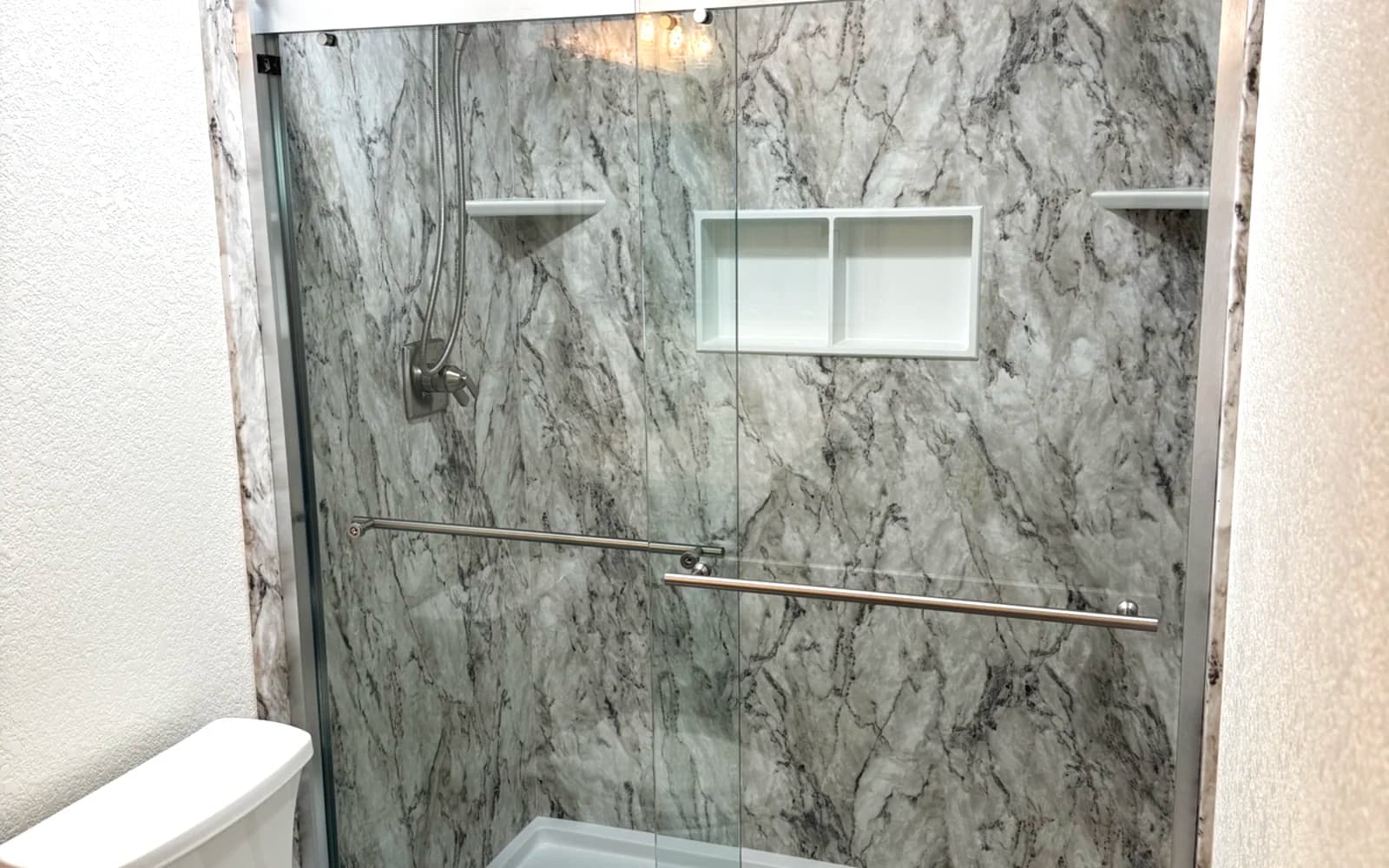
After: Dated Tile Shower to Marble-Look Master Bath - bathroom remodeling Citrus Heights, CA by Oakwood Remodeling Group
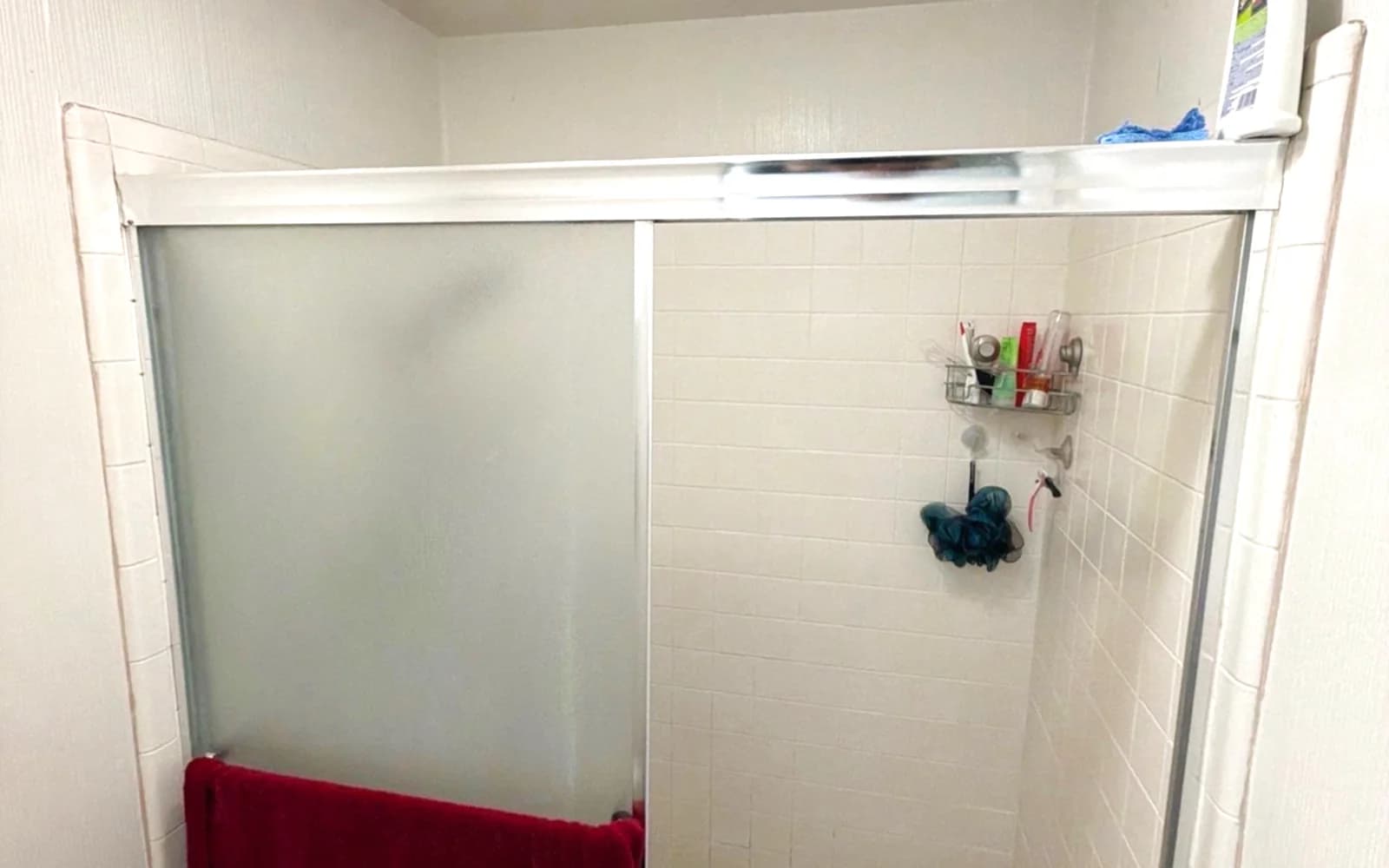
Before: Dated Tile Shower to Marble-Look Master Bath - bathroom remodeling Citrus Heights, CA

Dated Tile Shower to Marble-Look Master Bath

Small-tile shower and cloudy framed doors replaced with grout-free marble-look acrylic walls, a twin niche and a low-threshold base.

Citrus Heights, CA|See the full before & after
5.0

El Dorado Foothill Reviews

47 verified Google reviews · From homeowners on Google

8 months ago

Denis, Alex, and his team did a fantastic job on my project! It was a full gut, bathroom, laundry, and kitchen remodel. I even added a siding replacement on part of the house, along with some wood rot repairs. There were a ton of details throughout the various projects that they helped with or had suggestions on how to complete them, if there was a delay, they were on it, trying to find alternative vendors. If there were any changes or things that I didn't care for, they took care of it. I am very pleased with the final product and Oakwood Remodeling Group. I would highly recommend them for any of your remodeling needs.

5 months ago

I just purchased my first home in Loomis and Denis, Alex and the crew at Oakwood Remodeling Group did a wonderful job completely remodeling our bathroom. The quality of the work, attention to detail, and smooth process made a huge difference for us as new homeowners. We highly recommend anyone looking for bathroom remodeling in Loomis to get a free quote from Oakwood Remodeling Group.

3 months ago

From the very beginning Oakwood Remodeling Group has been extremely professional and Denis provided a reasonable quote to put up a set of very heavy barn doors. Artem, who came to our home was also very professional, funny, and did an outstanding job. In addition, they left our home very clean after the work was done and I was very impressed with their quality of work. I highly recommend them if you are interested in using them for a remodel job or just to put up barn doors.

2 months ago

I spent 35 years in the commercial construction industry as a carpenter, superintendent, then president of my own company and later as a senior project and construction manager building mostly offices, hospitals and schools. I know quality work when I see it, and I’m happy to report that Oakwood Remodeling Group does quality work. We contracted with Oakwood to replace out tub/shower with a walk-in shower. Their estimator Denis was courteous and thorough, and after several days clarifying details, he gave us a very competitive and firm price. One great advantage of using Oakwood is that their crews tend to do all the work themselves instead of scheduling and calling in a series of subcontractors. Illya and his helper did the demolition, plumbing, new tile, drywall, electrical and flooring themselves. No waiting for subs. Alex and all members of the firm were courteous, cooperative and a pleasure to work with. I highly recommend Oakwood Remodeling Group.

5 months ago

We’ve used Oakwood Remodeling Group for several remodeling projects and have been really happy with their work on every project. Alex and Denis were always professional, friendly, and very courteous throughout the whole process. Their pricing was fair and the quality of their work was excellent. It was great working with a team that was reliable and easy to communicate with. We’d definitely use them again and highly recommend them to anyone looking for remodeling work!

Rescue Bathroom Remodeling FAQ

Get Your Free Estimate

Ready to transform your Rescue bathroom? Contact us today!

By submitting this form, you agree to receive calls, texts, and emails from Oakwood Remodeling Group at the number and email provided. Consent is not a condition of purchase. Message and data rates may apply. You can opt out at any time. We collect your name, phone, email, and project details to respond to your inquiry — we do not sell your information. California residents may request deletion at any time. See our Privacy Policy and Terms of Service.

Transform Your Rescue Bathroom Today

Expert bathroom remodeling in Rescue, El Dorado County. Call (916) 907-8782 for your free estimate!

CallFinancingEstimate