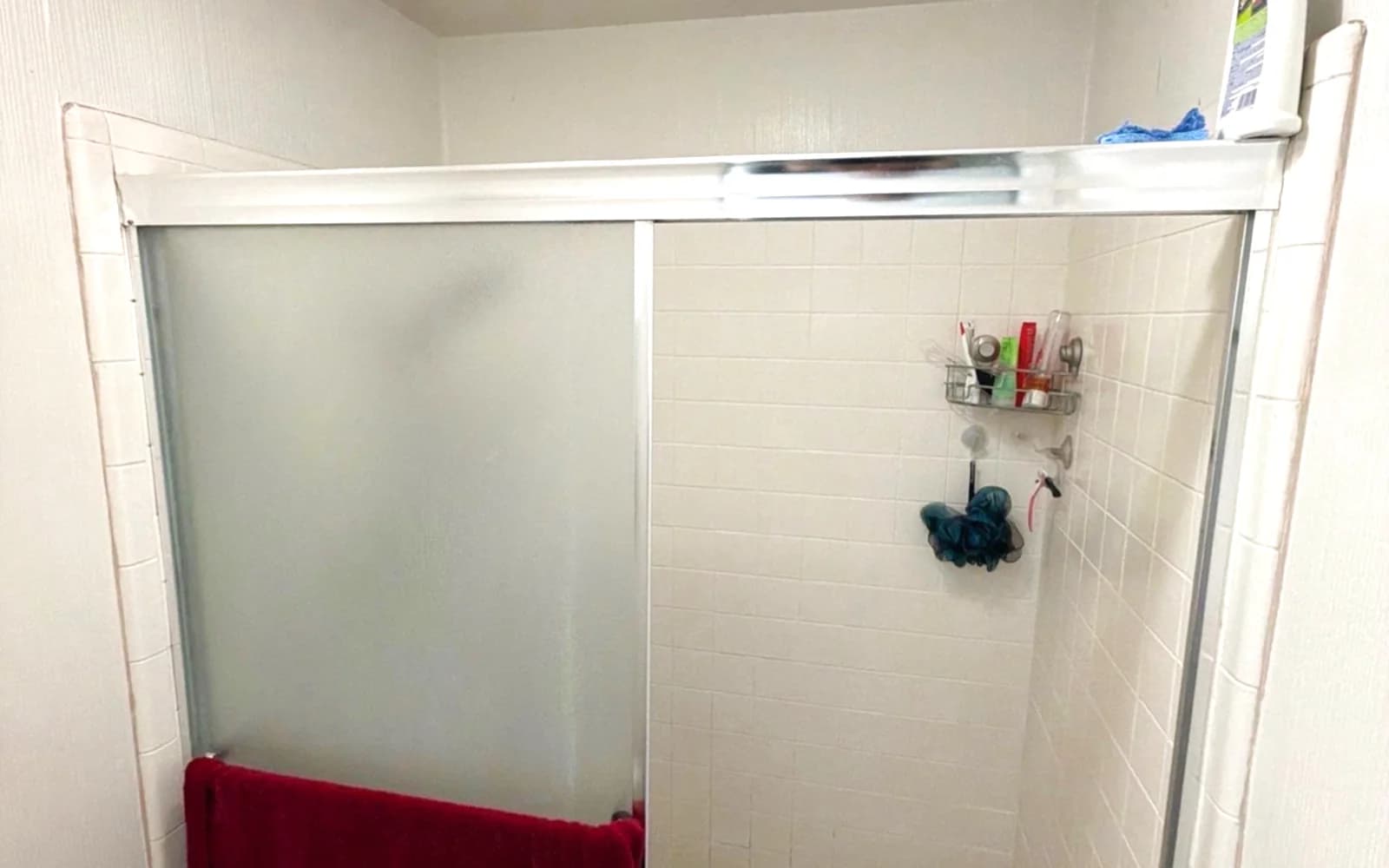
In older homes across the West Sacramento area, the original shower and tub surround was often built as tile set directly over a mortar-bed plaster substrate. That assembly was the industry standard for decades and it works well when the joints are maintained. The problem is that grout and caulk joints require periodic maintenance—recaulking at the tub deck, regrouting at cracked joints—and in many homes that maintenance was deferred or done incorrectly. Once water penetrates behind a plaster-bed installation, it has nowhere to go: the plaster absorbs it, the framing behind it absorbs it, and the damage spreads laterally and vertically before it shows on the surface.
By the time a homeowner sees a soft spot in the floor beside the tub or a stain on the ceiling of the room below, the substrate behind the tile has typically been wet for months. We do not patch or re-tile over existing plaster-bed surrounds. We remove everything—tile, plaster, lath if present—down to the stud framing, inspect the framing for moisture damage, and sister or replace any compromised members before starting the new assembly.
The new assembly uses a cement backer or glass-mat gypsum substrate fastened to the studs, followed by a sheet-applied or liquid-applied waterproof membrane. The membrane laps into the drain body at the floor and wraps all inside corners and penetrations. Tile is then set over the membrane—the tile itself is not the waterproofing layer, it is a decorative and wear surface over a system that is already watertight. This is the assembly that meets California Plumbing Code requirements for wet areas, and it is the assembly we install on every shower and tub surround in Bryte.
NOAA normals for the 1991–2020 period at the Sacramento area station show 15 nights per year at or below 32°F. Freeze nights in Bryte are mild by Sierra or Northern California coastal standards, but any freeze-thaw cycle stresses the silicone at plane changes—the joint where the floor meets the wall, the corner between two walls, and the perimeter where the tile meets a fixture or a frame. We use sanded caulk or 100% silicone at those joints, never grout, and we specify joint placement at every plane change in the tile layout. A correctly detailed silicone joint handles seasonal movement without cracking and can be replaced in place when it eventually wears, without disturbing the tile field.