Auburn Aging-in-Place Bathroom Design: Safe, Accessible & Beautiful
Universal design solutions that let Auburn homeowners stay in the foothill homes they love — safely and independently for years to come
Looking for bathroom remodeling in Auburn? View our Auburn service area page →
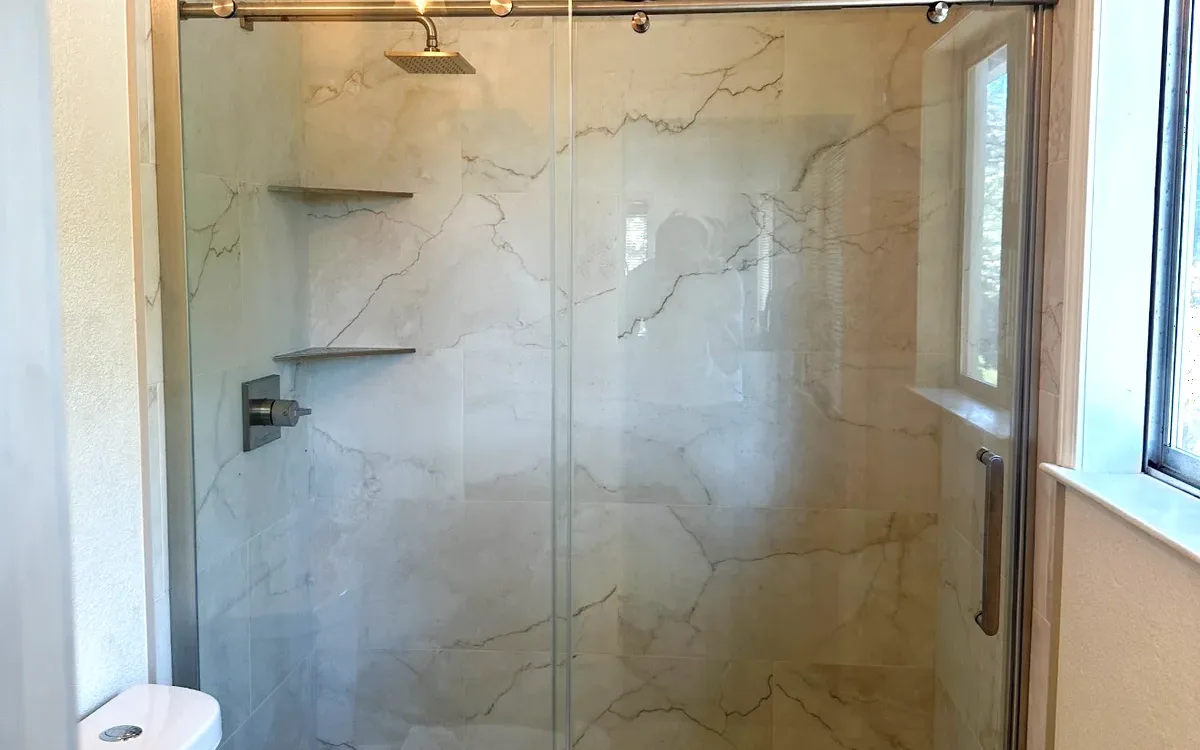
Aging-in-place bathroom design in Auburn — where safety features are indistinguishable from luxury design elements
Auburn's Aging Population and the Bathroom Safety Imperative
Auburn's foothill charm — its Gold Rush history, tree-lined streets, four-season climate, and small-town character — makes it a place people want to stay. Many Auburn residents bought their homes 20, 30, or even 40 years ago, and they have no intention of leaving. They've built lives in the foothills, and they want to enjoy those lives in the homes they love for as long as possible.
But the bathrooms in those homes weren't designed for aging bodies. A 1970s ranch home on Bell Road has a bathtub with a 16-inch wall that was no obstacle at 45 but becomes a fall hazard at 70. A charming bungalow in Old Town has a bathroom so compact that maneuvering with a cane or walker is nearly impossible. And every one of those bathrooms has smooth tile, standard-height toilets, and not a single grab bar.
The statistics are sobering: according to the CDC, bathrooms are the most dangerous room in any home for older adults. The combination of water, smooth surfaces, confined spaces, and the physical transitions required (stepping over tub walls, standing from a seated position on the toilet, reaching across the shower) creates a high-risk environment. For Auburn's 55+ population, a bathroom remodel focused on accessibility isn't a luxury — it's an investment in independence and safety.
The Case for Proactive Planning
The best time to remodel for aging in place is before you need to. Remodeling proactively — in your 50s or early 60s — means you make design decisions from a position of strength rather than urgency. You get to enjoy the upgraded bathroom for years before accessibility becomes critical. And you avoid the emotional and financial stress of emergency modifications after a fall or health event. Every accessibility feature we install proactively costs 30 to 50 percent less than the same feature installed as an urgent retrofit.
Universal Design: Beautiful, Not Institutional
The single biggest objection we hear from Auburn homeowners about aging-in-place bathrooms is the fear that their bathroom will look like a hospital. Chrome grab bars, plastic shower chairs, rubber floor mats — the image is deeply unappealing. And it's completely outdated.
Universal design — the approach we use at Oakwood Remodeling Group — creates spaces that are inherently accessible without looking medical. Every design element serves all users beautifully while providing discreet support for those who need it. A grab bar finished in brushed gold that matches the shower fixtures looks like a towel bar. A curbless shower with frameless glass looks like a luxury spa feature. A comfort-height toilet with a sleek profile looks like a designer upgrade.
The philosophy is simple: design the bathroom you want, then make sure every element in it supports accessibility. You shouldn't have to sacrifice beauty for safety. In fact, the best aging-in-place bathrooms we've built in Auburn are among the most attractive bathrooms we've designed, period. Universal design and modern aesthetics are not only compatible — they're mutually reinforcing.
Zero-Threshold Showers: The Foundation of Accessible Design
The curbless shower is the single most important accessibility feature in an aging-in-place bathroom. Stepping over a tub wall or shower curb requires balance, strength, and coordination — abilities that decline gradually and unpredictably with age. A zero-threshold shower eliminates this barrier entirely, providing step-free entry that works for walking, walker use, wheelchair access, and caregiver assistance.
For Auburn homes, curbless showers also solve the visual space problem in compact bathrooms. The seamless floor transition between bathroom and shower makes rooms feel larger — a significant benefit in Auburn's pre-1970 homes where bathrooms average 40 to 55 square feet. Combined with a walk-in shower design with frameless glass, the result is a bathroom that feels open and modern.
Shower bench integration: A built-in bench at 17 to 19 inches above the shower floor provides seated showering capability without the indignity of a plastic shower chair. Tiled to match the shower walls, it looks like an intentional architectural element. Fold-down teak benches offer the same functionality while preserving floor space when not in use — ideal for Auburn's smaller bathrooms.
Handheld shower head on slide bar: A combination of a fixed rain head and a handheld wand on an adjustable slide bar provides flexibility for standing or seated showering. The slide bar allows the handheld to be positioned at any height — standing, seated, or at waist level for lower body rinsing. Choose a model with a magnetic docking system for easy one-handed operation.
Modern Grab Bars: Stylish Safety That Matches Your Design
Today's grab bars are available in every finish, style, and configuration you can imagine. Brushed nickel, matte black, brushed gold, oil-rubbed bronze, polished chrome — any finish that matches your fixture suite is available in grab bar form. Many designs are virtually indistinguishable from towel bars or decorative hardware.
Strategic Placement for Maximum Safety
- Shower entry: A vertical grab bar at the shower entrance provides support during the transition from bathroom floor to shower floor.
- Shower interior (horizontal): A 24 to 36-inch horizontal bar at 33 to 36 inches high on the shower wall provides stability while standing and showering.
- Shower interior (vertical): A vertical bar on the control wall allows the user to stabilize while adjusting water temperature and flow.
- Toilet area: Grab bars on one or both sides of the toilet assist with sitting and standing — the transition that causes the most bathroom falls.
- Vanity area: A horizontal bar near the vanity provides support during grooming activities that require standing at the sink.
Combination Grab Bar Products
Several manufacturers now produce combination products that integrate grab bar functionality into standard bathroom accessories. A grab bar that doubles as a toilet paper holder. A corner shelf with grab bar support. A towel bar rated for grab bar loads. These combination products are nearly invisible as accessibility features — guests would never know they're looking at a safety device. For Auburn homeowners who want accessibility without any visual compromise, these products are ideal.
Comfort-Height Fixtures and Accessible Seating
Comfort-Height Toilets
Standard toilets sit 15 inches from floor to seat. Comfort-height (also called "right-height" or "ADA-height") toilets sit 17 to 19 inches — the same height as a standard chair. This 2 to 4-inch difference dramatically reduces the physical effort required to sit down and stand up, reducing strain on knees, hips, and back. For Auburn homeowners with arthritis, knee replacements, or general mobility limitations, a comfort-height toilet is one of the most impactful low-cost upgrades available.
Wall-mounted toilets offer even more flexibility because the installation height is adjustable. Setting a wall-mount at 18 to 19 inches provides maximum standing/sitting ease. The additional floor clearance underneath also simplifies wheelchair approach and bathroom cleaning.
Accessible Vanity Design
A standard vanity at 30 to 32 inches high works for standing use but is difficult to access from a wheelchair or seated position. Universal design vanities sit at 34 inches (counter height) with open space below for knee clearance. A floating vanity at this height provides the storage you need while remaining accessible from a seated position if mobility changes require it in the future.
Lever-Handle Everything
Round knob handles require grip strength and wrist rotation that becomes difficult with arthritis or reduced hand strength. Lever handles operate with a simple push or pull — operable with a fist, an elbow, or even a forearm. Specify lever handles on all faucets, door handles, and shower controls. This is universal design at its simplest: a feature that's easier for everyone to use, regardless of ability.
Anti-Slip Flooring That Looks Beautiful
Slip resistance is measured by the coefficient of friction (COF). Standard polished tile has a COF around 0.40 — slippery when wet. For aging-in-place bathrooms, we specify tile with a minimum COF of 0.60, which provides reliable traction even on wet surfaces. Modern textured porcelain tile achieves this rating while looking identical to smooth tile at normal viewing distance — the texture is micro-level, providing grip without visible roughness.
For Auburn homes, we recommend porcelain tile rated for both slip resistance and foothill climate performance. The tile should be dense enough to resist moisture absorption (water absorption rate under 0.5 percent) and rated for the temperature extremes Auburn experiences. Matte or textured finishes in warm neutrals — beige, warm gray, taupe — provide safety while maintaining the organic aesthetic that Auburn homeowners prefer.
Continuous floor treatment: For curbless shower bathrooms, using the same slip-resistant tile throughout the entire bathroom — shower floor and bathroom floor — provides consistent traction everywhere. There's no transition point where foot contact changes from grippy to slick, eliminating a common slip hazard.
Lighting for Visibility and Safety
Vision changes with age, and a bathroom that was adequately lit at 50 may feel dim at 70. Aging-in-place bathrooms need brighter, more evenly distributed light than standard bathrooms — without glare, which causes its own visual problems.
- Recessed LED ceiling fixtures: Provide even ambient light without shadows. Use a minimum of 3 fixtures in a standard bathroom for complete coverage.
- LED night lights: Low-level LED fixtures at baseboard height illuminate the path from bedroom to bathroom without requiring overhead lights that disrupt sleep patterns.
- Motion-sensor activation: Lights that activate automatically when someone enters the bathroom eliminate the need to find a switch in the dark.
- Vanity lighting: Side-mounted LED sconces at eye level provide shadow-free task lighting for grooming. Choose fixtures with 3000K color temperature for warm, natural light.
- Shower lighting: A dedicated shower light (rated for wet location) ensures the shower area is well-lit. Never rely solely on bathroom ceiling lights to illuminate the shower — the glass enclosure and shower walls create shadows.
Adapting Older Auburn Homes for Accessibility
Auburn's older homes present specific challenges for aging-in-place modifications, but none are insurmountable. Understanding these challenges upfront allows for proper planning and budgeting:
Narrow Doorways
Pre-1970 Auburn homes often have 24 to 28-inch bathroom doorways — too narrow for a wheelchair or standard walker. Widening to 32 to 36 inches requires modifying the door frame and potentially the wall structure. For homes where full widening isn't feasible, an offset hinge (swing-clear hinge) gains 2 inches of clearance without frame modification. A pocket door or barn door eliminates the door swing entirely, providing maximum clearance.
Compact Footprint
Small bathrooms in Old Town and Historic District homes can accommodate accessibility features, but every element must be carefully selected for compact spaces. Fold-down benches, wall-mounted toilets, floating vanities with knee space, and recessed grab bar placements allow full accessibility in bathrooms as small as 40 square feet. The small bathroom strategies for Auburn apply directly to aging-in-place design.
Wall Reinforcement for Grab Bars
Grab bars must support 250+ pounds of force, which standard drywall and hollow stud walls cannot reliably provide. During a remodel, we install solid wood blocking (2x6 or 2x8) horizontally between studs at grab bar mounting locations. This blocking is behind the drywall and completely invisible, but it provides bomb-proof mounting for grab bars installed now or in the future. We install blocking at every potential grab bar location — shower walls, toilet area, vanity area — so features can be added later without opening walls.
Future-Proofing: What to Install Now vs Later
Not every aging-in-place feature needs to be installed during your initial remodel. Some are essential now; others are smart to prepare for but install later when needed.
Install Now (During Remodel)
- Curbless shower (cannot be easily added later)
- Wall blocking for grab bars (invisible, minimal cost during remodel)
- Comfort-height toilet (no cost difference from standard)
- Lever-handle faucets and controls (no cost difference)
- Anti-slip tile flooring (chosen during tile selection)
- Adequate lighting circuits (easier during remodel)
- Wider doorway (must be done during construction)
Prepare Now, Install Later
- Grab bars (blocking in place, bars added when needed)
- Shower bench (fold-down bracket mounting, bench added later)
- Handheld shower head (slide bar mount in place, wand added or swapped)
- Night lights (electrical boxes roughed in, fixtures added later)
Cost of Accessibility Features: $2,000 to $15,000 Add-Ons
| Feature | Add-On Cost (During Remodel) | Retrofit Cost (Standalone) |
|---|---|---|
| Curbless shower upgrade | $1,500 - $3,000 | $8,000 - $15,000 |
| Wall blocking (all locations) | $100 - $300 | $800 - $2,000 |
| Designer grab bars (4-6 bars) | $600 - $1,800 | $800 - $2,400 |
| Built-in shower bench | $500 - $1,500 | $2,000 - $4,000 |
| Doorway widening | $400 - $1,200 | $1,500 - $3,500 |
| Comfort-height toilet | $0 - $200 | $400 - $800 |
| Handheld shower + slide bar | $200 - $600 | $400 - $900 |
The message is clear: incorporating accessibility features during a planned remodel costs a fraction of retrofitting them later. If you're already investing in a bathroom remodel in Auburn, adding universal design features is the most cost-effective time to do it.
Frequently Asked Questions
Plan Your Auburn Aging-in-Place Bathroom
Every aging-in-place bathroom starts with understanding your home's structure, your current needs, and your future plans. Contact Oakwood Remodeling Group for a free consultation focused on creating a bathroom that's safe, accessible, and beautiful.
Call us at (916) 907-8782 or request your free estimate online.
Related Reading
Auburn Walk-In Shower Installation
Zero-threshold options for foothill homes.
Auburn Tub-to-Shower Conversion
Converting tubs to accessible showers.
Auburn Bathroom Remodel Cost 2026
Complete pricing including accessibility features.
Auburn Small Bathroom Solutions
Space-saving strategies for compact bathrooms.
Bathroom Remodeling Services
Our complete bathroom renovation services.
Get Your Free Estimate
Schedule your consultation today
Related Articles
El Dorado Hills Aging-in-Place Bathroom Design: Safety Meets Luxury

Aging-in-Place Bathroom Design: The Complete Guide to Safe, Beautiful Bathrooms
ADA Bathroom Requirements for California Homes: What Applies to Residential Remodels
Get a Free Estimate
Call us at (916) 907-8782 or fill out our contact form.