Best Bathroom Tile for Auburn Homes: Materials That Handle Foothill Climate
How Auburn's extreme temperature swings, hard water, and humidity affect tile performance — and which materials stand up to it all
Looking for bathroom remodeling in Auburn? View our Auburn service area page →
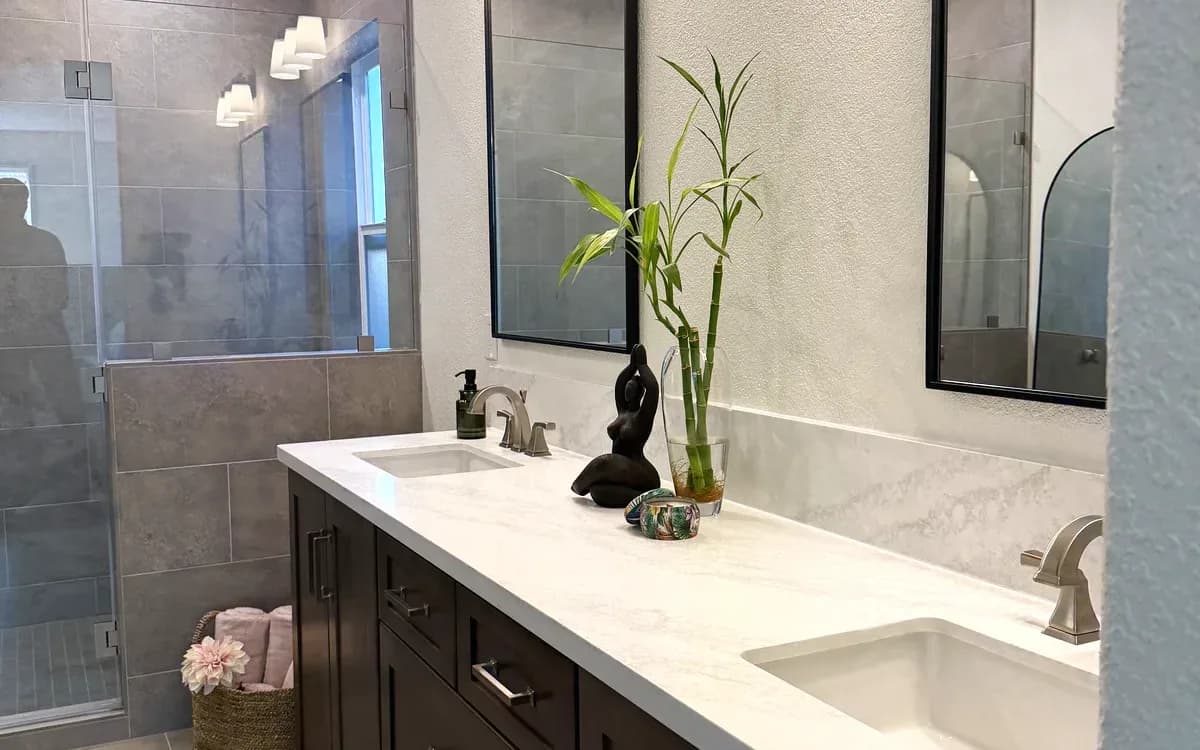
Large-format porcelain tile in an Auburn bathroom — chosen for both aesthetics and foothill climate performance
Auburn's Foothill Climate: Why Tile Selection Matters More Here
Tile is tile, right? Not in Auburn. At approximately 1,300 feet elevation in the Sierra Nevada foothills, Auburn experiences climate conditions that stress bathroom tile differently than homes on the Sacramento valley floor. Understanding these conditions is essential for selecting materials that will perform flawlessly for decades rather than failing prematurely.
Temperature extremes. Auburn summers regularly exceed 100°F, with multiple stretches of 105°F+ throughout July and August. Winter nights drop below freezing, with December and January lows routinely hitting 30 to 35°F. That's a 70+ degree annual temperature swing. While bathroom interiors are partially climate-controlled, exterior walls, poorly insulated bathrooms, and homes without central heating and cooling expose tile to significant thermal cycling. Tiles that absorb moisture — particularly ceramic and natural stone — can experience micro-cracking as absorbed water expands and contracts with temperature changes.
Humidity swings. Auburn's foothill climate alternates between bone-dry summers (single-digit humidity days are common) and damp winters. Inside a bathroom, hot showers create a humid micro-environment multiple times daily. When that humidity meets cold exterior walls in winter, condensation forms on and behind tile surfaces. In summer, the rapid evaporation cycle deposits minerals from Auburn's hard water on every surface. This wet-dry cycling is a stress test that separates quality tile installations from mediocre ones.
Hard water from PCWA. The Placer County Water Agency delivers water at 3 to 7 grains per gallon hardness — moderately hard with significant calcium and magnesium content. Every shower deposits a thin film of minerals on tile surfaces and within grout lines. Over months and years, this buildup affects appearance, cleanability, and even tile surface integrity. Your tile selection and grout strategy must account for this constant mineral exposure.
Porcelain Tile: The Auburn Workhorse
For Auburn bathroom remodels, porcelain tile is our default recommendation — and for quantifiable reasons, not just preference. Porcelain is manufactured from refined clay fired at temperatures exceeding 2,200°F, producing a tile body that is extremely dense, hard, and resistant to moisture absorption.
The critical metric is water absorption rate. Porcelain tile has a water absorption rate below 0.5 percent (per ANSI standards), meaning it absorbs virtually no moisture. This density is what makes porcelain ideal for Auburn's conditions:
- Temperature resilience: Because porcelain absorbs almost no water, there's minimal internal moisture to expand and contract during Auburn's thermal cycling. This prevents the micro-cracking that plagues more porous materials.
- Hard water resistance: Porcelain's dense, non-porous surface resists mineral penetration from PCWA water. Calcium deposits sit on the surface rather than bonding into the tile body, making them easier to clean.
- Humidity handling: Porcelain doesn't absorb moisture during showers and doesn't release it slowly afterward, reducing the humidity load on the bathroom and simplifying ventilation requirements.
- Durability: Porcelain rates 5 to 8 on the Mohs hardness scale (depending on surface finish), making it highly scratch-resistant and suitable for both floor and wall applications.
Modern porcelain tile replicates virtually any material — marble, wood, concrete, terrazzo, natural stone — with remarkable fidelity. The design limitations that once made porcelain a "practical but boring" choice are gone. Today's porcelain offers the beauty of natural materials with dramatically superior performance in Auburn's demanding conditions.
Porcelain Tile Quick Specs for Auburn
- Water absorption: <0.5% (ideal for Auburn conditions)
- Temperature resistance: Excellent — handles 0°F to 200°F+ without degradation
- Hard water resistance: Excellent — non-porous surface resists mineral penetration
- Cost range: $5 - $25 per sq ft (material), $8 - $14 per sq ft (installation)
- Recommended for: All Auburn bathroom applications — floors, walls, showers
Ceramic Tile: Where It Works and Where It Doesn't
Ceramic tile is porcelain's less dense cousin — fired at lower temperatures (around 1,800°F) and with a water absorption rate between 0.5 and 3 percent. It's lighter, softer, easier to cut, and significantly less expensive than porcelain. For these reasons, ceramic remains the default tile in budget-driven projects.
In Auburn's conditions, ceramic has specific limitations. Its higher porosity means it absorbs more moisture, which creates two problems: mineral deposits from hard water can penetrate the tile body (not just the surface), and absorbed moisture can cause micro-expansion during Auburn's freeze-thaw cycles. Neither issue causes immediate failure, but over 10 to 15 years, ceramic tile in Auburn showers degrades noticeably faster than porcelain.
Where ceramic works in Auburn bathrooms: Wall tile in areas that don't receive direct water exposure (wainscoting, accent walls above the splash zone) and backsplash areas behind vanities. In these applications, ceramic's lower cost provides good value without significant performance compromise.
Where ceramic underperforms: Shower floors, shower walls with direct water contact, and bathroom floors. These areas receive constant moisture exposure and benefit from porcelain's superior density and water resistance. The cost difference between ceramic and porcelain ($3 to $8 per square foot for material) is modest relative to the installation labor cost, which is the same for both. For Auburn's climate, porcelain's incremental material cost delivers disproportionate long-term value.
Natural Stone: Beauty vs Maintenance in Auburn
Natural stone — marble, travertine, slate, limestone — brings organic beauty that no manufactured tile can perfectly replicate. The veining, texture, and color variation of real stone create a bathroom environment that feels connected to Auburn's natural landscape. But natural stone in Auburn's hard water conditions requires significantly more maintenance than porcelain.
Marble
Marble is the aspirational choice for luxury Auburn bathrooms, and it delivers stunning results. Calacatta, Carrara, and Statuario marble varieties create timeless elegance. However, marble is porous (water absorption 0.2 to 0.5 percent for high-quality varieties, up to 2 percent for others), soft (Mohs 3-4), and chemically reactive — acidic cleaners etch the surface. In Auburn's hard water, the calcium deposits that build on marble surfaces require acidic cleaners to remove, which then damage the marble. It's a frustrating maintenance cycle. Budget extra time for monthly maintenance if you choose marble for an Auburn bathroom.
Travertine
Travertine has a warm, earthy quality that resonates with Auburn's foothill aesthetic. Its naturally pitted surface adds texture and character. However, those pits trap moisture and mineral deposits from hard water, making maintenance in Auburn bathrooms labor-intensive. Filled-and-honed travertine reduces this problem but doesn't eliminate it. Sealing every 6 to 12 months is mandatory in Auburn's conditions.
Slate
Slate is the most Auburn-appropriate natural stone option. Its naturally slip-resistant surface makes it excellent for bathroom floors. It's denser than marble or travertine, with lower water absorption. And its dark, variegated coloring camouflages hard water deposits better than lighter stones. Slate still requires sealing but is more forgiving of maintenance lapses than marble.
The Smart Alternative
For Auburn homeowners who love natural stone aesthetics but not the maintenance, stone-look porcelain tile delivers 90% of the visual impact with dramatically better hard water performance. Today's stone-look porcelain is remarkably convincing — even tile professionals sometimes can't distinguish high-quality porcelain from real stone at normal viewing distance. The cost is often comparable to natural stone, and the long-term maintenance savings are substantial.
Hard Water Impact on Tile and Grout
Auburn's PCWA water carries 3 to 7 grains per gallon of dissolved calcium and magnesium — minerals that deposit on every surface water contacts. Understanding how this affects tile helps you make smarter material and maintenance decisions.
On tile surfaces: Mineral deposits accumulate as water evaporates after each shower use. On smooth, polished surfaces, deposits form a thin film that wipes off with a squeegee or damp cloth. On textured surfaces, minerals settle into surface irregularities and become progressively harder to remove. After months of accumulation without cleaning, deposits bond to the tile surface and require acidic cleaners (vinegar solution or commercial lime removers) for removal. This is why finish selection matters: polished or semi-polished porcelain shows deposits less and cleans more easily than matte or heavily textured finishes.
In grout lines: Grout is the Achilles heel of tile installations in hard water areas. Standard cement grout is porous — it absorbs mineral-laden water and retains the minerals within its structure even after the surface dries. Over time, grout in Auburn showers develops a whitish-gray mineral crust that darkens as it accumulates. Unsealed grout can become permanently discolored within 12 to 18 months of regular use. Sealed grout resists this penetration, and epoxy grout eliminates it entirely.
For comprehensive information on fixture selection for Auburn's hard water, see our detailed hard water shower fixtures guide.
Grout Strategy for Auburn Bathrooms
Grout selection and maintenance are as important as tile selection in Auburn's hard water environment. Three approaches work well:
Option 1: Sanded Cement Grout + Penetrating Sealer
The traditional approach. Sanded cement grout is applied normally, then sealed with a penetrating sealer (not a topical sealer) that fills grout pores without changing the surface appearance. Reseal every 12 to 18 months. Cost: $2 to $4 per linear foot of grout + $50 to $100 for sealer materials per bathroom. Effective maintenance: squeegee shower walls after use, clean grout weekly with pH-neutral cleaner.
Option 2: Epoxy Grout
Epoxy grout is non-porous, chemically resistant, and never needs sealing. It's the premium grout solution for Auburn's hard water — minerals cannot penetrate the surface, and cleaning is effortless. The trade-off is cost (2 to 3 times the price of cement grout) and installation difficulty (shorter working time, requires experienced installers). Cost: $5 to $8 per linear foot of grout. For Auburn homeowners who want the lowest-maintenance tile installation possible, epoxy grout is the answer.
Option 3: Minimize Grout Lines
The most effective grout strategy is having less grout. Large-format rectified tile with 1/16-inch grout joints minimizes the total grout surface area by 60 to 70 percent compared to small-format tile with 1/8-inch joints. Less grout means fewer areas to seal, fewer places for minerals to accumulate, and a cleaner appearance. This is one of several reasons we recommend large-format tile for Auburn bathrooms.
Large Format Tile Trends for Auburn
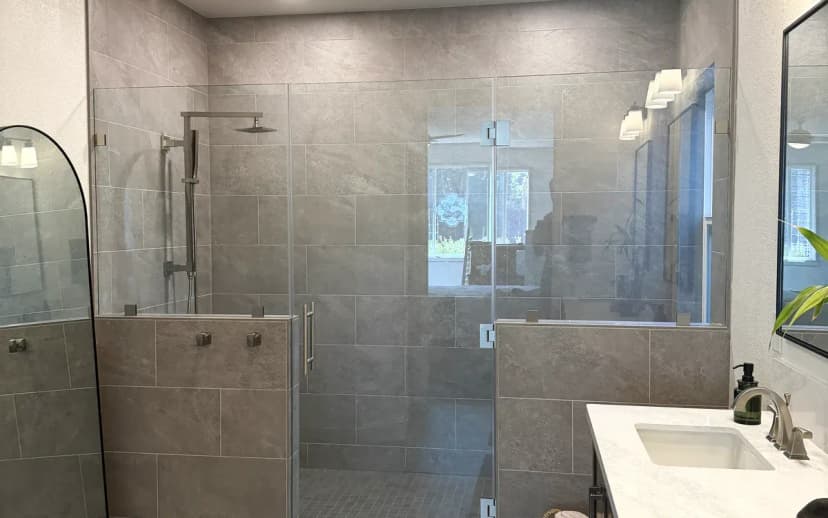
Large-format tile — broadly defined as any tile larger than 12x12 inches, with popular sizes ranging from 12x24 to 48x48 inches — has become the dominant choice in Auburn shower remodels and bathroom renovations. The trend is driven by both aesthetics and practicality.
12x24 inch: The new standard. This size provides excellent proportions on shower walls, bathroom floors, and feature walls. Horizontal orientation on walls makes rooms feel wider; vertical orientation adds height. For Auburn's compact bathrooms, 12x24 tile with 1/16-inch grout joints creates a clean, expansive look with minimal maintenance.
24x24 inch: Popular for bathroom floors in larger Auburn bathrooms. The square format creates a grid with minimal grout lines that reads as nearly seamless. Works well in master bathrooms and larger secondary baths.
24x48 inch and larger: The premium choice for Auburn master bath showers and feature walls. Slabs this large create a near-seamless appearance with very few grout lines. Installation requires experienced tile setters and proper substrate preparation — large-format tiles are unforgiving of wall or floor irregularities. The visual impact in a walk-in shower is dramatic.
Shower vs Floor Tile Selection
Different bathroom zones have different tile requirements. Selecting the right tile for each application ensures performance and safety:
Shower Walls
Shower walls receive direct water contact in a high-humidity environment. Use porcelain tile with low water absorption. Polished or semi-polished finishes clean more easily in Auburn's hard water and reflect light to brighten the shower. Large-format tiles (12x24 or larger) minimize grout maintenance. This is where you can make the strongest design statement — accent strips, decorative niches, and feature walls add visual interest.
Shower Floor
Safety is paramount. Shower floor tile must have a coefficient of friction (COF) of 0.60 or higher when wet. Small-format tile (2x2 mosaic or hexagonal) is typically required on shower floors because the numerous grout lines help the tile conform to the shower floor's slope. For curbless showers with linear drains, the single-direction slope allows slightly larger floor tiles (up to 4x4 or even 6x6) because the slope is less complex.
Bathroom Floor
Bathroom floor tile needs slip resistance (COF 0.42+ minimum, 0.60+ recommended), durability to handle foot traffic, and resistance to the temperature swings at Auburn's floor level. Porcelain in a matte or textured finish provides the best combination of safety, durability, and cleanability. For the most cohesive look, use the same tile on the bathroom floor and shower floor — especially in curbless designs where the continuous floor plane is part of the design intent.
Tile Installation in Auburn's Climate
Auburn's climate affects not just tile selection but tile installation. Professional installers familiar with foothill conditions adjust their techniques accordingly:
Summer installations (June-September): When Auburn temperatures exceed 95°F, thinset mortar can flash-dry before developing full bond strength. Experienced installers work in smaller sections, pre-wet porous substrates, and may adjust water ratios slightly. They also work earlier in the day (starting at 7 AM) before afternoon heat peaks. Maintaining the bathroom at reasonable temperatures with temporary cooling helps ensure proper cure.
Winter installations (December-February): Below 40°F, thinset cure times extend dramatically and may fail to bond properly. Most Auburn bathroom interiors stay above this threshold, but bathrooms on exterior walls of poorly insulated homes can approach these temperatures overnight. Running a portable heater overnight during the cure period prevents cold-related bonding failures.
Optimal season: March through May and September through November provide the ideal temperature range (50 to 85°F) for tile installation in Auburn. These shoulder seasons also coincide with lower contractor demand, potentially offering better scheduling availability and pricing.
Trending Tile Looks in Auburn Bathrooms
Auburn's tile preferences reflect the town's character — warm, natural, and grounded. Here are the looks Auburn homeowners are choosing in 2026:
- Warm neutral large-format: 12x24 or 24x24 porcelain in warm gray, greige, or beige tones. Clean and contemporary without feeling cold.
- Wood-look plank tile: 6x36 or 8x48 porcelain planks in weathered oak or walnut. Brings organic warmth to shower accent walls and bathroom floors.
- Natural stone look: Porcelain that replicates marble, travertine, or slate with realistic veining and color variation. The beauty of stone with Auburn-appropriate durability.
- Zellige and handmade looks: Slightly irregular, handcrafted-look tile for accent walls and niches. Adds character to transitional and rustic-modern designs.
- Muted geometric: Hexagonal, picket, and chevron patterns in subtle colors for shower floors and accent areas.
For a comprehensive look at what's trending in Auburn bathrooms beyond tile, see our 2026 design trends guide.
Cost Comparison by Material
| Material | Material/Sq Ft | Install/Sq Ft | Total/Sq Ft |
|---|---|---|---|
| Ceramic | $2 - $8 | $6 - $10 | $8 - $18 |
| Porcelain | $5 - $25 | $8 - $14 | $13 - $39 |
| Natural Stone | $10 - $50 | $10 - $18 | $20 - $68 |
| Large Format (24x48+) | $8 - $30 | $12 - $18 | $20 - $48 |
For full bathroom remodel pricing including tile, fixtures, and labor, see our Auburn bathroom remodel cost guide.
Frequently Asked Questions
Choose the Right Tile for Your Auburn Bathroom
Tile selection is one of the most important decisions in any bathroom remodel. Our design team will help you choose materials that look stunning, handle Auburn's conditions, and fit your budget. Contact Oakwood Remodeling Group for a free consultation.
Call us at (916) 907-8782 or request your free estimate online.
Related Reading
Auburn Bathroom Design Trends 2026
What Auburn homeowners are choosing this year.
Auburn Hard Water Fixture Guide
Fixtures that resist mineral buildup.
Auburn Vanity Upgrade Guide
Countertop materials for hard water areas.
Auburn Bathroom Remodel Cost 2026
Complete pricing guide for foothill homes.
Shower Remodeling Services
Our professional shower renovation services.
Get Your Free Estimate
Schedule your consultation today
Get a Free Estimate
Call us at (916) 907-8782 or fill out our contact form.