Roseville Aging-in-Place Bathroom: Safety Meets Style
Accessible bathroom design has moved far beyond grab bars and medical aesthetics. Here is how Roseville homeowners are creating bathrooms that are safe, stylish, and built to last a lifetime.
Looking for bathroom remodeling in Roseville? View our Roseville service area page →
Table of Contents
- 1. Why Roseville Homeowners Are Planning Ahead
- 2. Universal Design: What It Means for Bathrooms
- 3. Curbless Showers: The Cornerstone of Accessible Design
- 4. Grab Bars That Look Like They Belong
- 5. Non-Slip Flooring That Does Not Sacrifice Style
- 6. Toilets, Faucets, and Fixture Selection
- 7. Lighting for Safety and Ambiance
- 8. Doorways, Clearances, and Layout Planning
- 9. ADA Standards vs. Residential Aging-in-Place
- 10. Future-Proofing: What to Install Now for Later
- 11. Cost Breakdown for Roseville Projects
- 12. Most Common Accessibility Retrofits
- 13. Frequently Asked Questions
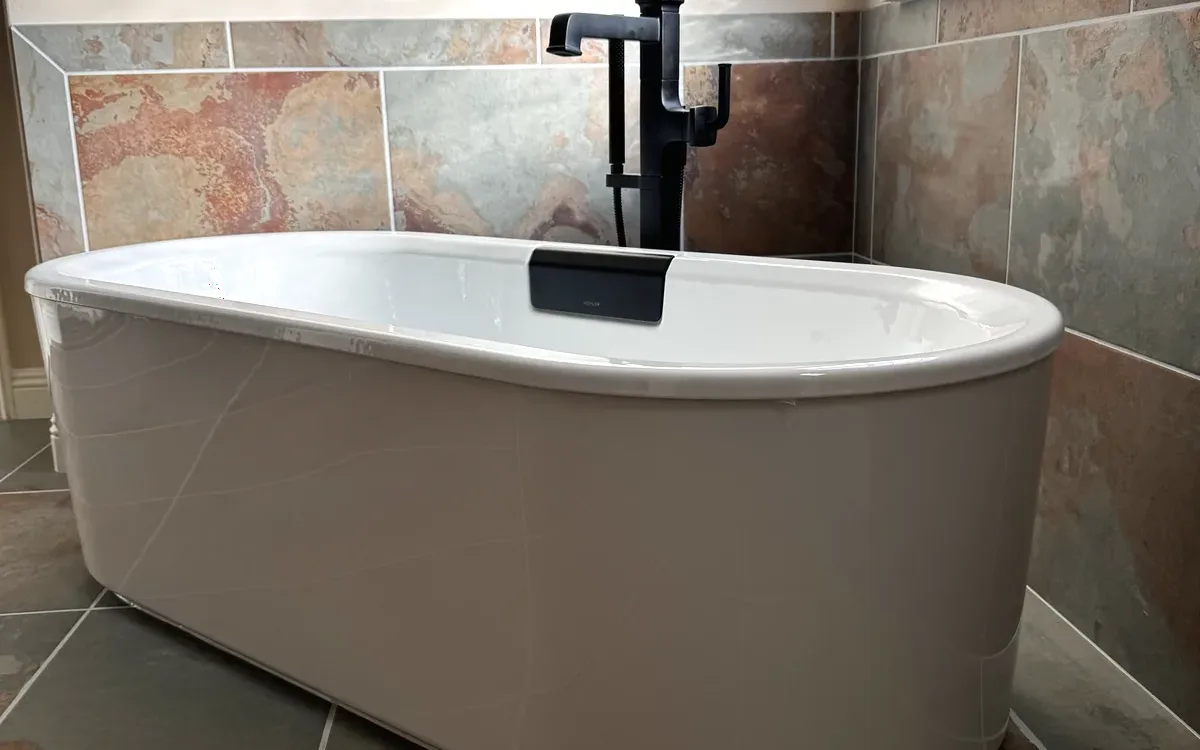
Pictured: a real Oakwood project in Elk Grove. See the full before & after
Why Roseville Homeowners Are Planning Ahead
Roseville is one of the fastest-growing cities in Placer County, and a significant portion of that growth has come from homeowners who moved here in the 1980s and 1990s and plan to stay. According to the AARP, nearly 90 percent of adults over 65 want to remain in their current home as they age. In Roseville, where established neighborhoods like West Roseville, Highland Reserve, and Sierra Vista offer mature landscaping, proximity to medical facilities, and strong community ties, the desire to age in place is even more pronounced.
The bathroom is the most dangerous room in the house for older adults. Wet surfaces, confined spaces, and the physical demands of stepping over a bathtub curb or standing in a shower create fall risks that increase with age. The Centers for Disease Control reports that one in four Americans over 65 falls each year, and bathrooms are the most common location for fall injuries in the home.
The good news is that modern aging-in-place bathroom design has evolved far beyond the institutional look of hospital-style grab bars and plastic shower chairs. Today's accessible fixtures and design strategies look like the luxury bathroom features they are — and they benefit users of every age. As Roseville's bathroom remodeling specialists, we design bathrooms that are safe, beautiful, and built to serve homeowners for decades. For a broader perspective on accessible design, see our guide on aging-in-place bathroom design beyond grab bars.
Universal Design: What It Means for Bathrooms
Universal design is the concept of creating spaces that are usable by all people, regardless of age, size, or ability, without the need for adaptation or specialized design. In a bathroom context, universal design means every fixture, surface, and layout decision considers the full range of users who may occupy the space over its lifetime.
The National Association of Home Builders (NAHB) Certified Aging-in-Place Specialist (CAPS) program identifies key universal design principles for bathrooms:
- Zero-step entry: Eliminating barriers between rooms and between dry and wet zones — including shower curbs, threshold transitions, and step-ups.
- Clear floor space: Maintaining adequate clearance for mobility aids, turning, and transfers. A minimum 60-inch turning radius accommodates most wheelchairs and walkers.
- Lever-style hardware: Replacing round knobs with lever handles on doors and faucets. Levers require less grip strength and are operable with a closed fist.
- Variable-height fixtures: Installing showerheads on adjustable slide bars, mounting mirrors at heights usable from both standing and seated positions, and placing controls within reach of seated users.
- Contrasting colors: Using color contrast between floors, walls, and fixtures to provide visual cues for users with reduced vision. A dark floor meeting a light wall, for example, clearly defines the boundary.
The beauty of universal design is that none of these features look clinical or institutional. A curbless shower with a linear drain looks like a luxury spa feature. Lever faucets are the standard in contemporary bathroom design. Wider doorways make bathrooms feel more open and inviting. When specified from the beginning of a remodel, accessibility becomes invisible — it is simply good design.
Curbless Showers: The Cornerstone of Accessible Design
The single most impactful feature in an aging-in-place bathroom is a curbless (zero-threshold) shower. By eliminating the curb that traditional showers require, a curbless design allows step-in access, wheelchair roll-in access, and a seamless visual transition between the bathroom floor and the shower floor.
Our walk-in shower installations in Roseville use one of two approaches depending on the existing floor structure:
Recessed Shower Floor (Slab-on-Grade Homes)
Most Roseville homes sit on concrete slab foundations. Creating a curbless shower on a slab requires recessing the shower floor below the surrounding bathroom floor to accommodate the slope to the drain. This involves cutting into the slab, routing the drain to the proper depth, and pouring a new mud bed with the correct slope. A linear drain positioned along the shower entry allows the floor to slope in one direction, simplifying the tile installation and providing a wider drain channel that handles high water flow.
Raised Bathroom Floor (Alternative Approach)
When slab cutting is not feasible or cost-effective, an alternative is to raise the bathroom floor outside the shower to match the shower threshold height. This is achieved with a mud bed or engineered slope system that brings the entire bathroom floor up by 1 to 2 inches, creating a flush transition into the shower without cutting the slab. The trade-off is a slight step up from the hallway into the bathroom, which can be managed with a beveled transition strip.
Both approaches require meticulous waterproofing — a curbless shower has no physical barrier to contain water, so the entire bathroom floor must be waterproofed as part of the shower system. We use full-floor sheet membrane waterproofing that extends from the shower drain to the bathroom walls and under the threshold. For more on curbless shower drain options, read our guide on linear drain vs. center drain systems.
Grab Bars That Look Like They Belong
The biggest objection homeowners raise about aging-in-place features is aesthetics — specifically the concern that grab bars will make their bathroom look like a hospital room. This concern is legitimate if you are thinking about the stainless steel institutional bars from 20 years ago. It is completely unfounded when you see what is available today.
Modern grab bars from manufacturers like Moen, Delta, and Kohler come in every finish that is popular in contemporary bathroom design: brushed nickel, matte black, polished chrome, brushed gold, and oil-rubbed bronze. Many designs double as towel bars, toilet paper holders, or shower shelf supports — serving both a decorative and a safety function simultaneously.
The critical requirement for grab bars is structural mounting. A grab bar must support a minimum of 250 pounds of force — which means it must be anchored into wall studs or solid wood blocking, not just drywall. During our Roseville bathroom remodels, we install solid 2x6 blocking behind the tile backer at every location where a grab bar might be needed — even if the homeowner does not plan to install bars immediately. This blocking is invisible behind the finished wall and costs almost nothing to install during construction. It provides mounting points for bars at any time in the future without needing to open the wall.
Recommended Grab Bar Locations
- Shower entry: One vertical bar (18 to 24 inches) on the wall adjacent to the shower opening, positioned at 33 to 36 inches above the floor.
- Shower interior (long wall): One horizontal bar (36 to 42 inches) at 33 to 36 inches above the floor, running along the wall opposite the showerhead.
- Shower interior (back wall): One horizontal bar (24 to 36 inches) at 33 to 36 inches above the floor, behind the user when facing the showerhead.
- Toilet (wall side): One horizontal bar (24 to 36 inches) at 33 to 36 inches above the floor, centered on the toilet.
- Toilet (open side): A swing-up bar or a floor-mounted support provides a grab point on the side without a wall.
For a deeper exploration of safety features that go beyond basic grab bars, see our guide on aging-in-place design beyond grab bars. We also discuss similar approaches for Granite Bay homeowners in our Granite Bay walk-in shower and aging-in-place guide.
Non-Slip Flooring That Does Not Sacrifice Style
Floor surface selection is the second most important safety decision in an aging-in-place bathroom, after the curbless shower entry. The goal is a surface that provides reliable traction when wet without looking or feeling like an industrial floor.
For Roseville aging-in-place bathrooms, we specify porcelain tile with a DCOF (Dynamic Coefficient of Friction) rating of 0.42 or higher — the minimum required by ANSI A137.1 for wet areas. In practice, we target 0.50 or higher for aging-in-place applications to provide an additional margin of safety.
The texture that provides slip resistance comes from the tile surface itself — not from a rough, gritty finish that is uncomfortable underfoot. Modern porcelain manufacturers achieve high DCOF ratings through micro-texturing processes that create traction without visible roughness. The tile looks smooth and contemporary but grips securely when wet. Popular options include:
- Matte-finish large format porcelain: 12x24 or 24x24-inch tiles with a matte surface provide excellent traction and a clean, modern look. Fewer grout lines mean easier cleaning and maintenance.
- Wood-look porcelain planks: These tiles replicate the appearance of natural wood but provide the water resistance and slip resistance of porcelain. The wood grain texture adds natural traction.
- Concrete-look porcelain: A popular choice for contemporary aging-in-place bathrooms. The slightly textured surface provides excellent DCOF ratings, and the neutral color palette works with any design scheme.
One important note for Roseville homes: avoid highly polished or glossy floor tile in aging-in-place bathrooms. Polished tile typically has a DCOF below 0.35 — well below the safety threshold. Even tiles marketed as non-slip should be verified against the manufacturer's published DCOF data, not sales descriptions.
Toilets, Faucets, and Fixture Selection
Every fixture in an aging-in-place bathroom should be selected for ease of use without sacrificing design. Here are the key fixture considerations:
Comfort-Height Toilets
Standard toilets sit 15 inches from floor to seat. Comfort-height toilets (also called right-height or universal-height) sit 17 to 19 inches — closer to standard chair height, which makes sitting down and standing up significantly easier for users with limited mobility, knee issues, or hip replacements. ADA standards specify 17 to 19 inches, and comfort-height toilets meet this range. They are now standard in most contemporary bathroom designs regardless of accessibility needs.
Lever-Handle Faucets
Round knob faucets require grip strength and wrist rotation that can be difficult for users with arthritis or limited hand mobility. Lever-handle faucets operate with a push or pull motion that requires minimal strength and can be operated with a closed fist, an elbow, or a forearm. Single-lever faucets that control both temperature and flow with one handle are the most accessible option.
Shower Controls and Showerheads
Shower controls should be positioned at 38 to 48 inches above the shower floor — within reach from both standing and seated positions. A thermostatic mixing valve with a clearly marked temperature indicator prevents scalding. For showerheads, a hand-held unit on an adjustable slide bar provides the most flexibility: it can be positioned at full height for standing users or lowered for seated users. We typically install a dual showerhead system — a fixed rain head overhead and a hand-held unit on a slide bar — which provides luxury appeal while delivering full accessibility.
Lighting for Safety and Ambiance
Adequate lighting is a safety feature that is often overlooked in aging-in-place design. As vision changes with age — reduced contrast sensitivity, slower adaptation to light changes, and increased sensitivity to glare — bathroom lighting needs to compensate.
We design aging-in-place bathroom lighting in three layers:
- General illumination: LED recessed cans on a dimmer provide even, shadow-free light across the entire bathroom. We typically install 4 to 6 recessed cans in a master bathroom, positioned to eliminate dark spots in corners, behind the toilet, and inside the shower.
- Task lighting: LED sconces flanking the vanity mirror at eye level provide front-facing light that eliminates shadows under the eyes and chin. This is critical for grooming tasks. Backlit mirrors are an excellent alternative that provide even, glare-free illumination.
- Night lighting: LED strip lighting under the vanity toe kick or along the floor perimeter provides low-level illumination for nighttime bathroom visits without requiring full overhead lights. Motion-activated night lights that turn on when someone enters the bathroom eliminate the need to locate a light switch in the dark — removing a common trip-and-fall scenario.
All bathroom lighting in an aging-in-place design should be on dimmers. The ability to adjust light levels prevents the jarring transition from a dark hallway to a fully lit bathroom during nighttime visits — allowing the user to increase light gradually as their eyes adjust.
Doorways, Clearances, and Layout Planning
Many Roseville bathrooms — especially hall bathrooms in homes built during the 1980s and 1990s — have doorways that are 24 to 28 inches wide. This is too narrow for a walker and completely impassable for a wheelchair. ADA guidelines recommend a minimum 32-inch clear opening (the space between the door and the frame when the door is fully open), which typically requires a 36-inch door.
Beyond the doorway, the bathroom layout must provide adequate clear floor space for mobility:
- 60-inch turning radius: A circle with a 60-inch diameter should fit in the open floor area of the bathroom, allowing a wheelchair user to turn completely. In compact bathrooms, a T-shaped turning space can substitute for a full circle.
- 18 inches beside the toilet: Clear space on at least one side of the toilet allows for lateral transfer from a wheelchair. Both sides is ideal.
- 36-inch clear path: A continuous 36-inch wide path from the doorway to the shower, toilet, and vanity ensures all fixtures are accessible without maneuvering through tight gaps.
Door type matters as much as door width. A standard swing door requires 21 square feet of clear floor space for its arc. A pocket door or a barn-style sliding door provides the full doorway width without requiring any floor space for the door swing. In compact Roseville bathrooms, switching from a swing door to a pocket door often provides the additional floor space needed to meet clearance requirements.
ADA Standards vs. Residential Aging-in-Place
A common question from Roseville homeowners is whether their aging-in-place bathroom must be fully ADA compliant. The short answer is no — ADA standards apply to public accommodations and commercial facilities, not private residences. However, ADA dimensions and guidelines provide the most thoroughly researched and tested framework for accessible design, and we use them as our reference baseline.
Here is how we adapt ADA guidelines for residential aging-in-place projects:
- Grab bar mounting height: ADA specifies 33 to 36 inches above the floor. We follow this range for residential projects because it provides the most natural support position for most adults.
- Toilet centerline distance: ADA requires 18 inches from the centerline to the nearest wall. In residential applications, 15 to 18 inches works for most users and is more compatible with existing Roseville bathroom layouts.
- Shower size: ADA specifies a minimum 36x36-inch transfer shower or 30x60-inch roll-in shower. For residential projects, we design the largest shower the space allows — typically 48x60 inches or larger when possible.
- Vanity height: ADA requires a maximum 34-inch counter height with knee clearance underneath. For residential aging-in-place, we typically install a standard 34 to 36-inch vanity unless the homeowner specifically needs wheelchair-accessible knee clearance, in which case we provide an open-shelf vanity design.
The flexibility of residential design means we can customize every dimension to the specific homeowner's needs, body mechanics, and mobility level — rather than designing to a one-size-fits-all commercial standard.
Future-Proofing: What to Install Now for Later
The smartest approach to aging-in-place design is to install the invisible infrastructure during the remodel — even if you do not need the visible features yet. Here is what we include in every Roseville bathroom remodel where homeowners plan to age in their home:
- Blocking in all wet-area walls: Solid 2x6 wood blocking installed between studs at 33 to 36 inches above the floor on all shower and toilet walls. This provides mounting points for grab bars at any time without opening the wall. Cost during construction: essentially zero when walls are already open.
- Curbless or low-threshold shower: Even if a full curbless design is not in the current budget, a low-threshold (1-inch maximum) curb provides most of the accessibility benefit and is far easier than retrofitting a standard 4 to 6-inch curb later.
- Comfort-height toilet: There is no reason not to install this now. It costs the same as a standard-height toilet and is more comfortable for users of all ages.
- Lever-handle faucets: Standard in contemporary design. No additional cost. Universally easier to operate.
- Hand-held shower on slide bar: Install this as the secondary showerhead in a dual-head configuration. It serves as a luxury feature now and a critical accessibility tool later.
- Wider doorway: If the bathroom door is being replaced during the remodel, upgrade to a 36-inch opening. The incremental cost is $200 to $400 — a fraction of what it would cost to widen the doorway as a standalone project later.
- Non-slip floor tile: Select tile with a DCOF of 0.50 or higher. The same matte porcelain that provides safety also happens to be the most popular aesthetic choice in contemporary bathroom design.
The total additional cost of future-proofing during a full remodel is typically $500 to $2,000 — compared to $10,000 to $20,000 for a retrofit project that requires reopening finished walls and replacing existing fixtures.
Cost Breakdown for Roseville Projects
Here are realistic costs for aging-in-place bathroom projects in Roseville, based on our actual project experience:
| Project Scope | Cost Range | Timeline |
|---|---|---|
| Safety retrofit (grab bars, hand-held shower, anti-scald valve) | $3,000 – $8,000 | 1 – 3 days |
| Tub-to-curbless-shower conversion | $18,000 – $30,000 | 2 – 3 weeks |
| Full aging-in-place bathroom remodel | $25,000 – $40,000 | 3 – 4 weeks |
| Premium universal design master bath | $35,000 – $50,000+ | 4 – 6 weeks |
| Doorway widening (standalone) | $800 – $2,000 | 1 day |
These ranges include materials, labor, permits, and all accessibility features. The cost difference between a standard bathroom remodel and an aging-in-place remodel is typically 10 to 20 percent — most of which goes toward the curbless shower construction and wider doorway. Features like comfort-height toilets, lever faucets, and non-slip tile cost the same as their non-accessible counterparts.
Most Common Accessibility Retrofits
For Roseville homeowners who are not ready for a full remodel but want to improve bathroom safety now, here are the most common retrofits we install and their approximate costs:
- Grab bar installation ($200 – $500 per bar): Includes locating studs, installing blocking if needed, and mounting the bar with proper fasteners. We recommend a minimum of three bars — one at the shower entry, one inside the shower, and one at the toilet.
- Hand-held showerhead addition ($300 – $600): Adding a slide-bar-mounted hand-held unit to the existing shower. Can often be done without opening walls by using the existing showerhead connection.
- Comfort-height toilet swap ($500 – $900): Replacing the existing toilet with a comfort-height model. Includes removal, new wax ring, and connection to existing supply line.
- Anti-scald valve installation ($400 – $800): Replacing the existing shower valve with a pressure-balancing or thermostatic model that prevents sudden temperature spikes. Requires opening the wall behind the valve.
- Night lighting addition ($200 – $500): Installing motion-activated LED night lights under the vanity toe kick or at floor level. Provides safe navigation for nighttime bathroom visits without the jarring brightness of overhead lights.
- Lever faucet replacement ($250 – $600): Swapping existing knob-style faucets for lever-handle models at the vanity and tub/shower. The cost depends on whether the new faucet is compatible with the existing plumbing connections or requires adapter work.
These retrofits can be completed individually or in combination, and most do not require permits. They provide meaningful safety improvements at a fraction of the cost of a full remodel and can bridge the gap until a comprehensive aging-in-place remodel is planned.
Frequently Asked Questions
Design Your Roseville Aging-in-Place Bathroom
Oakwood Remodeling Group designs aging-in-place bathrooms that Roseville homeowners are proud of — not bathrooms they tolerate. Every project starts with understanding your current needs and planning for the future, and every detail is designed to be both beautiful and functional for life.
Related Reading
Walk-in Shower Installation
Our curbless and walk-in shower services.
Aging-in-Place Design Beyond Grab Bars
Advanced accessible design strategies.
Granite Bay Walk-in Shower & Aging in Place
Accessibility solutions for Granite Bay homes.
Linear Drain vs. Center Drain for Curbless Showers
Drain options for barrier-free shower designs.
Bathroom Remodeling in Roseville, CA
Our full service area page for Roseville homeowners.
Get Your Free Estimate
Schedule your consultation today
Related Articles
Auburn Aging-in-Place Bathroom Design: Safe, Accessible & Beautiful
El Dorado Hills Aging-in-Place Bathroom Design: Safety Meets Luxury

Aging-in-Place Bathroom Design: The Complete Guide to Safe, Beautiful Bathrooms
Get a Free Estimate
Call us at (916) 907-8782 or fill out our contact form.