Aging-in-Place Bathroom Design: It's About More Than Grab Bars
The specific design decisions, products, and construction methods that make a bathroom genuinely safe for decades of use—without looking like a hospital
Looking for bathroom remodeling in Sacramento? View our Sacramento service area page →
Table of Contents
- 1. Why Grab Bars Alone Are Not Enough
- 2. Zero-Threshold Shower Entry: Eliminating the #1 Fall Risk
- 3. Non-Slip Tile: DCOF Ratings Explained
- 4. Thermostatic Valves for Scald Prevention
- 5. Lighting: Task, Ambient, and Nightlight Circuits
- 6. Wider Doorways and Door Hardware
- 7. Blocking in Walls: The $100 Decision That Saves Thousands Later
- 8. Shower Seating: Fold-Down vs. Built-In Benches
- 9. Comfort-Height Toilets and Accessible Vanities
- 10. Lever Handles and Controls Throughout
- 11. Making Accessible Design Look Beautiful
- 12. Aging-in-Place Bathroom Planning Checklist
- 13. Frequently Asked Questions

An aging-in-place bathroom that integrates safety features seamlessly into a contemporary design
Why Grab Bars Alone Are Not Enough
When most people think about making a bathroom safer for aging, the first image that comes to mind is a stainless steel grab bar bolted to the shower wall. Grab bars are important. They are also the minimum. A bathroom that genuinely supports safe, independent use across decades of aging addresses a much wider set of risks: falls from stepping over thresholds, scalds from temperature fluctuations, slips on wet flooring, difficulty with small controls, inadequate lighting, and doorways too narrow for walkers or wheelchairs.
The bathroom is the most dangerous room in the house for older adults. CDC data consistently shows that bathrooms account for a disproportionate share of fall injuries in people over 65. The causes are predictable and preventable—but prevention requires thinking about the room as a system, not just adding a single safety product after the fact.
What follows is a component-by-component breakdown of aging-in-place bathroom design based on what we build in the Sacramento region, including communities like Auburn where aging-in-place bathroom upgrades are in high demand. Our walk-in shower installation services incorporate every feature discussed below. Each section covers what the feature does, why it matters, the specific products or specifications involved, and how to integrate it into a design that looks intentional rather than institutional.
Zero-Threshold Shower Entry: Eliminating the #1 Fall Risk
A standard shower curb is 4–6 inches high. Stepping over that curb on a wet surface, with wet feet, is the single most common fall scenario in residential bathrooms. A zero-threshold (curbless) shower eliminates this risk entirely by creating a seamless transition from bathroom floor to shower floor.
Building a zero-threshold shower is not simply a matter of removing the curb. The entire shower floor must slope toward the drain at a minimum of 1/4 inch per foot. The surrounding bathroom floor may need to be built up slightly or the shower floor recessed to create the necessary slope without a visible ramp. Waterproofing becomes even more critical because there is no curb to contain water—the curbless shower drainage system must handle 100% of water management through slope and drain placement alone.
Linear drains (also called trench drains) positioned at the shower entry or along the back wall are the standard approach for curbless showers. They allow a single-direction slope rather than the four-direction slope required by a center drain, which simplifies construction and creates a flatter, more walkable surface. A linear drain at the entry point acts as a water barrier, catching water before it can flow into the rest of the bathroom.
Zero-Threshold Shower Requirements:
Minimum shower size of 36×60 inches (42×60 preferred for wheelchair access). Floor slope of 1/4 inch per foot toward drain. Linear drain with adequate flow capacity (recommend minimum 7 GPM for a single showerhead). Continuous waterproofing membrane from shower floor extending onto bathroom floor at least 3 inches past the shower boundary. Non-slip tile with DCOF rating of 0.42 or higher on all wet surfaces. These are minimum thresholds—check current CA bathroom code requirements for the most up-to-date accessibility standards.

A curbless shower with a linear drain at the entry point—no curb to step over, and water is captured before it reaches the bathroom floor
Non-Slip Tile: DCOF Ratings Explained
“Non-slip” is a marketing term. The industry-standard measurement for slip resistance is the Dynamic Coefficient of Friction (DCOF), tested according to ANSI A326.3. This test measures the friction between a standardized sensor (called a BOT-3000E tribometer) and the wet tile surface. The higher the DCOF number, the more grip the tile provides when wet.
The minimum DCOF threshold for wet areas per ANSI standards is 0.42. For aging-in-place showers, we recommend specifying tile with a DCOF of 0.50 or higher for an additional safety margin. Here is what different ratings look like in practice:
- Below 0.42: Not suitable for wet areas. Polished porcelain, polished marble, and glazed ceramic often fall in this range. Dangerous when wet.
- 0.42–0.50: Meets minimum wet area standard. Acceptable for bathroom floors. Borderline for shower floors where standing water is more persistent.
- 0.50–0.60: Good slip resistance. Recommended for aging-in-place shower floors and bathroom floors.
- Above 0.60: High slip resistance. Excellent for shower floors. May feel slightly rough underfoot, so it is typically specified for shower floors rather than the entire bathroom.
How to find the DCOF rating: ask your tile supplier for the technical data sheet (TDS) for any tile you are considering. The DCOF value should be listed. If the supplier cannot provide it, or if the tile has no DCOF data, treat it as unsuitable for wet-area aging-in-place applications.
An important note about tile format: smaller tiles with more grout lines inherently provide better wet traction than large-format tiles, because grout lines are textured and act as grip channels. 2×2 inch mosaic on a shower floor offers significantly more grip than a 24×24 inch tile even at the same DCOF rating, because of the grout line density.
Tile Selection for Aging-in-Place Showers:
Shower floor: textured porcelain or mosaic tile, DCOF 0.50+. Shower walls: any porcelain or ceramic (walls are not a slip surface). Bathroom floor: matte or textured porcelain, DCOF 0.42+ (0.50+ preferred). Avoid: polished porcelain, polished natural stone, or large-format smooth tile on any floor surface in an aging-in-place bathroom.
Thermostatic Valves for Scald Prevention
Scald injuries from hot water are a serious and underappreciated risk for older adults. Reduced sensitivity to temperature (peripheral neuropathy, which affects many people with diabetes or circulation issues) means a person may not realize the water is dangerously hot until damage has already occurred. Standard pressure-balancing shower valves help by compensating for pressure changes, but they do not actively maintain a set temperature.
A thermostatic shower valve is different. It contains a temperature-sensing element (typically a wax thermostat or bimetallic strip) that continuously monitors and adjusts the hot-to-cold water ratio. When the incoming water temperature changes—because a dishwasher started, a toilet flushed, or the water heater cycled—the thermostatic valve adjusts within 1–2 degrees Fahrenheit. It also includes a physical temperature stop (typically set at 104°F–110°F) that prevents the handle from being turned past a safe maximum.
The cost difference between a pressure-balancing valve ($100–$200 for the rough-in body) and a thermostatic valve ($250–$600 for the rough-in body) is meaningful but not prohibitive, especially relative to the total project cost. For an aging-in-place bathroom, the thermostatic valve is the correct choice.
Brands offering quality thermostatic valves include Moen (M-CORE thermostatic system), Delta (TempAssure and MultiChoice T17T series), Kohler (Rite-Temp thermostatic), and Grohe (GrohTherm). All are available with accessible trim and lever-style handles.

A thermostatic valve with separate temperature and volume controls—the temperature stop prevents accidentally exceeding a safe maximum
Lighting: Task, Ambient, and Nightlight Circuits
Poor lighting is a compounding risk factor in bathroom falls. As eyes age, the amount of light needed to see clearly increases significantly—a 60-year-old needs roughly twice the light level of a 20-year-old to see the same detail. At the same time, sensitivity to glare increases. An aging-in-place bathroom needs more light without more glare, which requires layered lighting on separate circuits.
Three lighting layers work together:
- Task lighting: Bright, focused light at the vanity mirror (ideally on both sides to reduce shadows on the face) and inside the shower. Shower-rated recessed LED fixtures (IC-rated, wet-location listed) placed directly above the shower area ensure visibility of controls, shampoo labels, and footing. Minimum recommendation: 40–50 foot-candles at the vanity, 30 foot-candles in the shower.
- Ambient lighting: General overhead illumination, typically recessed can lights or a flush mount fixture. This provides overall room brightness. Put ambient lighting on a dimmer so it can be adjusted for comfort.
- Nightlight circuit: This is the layer most people miss, and it may be the most important for fall prevention. A dedicated nightlight circuit provides low-level illumination (2–5 foot-candles) that stays on continuously or activates via motion sensor. LED strip lighting under the vanity toe kick, a recessed step light near the shower entry, or a motion-activated sconce provides enough light to navigate safely during nighttime bathroom trips without the disorientation of turning on full overhead lights.
All lighting should be controlled by switches at accessible height (between 36 and 48 inches from the floor) with rocker-style switches rather than traditional toggles. A motion sensor on the nightlight circuit eliminates the need to find a switch entirely during nighttime use.
Wider Doorways and Door Hardware
Most existing bathroom doorways provide 28–30 inches of clear opening. A standard walker requires at least 28 inches, and a standard wheelchair requires 32 inches. If mobility needs increase in the future, a narrow doorway becomes a barrier that is expensive to widen after the fact because it involves reframing the rough opening, modifying the header, and potentially rerouting electrical wiring in the wall.
During a remodel, widening the doorway to achieve 32–36 inches of clear opening is straightforward. Options include:
- Wider door in wider frame: The most permanent solution. A 36-inch door in a standard frame provides approximately 34 inches of clear opening.
- Offset (swing-clear) hinges: These hinges pivot the door completely clear of the frame when open, adding approximately 2 inches of usable width without changing the frame. A quick and cost-effective retrofit.
- Pocket door: Slides into the wall, eliminating the door swing entirely and providing the full width of the opening. Excellent for tight bathrooms, but requires the adjacent wall to be free of plumbing, electrical, and structural elements.
- Barn-style sliding door: Slides along the exterior wall surface. Does not provide the acoustic seal of a pocket door, but requires no wall cavity and no swing space.
Door hardware matters as well. Round doorknobs require grip strength and wrist rotation that diminish with arthritis, stroke recovery, or general aging. Lever handles are operable with a closed fist, an elbow, or a forearm. For bathroom doors specifically, lever handles with a privacy lock that can be overridden from outside (using a coin or flat tool) add a safety layer—if someone falls inside, the door can be opened from outside.
Blocking in Walls: The $100 Decision That Saves Thousands Later
Blocking is solid wood or plywood installed horizontally between wall studs, behind the finished wall surface. Its purpose is to provide a structural anchor point for grab bars, shower seats, or safety rails. Without blocking, a grab bar can only be anchored to studs (which may not be positioned where you need the bar) or to drywall anchors (which cannot support the force loads of a person catching themselves during a fall).
A grab bar must support a sudden load of up to 250 pounds. Drywall anchors, even heavy-duty toggle bolts, are not rated for that kind of dynamic loading. A grab bar that pulls out of the wall during a fall makes the situation worse, not better.
During a bathroom remodel—when walls are open to studs—installing blocking costs $50–$150 in materials and takes 30–60 minutes of labor. Retrofitting a grab bar location after the bathroom is finished requires cutting open the wall, installing blocking, patching and refinishing the wall (including retiling if it is a tiled surface), and then mounting the bar. That retrofit costs $500–$1,500 per location.
Where to Install Blocking (Even If You Do Not Need Grab Bars Yet):
Both sides of the shower entry (vertical grab bar location). Inside the shower at 33–36 inches above the floor (horizontal bar location). Behind the toilet area at 33–36 inches (assist bar). Next to the tub at entry point (if retaining a tub). Around the shower seat location (for future fold-down bench or fixed grab bar). The blocking should span at least 32 inches horizontally between studs, using 2×6 or 2×8 lumber, secured to studs with structural screws.

Blocking installed during a remodel—invisible after the wall is finished, but ready to support grab bars at any point in the future
Shower Seating: Fold-Down vs. Built-In Benches
Seated showering is safer than standing for anyone with balance concerns, fatigue issues, or lower-body mobility limitations. The two main options for permanent shower seating are built-in tile benches and fold-down wall-mounted benches. Each has clear advantages depending on the shower size and the household's current and anticipated needs.
Built-In Tile Bench
- Tiled to match the shower walls for a seamless, integrated look
- Extremely sturdy—supported by the shower wall and floor structure, with no weight limit concern
- Typically 16–20 inches deep, 18–20 inches tall (matching standard chair seat height)
- Permanently occupies floor space—works best in showers 48×60 inches or larger
- Must be properly waterproofed (the bench top is a horizontal surface that holds water and must slope slightly toward the drain)
Fold-Down Wall-Mounted Bench
- Folds flat against the wall when not in use, preserving full shower floor space for standing users
- Available in teak, bamboo, phenolic resin, and padded options
- Weight capacity typically 250–400 pounds (depends on model and mounting)
- Requires wall blocking for secure mounting—standard drywall or cement board alone cannot support the load
- Ideal for households where some users shower seated and others prefer standing
- Teak models (like those from Moen or SerenaSeat) look like spa furniture rather than medical equipment
If the shower is large enough (48×60 or greater) and seated showering is the primary or expected use, a built-in bench is the better long-term choice. If flexibility is more important—or if the shower is smaller—a fold-down bench provides the safety benefit without permanently reducing the usable shower space.
Comfort-Height Toilets and Accessible Vanities
Standard toilet seat height is approximately 15 inches from the floor. Comfort-height toilets (sometimes marketed as “right height” or “chair height”) sit at 17–19 inches. That 2–4 inch difference has a significant impact on the biomechanics of sitting and standing. A higher seat reduces the degree of knee bend required, placing less strain on the knees, hips, and lower back. For anyone with joint replacement, arthritis, or general stiffness, a comfort-height toilet is noticeably easier to use.
Comfort-height toilets are now the default specification for most major manufacturers (Kohler, TOTO, American Standard) in their standard residential lines. They cost the same or marginally more than standard-height models. There is no reason to install a standard-height toilet in an aging-in-place bathroom.
Vanity considerations for aging-in-place design center on clearance and reach:
- Height: Standard vanity height is 30–32 inches. Comfort-height vanities are 34–36 inches, reducing the need to bend forward. If the bathroom may eventually need wheelchair access, a wall-mounted vanity at 34 inches with open space below allows a wheelchair to roll under the sink.
- Faucet: Single-lever faucets (or touchless sensor faucets) require minimal hand strength and dexterity. Avoid cross-handle or two-handle faucets that require grip and wrist rotation.
- Storage: Pull-out drawers rather than cabinet doors with fixed shelves reduce the need to bend and reach into the back of a cabinet. Keep frequently-used items between hip and shoulder height.
Lever Handles and Controls Throughout
ADA standards require that all operable hardware be usable with one hand, without tight grasping, pinching, or wrist twisting. While residential bathrooms are not required to meet ADA standards, these requirements exist because they reflect the real-world limitations that aging hands experience.
Apply the lever-handle principle throughout the bathroom:
- Door: Lever handle instead of round knob
- Faucet: Single-lever or touchless
- Shower valve: Lever trim (not cross handle or knob)
- Toilet flush: Lever flush or touchless flush (many comfort-height toilets now offer touchless wave-to-flush options)
- Cabinet hardware: D-pulls or bar pulls rather than small knobs
- Light switches: Rocker or Decora-style paddle switches rather than toggle switches
None of these choices compromise aesthetics. Lever handles and bar pulls are standard in contemporary and transitional design. They are a design preference that happens to also be an accessibility feature.

Lever faucets, D-pull hardware, and rocker switches are both a design choice and an accessibility feature
Making Accessible Design Look Beautiful
The biggest resistance to aging-in-place design is aesthetic. People associate accessibility features with institutional settings—stainless steel rails, plastic benches, hospital-white everything. That association is outdated. Modern accessible design is indistinguishable from high-end contemporary design when executed intentionally.
Here is how each safety feature integrates into a beautiful bathroom:
- Zero-threshold showers are the defining feature of luxury spa bathrooms. High-end hotel bathrooms and designer showrooms showcase curbless showers as a premium design element. A curbless shower in your home reads as luxury, not accommodation.
- Grab bars now come from major fixture manufacturers (Moen, Delta, Kohler, Brizo) in finishes that match their faucet and showerhead lines—brushed nickel, matte black, polished chrome, champagne bronze. Some are designed as combination towel bar / grab bar, so they serve a dual purpose and look like standard bathroom hardware.
- Built-in benches tiled to match the shower walls look like a design feature. Teak fold-down benches look like they belong in a spa.
- Linear drains create a cleaner, more contemporary look than center drains. They are a design upgrade, not a concession.
- Comfort-height toilets are the standard in new construction. No one sees a comfort-height toilet and thinks “accessibility.”
- Lever handles are the dominant style in modern faucet and hardware design.
- Under-vanity nightlighting is an increasingly popular design feature that adds ambiance while providing safety illumination.
The concept at work here is universal design—creating spaces that work for everyone across the full range of ability and age, without signaling that they were designed for a specific limitation. A well-designed aging-in-place bathroom is simply a well-designed bathroom. It serves a 35-year-old as well as a 75-year-old. It is the kind of bathroom most people would choose if they understood the options.
Aging-in-Place Bathroom Planning Checklist
Use this checklist when planning or evaluating an aging-in-place bathroom remodel. Items marked with an asterisk (*) are strongly recommended even if you have no current accessibility needs—they are inexpensive during construction but costly to retrofit.
Shower
- Zero-threshold (curbless) entry
- Linear drain with adequate flow capacity
- Non-slip tile (DCOF 0.50+) on shower floor
- Thermostatic mixing valve with temperature stop
- Handheld showerhead on adjustable slide bar (reachable from seated and standing positions)
- Blocking in walls for future grab bars *
- Shower bench (built-in or fold-down) or blocking for future bench *
- Shower-rated recessed lighting directly above shower area
Bathroom Floor
- Non-slip tile (DCOF 0.42+ minimum, 0.50+ preferred)
- No threshold or transition strip that creates a trip hazard at the doorway
- Radiant floor heating (optional but reduces cold-surface shock and improves circulation comfort)
Door and Access
- 32-inch minimum clear opening (36-inch preferred) *
- Lever handle with exterior emergency release *
- Consider pocket door or outswing door (a door that swings into a small bathroom can trap a person who has fallen against it)
Toilet
- Comfort-height (17–19 inches) *
- Blocking in adjacent wall for future grab bar *
- 18 inches minimum from wall centerline to nearest obstruction on each side
Vanity and Fixtures
- Single-lever or touchless faucet *
- Comfort-height vanity (34–36 inches) or wall-mounted with knee clearance
- Pull-out drawers instead of door cabinets with fixed shelves
- Anti-scald device on vanity faucet (if not served by a whole-house tempering valve)
Lighting and Electrical
- Three-layer lighting: task, ambient, nightlight *
- Motion-sensor on nightlight circuit *
- Rocker-style switches at 36–48 inches height *
- GFCI protection on all receptacles (code requirement)
Planning an Aging-in-Place Bathroom? Start With the Right Conversation.
Aging-in-place design works best when it is built into the remodel plan from the beginning—not added as an afterthought. We walk through every item on this checklist during the planning phase, recommending which features to install now and which to prepare for with blocking and infrastructure. The result is a bathroom that works for your household today and adapts to changing needs for decades to come.
Frequently Asked Questions
Related Reading
Get Your Free Estimate
Schedule your consultation today
Related Articles

Aging-in-Place Bathroom Design: The Complete Guide to Safe, Beautiful Bathrooms
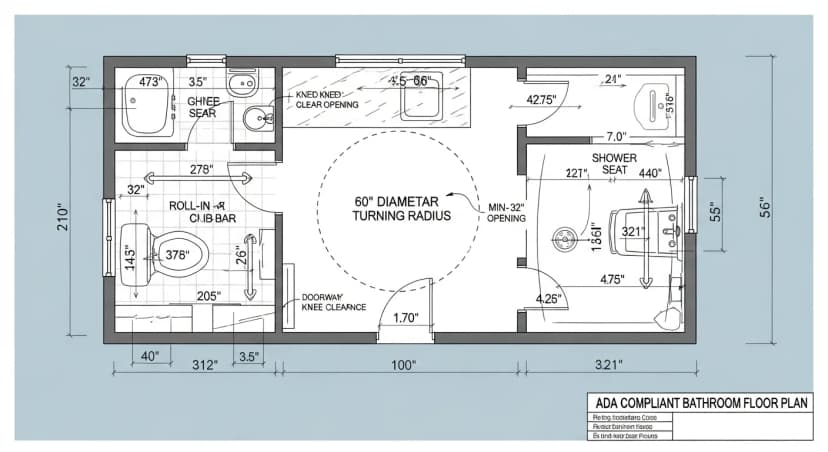
ADA Bathroom Requirements for California Homes: What Applies to Residential Remodels

Grab Bar Placement Guide: Where, How, and Why Every Bathroom Needs Them
Get a Free Estimate
Call us at (916) 907-8782 or fill out our contact form.