Lincoln Bathroom Accessibility: ADA Design for All
Accessible bathrooms are not just for people with disabilities. Universal design creates spaces that work for every age, every ability, and every stage of life — without looking institutional. Here is how to do it right in Lincoln homes.
Looking for bathroom remodeling in Lincoln? View our Lincoln service area page →
Table of Contents
- 1. Why Accessibility Matters in Lincoln Homes
- 2. ADA Compliance vs. Universal Design
- 3. Barrier-Free Showers: The Foundation of Access
- 4. Grab Bars: Placement, Styles, and Installation
- 5. Wider Doorways and Clear Floor Space
- 6. Accessible Vanity Design
- 7. Toilet Height and Placement
- 8. Flooring and Slip Prevention
- 9. Lighting and Controls
- 10. Aging-in-Place Planning for Lincoln Homeowners
- 11. Cost and Return on Investment
- 12. Accessibility in Lincoln's Active Adult Communities
- 13. Frequently Asked Questions

Why Accessibility Matters in Lincoln Homes
Lincoln has one of the fastest-growing populations of adults over 55 in Placer County. Communities like Sun City Lincoln Hills, Dell Webb at Lincoln Hills, and Twelve Bridges are home to thousands of residents who plan to stay in their homes for decades. The bathroom is the most dangerous room in any home — the CDC reports that more than 230,000 bathroom injuries send people to emergency rooms annually, with adults over 65 and children at highest risk.
Accessible bathroom design is not just about wheelchair access. It addresses the gradual changes in balance, grip strength, flexibility, and vision that affect most people as they age. A well-designed accessible bathroom is safer and more comfortable for everyone — a 30-year-old recovering from knee surgery, a parent bathing a child, or a 75-year-old navigating a wet tile floor.
As Lincoln's bathroom remodeling specialists, we design and build accessible bathrooms that meet ADA standards while maintaining the residential aesthetics homeowners expect. This guide covers every aspect of accessible bathroom design for Lincoln homes.
ADA Compliance vs. Universal Design
Understanding the difference between ADA compliance and universal design helps you make informed decisions about your bathroom remodel:
ADA Standards
The Americans with Disabilities Act (ADA) defines specific dimensional requirements for accessible bathrooms: minimum 60-inch turning radius for wheelchair access, 32-inch minimum clear door opening, grab bars at 33 to 36 inches above the floor, knee clearance under the sink, and a roll-in shower with a maximum 1/2-inch threshold. ADA standards are legally required in public and commercial buildings but not in private homes.
Universal Design
Universal design takes the functional intent of ADA standards and applies it with residential aesthetics. A universally designed bathroom meets or exceeds ADA clearances, includes safety features like grab bars and non-slip surfaces, and uses comfort-height fixtures — but it looks like a contemporary luxury bathroom, not an institutional facility. Lever handles replace round knobs, curbless showers replace traditional curbed entries, and grab bars come in decorative finishes that match the faucets and hardware.
For Lincoln homeowners, we recommend universal design as the standard approach. It serves current needs, anticipates future needs, maintains home value, and looks beautiful. For a deeper exploration, read our guide on aging-in-place bathroom design beyond grab bars.
Barrier-Free Showers: The Foundation of Access
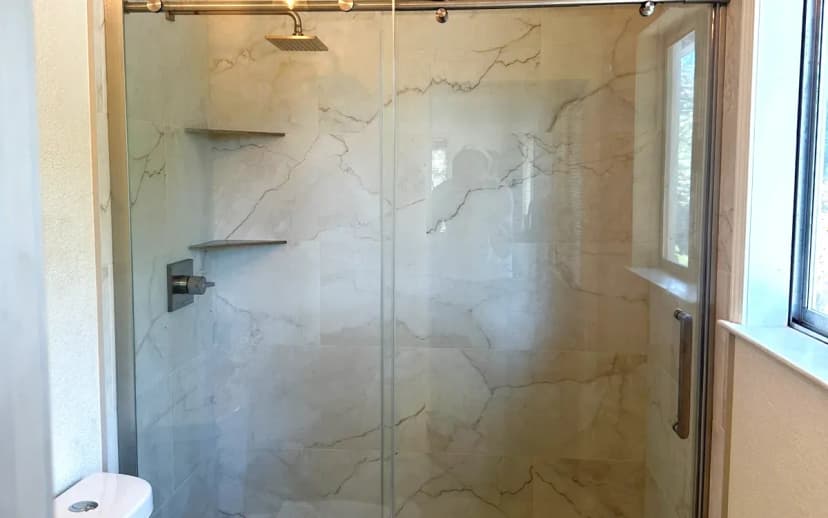
The shower is the most critical element in an accessible bathroom. A barrier-free (curbless) shower eliminates the step-over that causes falls and blocks wheelchair access. Here is how we build them in Lincoln homes:
Curbless Entry
A true curbless shower has zero threshold — the bathroom floor transitions directly into the shower floor at the same level. The shower floor slopes toward the drain (1/4 inch per foot), and a linear drain at the shower entry catches water before it reaches the bathroom floor. This requires careful waterproofing and precise floor preparation, especially on Lincoln's concrete slab foundations where modifying the floor level involves cutting into the slab.
Shower Size
ADA standards specify a minimum 36x36-inch roll-in shower, but we recommend 36x60 inches or larger for comfortable wheelchair access and caregiver assistance. A 48x60 or 60x60-inch shower provides room for a built-in bench, a wheelchair turning area, and a caregiver standing beside the user. This size also creates a luxury spa-like experience for ambulatory users.
Built-In Bench
A tiled bench at 17 to 19 inches high (matching toilet seat height for lateral transfer from a wheelchair) provides a seated showering option. The bench should be at least 15 inches deep and extend the full width of one shower wall. Built-in benches are structurally supported by the wall framing — they are not aftermarket additions screwed into tile. For shower options, see our walk-in shower service page.
Grab Bars: Placement, Styles, and Installation
Grab bars are the most recognizable accessibility feature — and the one most often done wrong. Proper grab bar installation requires three things: correct placement, structural mounting, and appropriate style selection.
Placement Standards
- Shower entry: Vertical bar, 33 to 36 inches from the floor, at the shower opening for stability when entering and exiting.
- Shower side wall: Horizontal bar, 33 to 36 inches from the floor, running the full length of the side wall for support while standing or moving within the shower.
- Shower control wall: Vertical bar near the valve so the user can stabilize with one hand while adjusting water temperature with the other.
- Toilet side wall: Horizontal bar, 33 to 36 inches from the floor, extending at least 12 inches beyond the front edge of the toilet for support when sitting and standing.
- Toilet rear wall: Horizontal bar, 33 to 36 inches from the floor, extending 12 inches from the toilet centerline on each side.
Structural Mounting
Grab bars must support at least 250 pounds of force. This requires mounting to solid wood blocking installed between studs — not to drywall anchors, which can pull out under load. During a remodel, we install 2x6 blocking at all planned grab bar locations before closing up the walls. We also add blocking at additional locations where grab bars might be needed in the future, because the cost to install blocking during construction ($200 to $400) is negligible compared to opening a finished wall later ($800 to $1,500).
Style Options
Modern grab bars are available in every finish — brushed nickel, matte black, polished chrome, oil-rubbed bronze — to match your fixtures. Combination grab bar-towel bars and grab bar-shelves serve dual purposes, providing support and function without the institutional look. Companies like Moen, Delta, and Kohler offer residential grab bar lines that are indistinguishable from standard bathroom accessories.
Wider Doorways and Clear Floor Space
Most Lincoln homes have 24 to 28-inch bathroom doors — too narrow for wheelchair access and tight even for someone using a walker. ADA standards require a 32-inch clear opening, which means a 36-inch door frame. Here is how we address doorway width in Lincoln bathroom remodels:
- Reframing the opening: In non-load-bearing partition walls (most interior bathroom walls in Lincoln homes), widening the opening is straightforward — remove the existing frame, cut the studs, install a wider header, and hang a 36-inch door. Cost: $800 to $1,500.
- Pocket doors: A 36-inch pocket door provides full clear width without the swing clearance issue. The door slides completely into the wall, leaving the entire opening unobstructed. This is ideal for bathrooms where a swing door blocks access to the toilet or vanity.
- Offset hinges: Swing-clear (offset) hinges position the door completely outside the frame when open, gaining an additional 2 inches of clear width without reframing. This converts a 30-inch door to a 32-inch clear opening at a fraction of the reframing cost ($100 to $200).
Inside the bathroom, ADA standards require a 60-inch turning radius for wheelchair access. This circle must be clear of all fixtures and obstructions. In smaller bathrooms, achieving a full 60-inch turning radius may require reconfiguring the layout or removing the tub to create floor space.
Accessible Vanity Design
An accessible vanity accommodates both standing and seated users. The key requirements:
- Knee clearance: ADA requires 27 inches of knee clearance height, 30 inches wide, and 19 inches deep under the sink. A wall-mounted vanity at 34 inches (standard counter height) with open space beneath meets this requirement while looking contemporary.
- Sink type: A shallow undermount or vessel sink provides maximum knee clearance underneath. The drain should run to the back wall, not straight down, to avoid interference with a wheelchair user's knees. Insulate hot water pipes under the sink to prevent burns.
- Faucet: Lever-handle or touchless faucets are easier to operate than round knobs for people with limited grip strength or arthritis. A single-lever faucet with temperature limit stop prevents scalding.
- Mirror: A tilted mirror or a full-height mirror (starting at the countertop and extending to the ceiling) allows both standing and seated users to see their reflection. Avoid mounting a mirror with the bottom edge at 40 inches — it works for standing users but not seated ones.
Toilet Height and Placement
Toilet height and positioning significantly affect usability for people with mobility limitations:
Height
ADA-compliant toilets have a seat height of 17 to 19 inches (measured from the floor to the top of the seat). This is called "comfort height" or "right height" in residential products. Standard toilets are 15 inches. The additional 2 to 4 inches makes sitting down and standing up significantly easier for people with knee, hip, or back limitations. Comfort-height toilets are now the default in most new bathroom designs regardless of accessibility needs.
Lateral Transfer Space
ADA standards require at least 18 inches of clear space on one side of the toilet for lateral transfer from a wheelchair. This means the toilet cannot be placed in a tight alcove with walls on both sides. If the existing layout does not provide this clearance, the toilet may need to shift position — which on Lincoln's slab foundations requires cutting concrete to relocate the drain ($2,000 to $4,000).
Flush Controls
Side-mounted flush levers or dual-flush buttons on the tank top are easier to reach than front-mounted levers. Touchless flush sensors — now available in residential models from Kohler and Toto — eliminate the need to reach for a handle entirely. For the comparison between curbless and curbed shower options relevant to accessible design, see our curb vs. curbless shower guide.
Flooring and Slip Prevention
Slip-and-fall prevention starts with the floor surface. In an accessible bathroom, every floor surface — bathroom floor, shower floor, and transition areas — must provide reliable traction when wet:
- DCOF rating: All floor tile should have a Dynamic Coefficient of Friction (DCOF) rating of 0.42 or higher. This is the TCNA-recommended minimum for wet barefoot surfaces. Verify the rating on the manufacturer's specification sheet for the specific tile you select.
- No polished tile on floors: Polished porcelain and polished stone are dangerously slippery when wet, regardless of their appearance. Use matte, textured, or honed finishes on all floor surfaces.
- Continuous flooring: Minimize transitions between different floor surfaces. Each transition is a potential trip hazard. A curbless shower with the same floor tile running from the bathroom into the shower eliminates the most common transition.
- No loose rugs: Bath mats and area rugs slide on tile and bunch under feet or wheels. If a mat is necessary, use one with a permanent non-slip backing and secure it to the floor.
Lighting and Controls
Vision changes are among the earliest effects of aging, and inadequate bathroom lighting contributes to falls and difficulty with grooming tasks. Accessible lighting design addresses both:
- General illumination: Recessed LED cans providing even, bright light throughout the room. Minimum 50 foot-candles at floor level — significantly brighter than the 20 to 30 foot-candles typical of builder-grade lighting. Dimmable controls allow adjustment for nighttime use.
- Task lighting: Vanity sconces at eye level on both sides of the mirror provide shadow-free illumination for grooming. A backlit mirror adds additional face-level lighting.
- Night lighting: LED strip lighting along the toe kick of the vanity or along the floor perimeter provides enough light to navigate the bathroom at night without turning on the main lights. Motion-activated night lights eliminate the need to reach for a switch.
- Switch placement: Light switches should be at 42 to 48 inches above the floor — reachable from both standing and seated positions. Rocker switches or touch panels are easier to operate than toggle switches for people with limited hand strength.
Every electrical circuit in the bathroom must have GFCI protection, which is required by California Electrical Code. During an accessibility remodel, we verify all circuits and upgrade any non-compliant wiring.
Aging-in-Place Planning for Lincoln Homeowners
The most cost-effective approach to accessibility is planning ahead. If you are remodeling a bathroom today and plan to live in your Lincoln home for 10 to 20 more years, building in accessibility features now — even if you do not need them yet — saves significant money compared to retrofitting later:
- Install blocking now: Adding 2x6 blocking between studs at all potential grab bar locations costs $200 to $400 during a remodel (the walls are already open). Retrofitting blocking later requires opening finished walls, repairing tile, and repainting — $800 to $1,500 per location.
- Choose a curbless shower: A curbless shower serves ambulatory users beautifully today and accommodates a wheelchair or walker in the future without modification.
- Widen the doorway: A 36-inch door is comfortable for everyone and essential for wheelchair or walker access. The incremental cost during remodeling is $300 to $500 compared to $800 to $2,000 as a standalone project.
- Select comfort-height fixtures: Comfort-height toilets and appropriately mounted vanities serve all users well and are standard in contemporary design.
- Plan electrical for future needs: Install a dedicated circuit near the toilet for a future bidet seat. Wire for motion-activated night lighting. These are inexpensive additions during a remodel but costly retrofits.
For more on proactive aging-in-place design, see our post on aging-in-place bathroom design beyond grab bars.
Cost and Return on Investment
Accessible bathroom remodels in Lincoln range from targeted upgrades to full ADA-compliant redesigns. Here are the cost ranges:
| Project Scope | Cost Range | Timeline |
|---|---|---|
| Basic accessibility add-ons (grab bars, anti-scald, comfort-height toilet) | $5,000 – $12,000 | 3 – 5 days |
| Tub-to-curbless shower conversion | $20,000 – $32,000 | 2 – 3 weeks |
| Full accessible remodel (curbless shower, wider door, roll-under vanity) | $30,000 – $45,000 | 3 – 4 weeks |
| Wheelchair-accessible full remodel with expanded footprint | $40,000 – $60,000 | 4 – 6 weeks |
The ROI on accessible features is both financial and practical. According to the National Association of Realtors, accessible bathroom features are increasingly valued by buyers — especially in communities like Lincoln with large active-adult populations. But the real return is independence: every year you can safely live in your own home instead of moving to assisted living saves $50,000 to $100,000 in annual care costs.
Accessibility in Lincoln's Active Adult Communities
Lincoln is home to several active adult (55+) communities where accessible bathroom design is especially relevant:
- Sun City Lincoln Hills: Homes built from 1999 to 2010 with single-story floor plans that are ideal for accessibility modifications. Most master bathrooms have space for curbless shower conversion and can accommodate a 60-inch turning radius with minimal layout changes. See our Sun City Lincoln Hills bathroom remodel guide for community-specific details.
- Dell Webb at Lincoln Hills: Similar construction era and floor plans to Sun City. Many homes already have wider doorways and single-story layouts but lack modern accessible features like curbless showers and properly placed grab bars.
- Twelve Bridges: Multi-story homes where the ground-floor bathroom is often the best candidate for accessibility modifications. Converting a ground-floor half bath to a full accessible bathroom eliminates the need to navigate stairs for daily bathing.
Each community has specific construction characteristics that affect the remodel approach. Slab foundations, wall construction, plumbing routing, and HOA requirements all factor into the design. We are familiar with the construction details of all Lincoln's major communities and tailor our approach accordingly.
Frequently Asked Questions
Ready for an Accessible Bathroom in Lincoln?
Oakwood Remodeling Group designs and builds accessible bathrooms for Lincoln homeowners in Sun City Lincoln Hills, Twelve Bridges, and throughout the city. Our accessible designs meet ADA standards while maintaining the residential aesthetics you expect — because safety and style are not mutually exclusive. Every project includes a detailed scope, fixed pricing, and a timeline you can count on.
Related Reading
Bathroom Remodeling in Lincoln, CA
Our full service area page for Lincoln homeowners.
Aging-in-Place Bathroom Design
Going beyond grab bars for long-term accessibility.
Sun City Lincoln Hills Bathroom Remodel
Community-specific remodel guide for SCLH.
Walk-In Shower Services
Barrier-free and curbless shower options.
Walk-In Shower Guide: Curb vs. Curbless
Comparing shower entry options for accessibility.
Get Your Free Estimate
Schedule your consultation today

Get a Free Estimate
Call us at (916) 907-8782 or fill out our contact form.