Galley Bathroom Layout: How to Maximize a Long, Narrow Space
A 5-foot-wide bathroom does not have to feel like a hallway. The right fixture placement, tile direction, mirror strategy, and lighting can transform a galley bathroom into a space that feels wider, more open, and genuinely comfortable to use every day.
Looking for bathroom remodeling in Sacramento? View our Sacramento service area page →
Table of Contents
- 1. Why Galley Bathrooms Are So Common
- 2. Fixture Placement Strategies
- 3. The 5x9 Layout: Making Every Inch Count
- 4. The 5x10 Layout: That Extra Foot Matters
- 5. Visual Width Tricks That Actually Work
- 6. Tile Direction and Pattern Strategy
- 7. Mirror Placement for Maximum Impact
- 8. Lighting Design for Narrow Spaces
- 9. Vanity and Toilet Considerations
- 10. Cost Data for Galley Bathroom Remodels
- 11. Frequently Asked Questions

Walk into most secondary bathrooms in Sacramento-area homes built between 1985 and 2010, and you will find essentially the same layout: a narrow rectangle roughly 5 feet wide and 9 to 10 feet long. Builders called it efficient. Homeowners call it frustrating. Two people cannot pass each other comfortably. The door swings into the vanity. The shower feels like a phone booth. And somehow, despite having 45 to 50 square feet of floor space, there is never enough room.
This is the galley bathroom, and it is one of the most common bathroom shapes in Placer and Sacramento counties. The good news is that galley bathrooms respond beautifully to smart design. Unlike square bathrooms where the challenges are more diffuse, a galley bathroom has one specific problem — perceived width — and a well-defined set of solutions. As a small bathroom remodel specialist, we have optimized hundreds of galley layouts, and the transformation is consistently dramatic.
Why Galley Bathrooms Are So Common
Understanding why your bathroom is shaped this way helps explain the design constraints you are working within. During the building booms that shaped Rocklin, Roseville, Folsom, and surrounding communities, builders optimized floor plans around bedroom count. A 5-foot-wide bathroom fits neatly between two bedrooms, sharing a plumbing wall with minimal waste. The layout was code-compliant, cost-effective to build, and technically functional.
The problem is that "technically functional" and "comfortable" are very different things. A galley bathroom with a standard 60-inch tub, builder-grade vanity, and swing door often feels cramped even for one person. Add a towel bar, a toilet paper holder, and a bath mat, and you are navigating an obstacle course every morning.
The underlying structure of these bathrooms is actually quite workable. The 5-foot width accommodates modern fixtures perfectly. The 9 to 10-foot length provides enough linear space for a shower, toilet, and vanity. The challenge is purely about optimizing the arrangement and creating the visual perception of width. That is where thoughtful design makes all the difference.
Fixture Placement Strategies
The arrangement of fixtures in a galley bathroom determines everything — traffic flow, usable space, storage potential, and how the room feels. There are three proven layouts that work in narrow bathrooms, and choosing the right one depends on your room's exact dimensions, door location, and plumbing positions.
Layout A: Linear arrangement (shower at back wall). This is the most common and often the best layout for galley bathrooms. The shower occupies the far short wall, the toilet sits mid-room along one long wall, and the vanity sits along the same or opposite long wall near the door. This arrangement keeps the entry area clear and draws the eye toward the back wall, which creates a sense of depth rather than width — an advantage in a narrow space.
Layout B: Opposed arrangement. In this layout, the vanity and toilet face each other on opposite long walls, with the shower at the back. This works best when the room is at least 5.5 feet wide, as you need clearance in front of both fixtures simultaneously. The advantage is that it distributes visual weight evenly across both walls, which can make the room feel more balanced.
Layout C: Staggered arrangement. The vanity is near the door on one wall, the toilet is mid-room on the same wall, and the shower wraps the far end. This keeps one wall completely clear — which is where you place a full-length mirror or towel storage — and creates a visual corridor that makes the space feel longer and more organized.
The 5x9 Layout: Making Every Inch Count
A 5x9 bathroom gives you 45 square feet of floor space. After fixtures, you are working with about 15 to 18 square feet of usable floor area. Every decision matters at this scale.
The biggest single improvement in a 5x9 galley bathroom is replacing a standard 60-inch bathtub with a walk-in shower. A tub in a 5x9 bathroom consumes the entire short wall and extends 30 to 32 inches into the room — that is more than half your width gone. A walk-in shower with frameless glass creates the same footprint but feels dramatically more open because you can see through it.
In the 5x9 layout, we recommend a 24-inch floating vanity positioned near the door. This leaves 36 inches of passage width beside the vanity — comfortable for daily use. The toilet sits 12 to 18 inches from the vanity, centered on its allocated wall space. A pocket door instead of a swing door recovers approximately 7 square feet of usable floor area — a massive gain in a 45-square-foot room.
For the shower, a 36x48-inch alcove shower fits the short wall perfectly. With frameless glass panels rather than a framed door, the shower visually extends the room rather than dividing it. A corner shower configuration is another option if the plumbing allows repositioning the drain.
The 5x10 Layout: That Extra Foot Matters
An additional 12 inches of length transforms a galley bathroom from tight to workable. A 5x10 layout provides 50 square feet, and that extra 5 square feet translates to meaningful breathing room between fixtures.
In a 5x10 layout, you can accommodate a 30-inch vanity instead of 24 inches — a significant upgrade in counter space and storage. The extra length also allows a slightly larger shower (36x60 inches), which feels noticeably more comfortable. You gain enough space between the toilet and vanity to install a small storage tower or recessed shelving.
The most impactful use of the extra foot is often between the shower and the toilet. Increasing the gap from 12 inches to 24 inches eliminates the cramped feeling that makes people dislike galley bathrooms. That single design decision — allocating the extra space to breathing room rather than larger fixtures — often delivers the biggest quality-of-life improvement.
Visual Width Tricks That Actually Work
You cannot physically widen a 5-foot bathroom without structural renovation. But you can make it feel 30 to 40 percent wider through proven design strategies. These are not gimmicks — they are principles rooted in how the human eye perceives space, and they work consistently across hundreds of projects we have completed.
Continuous flooring into the shower. When the floor tile runs unbroken from the bathroom entry into a curbless or low-curb shower, the eye reads the entire length as one continuous plane. The shower stops being a separate compartment and becomes part of the room, which dramatically increases perceived size.
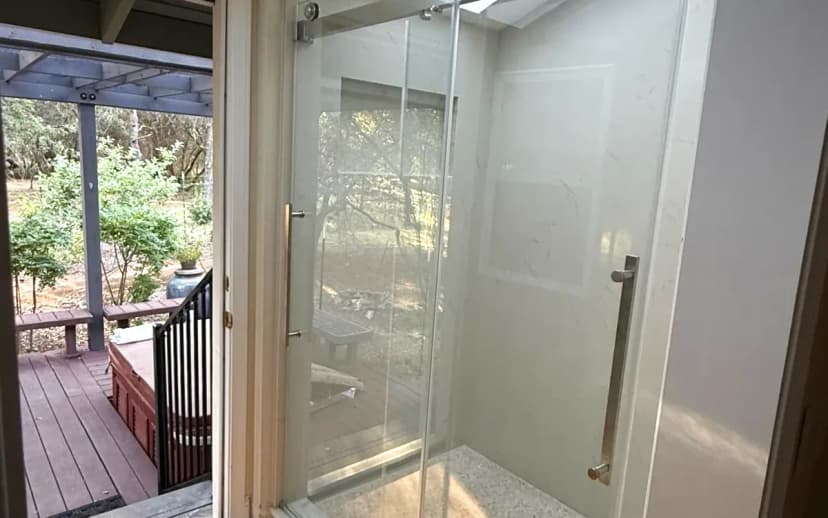
Frameless glass shower enclosure. A framed shower door creates a visual barrier that divides the room. Frameless glass is nearly invisible, allowing your eye to travel the full length without interruption. This is arguably the single most impactful upgrade in a galley bathroom. Learn more about visual tricks that make small bathrooms feel bigger.
Floating vanity. A wall-mounted vanity exposes the floor beneath it, allowing the eye to see the full width of the floor from wall to wall. In a narrow bathroom, this creates a powerful sense of openness at the most visually important point — the entry zone where you form your first impression of the space.
Consistent color palette. Using the same tile color on floors and walls eliminates visual boundaries. When walls and floors blend, the room feels like a unified volume rather than a collection of surfaces. Light colors — whites, warm grays, soft creams — reflect light and enhance this effect.
Tile Direction and Pattern Strategy
Tile direction is one of the most underutilized tools in narrow bathroom design. The orientation of rectangular tiles creates strong directional lines that guide the eye, and you can use this to your advantage.
Wall tile: run it horizontally. Horizontal lines make surfaces appear wider. A 12x24 tile installed in a horizontal orientation on the long walls creates strong width lines that counteract the narrow proportions. Stack-bond (straight horizontal lines) is more effective than brick-lay (offset) for this purpose because the continuous horizontal lines are unbroken.
Floor tile: diagonal or perpendicular to length. On the floor, laying tile at a 45-degree diagonal breaks up the bowling-alley effect. The diagonal lines draw the eye corner-to-corner, which is the widest dimension in any rectangle. Alternatively, running rectangular floor tile perpendicular to the long axis (widthwise) creates short horizontal lines that widen the perceived floor plane.
Large format tiles reduce grout lines. Fewer grout lines mean fewer visual interruptions. In a narrow bathroom, every grout line is a visual boundary that the eye registers. A 12x24 tile has roughly 60 percent fewer grout joints than a 6x6 tile covering the same area. That visual simplicity makes a meaningful difference in perceived spaciousness.
Match your grout color to your tile. Contrasting grout turns every joint into a visible line. Matching grout makes the joints nearly invisible, creating the illusion of continuous surfaces. In a galley bathroom, this detail alone can shift the perception from "narrow and gridded" to "clean and seamless."
Mirror Placement for Maximum Impact
Mirrors are the most powerful tool for visually expanding a narrow bathroom. A mirror effectively doubles the perceived depth of whatever it reflects, and in a galley bathroom, that means doubling the apparent width.
Full-width vanity mirror. Instead of a medicine cabinet or small decorative mirror, install a mirror that spans the entire width of the wall above the vanity. A 60-inch-wide mirror on a 60-inch-wide wall creates an unbroken reflection that makes the room feel twice as wide. Edge-to-edge installation (no frame, or minimal frame) maximizes this effect.
Mirror on the long wall opposite the vanity. If your layout leaves one long wall relatively clear, a full-length mirror on that wall creates an extraordinary sense of space. The mirror reflects the vanity area, which typically has the most visual depth, creating a corridor-like infinity effect.
Backlit mirrors. A LED-backlit mirror does double duty: it provides excellent task lighting while creating a soft halo that makes the wall appear to recede. The glow behind the mirror eliminates the hard visual boundary between mirror and wall, which enhances the depth illusion.
Lighting Design for Narrow Spaces
Lighting in a galley bathroom serves two functions: practical illumination and visual space expansion. The wrong lighting makes a narrow bathroom feel like a tunnel. The right lighting eliminates shadows, bounces light off surfaces, and creates the impression of airiness.
Recessed LED ceiling fixtures. Recessed lights sit flush with the ceiling, adding zero visual bulk. In a galley bathroom, space two to three 4-inch recessed LED fixtures along the centerline, spaced 24 to 30 inches apart. Use 3000K color temperature for warmth without yellowing.
Vanity lighting. Side-mounted sconces at mirror height (60 to 65 inches from the floor) provide even facial illumination without overhead shadows. In very narrow bathrooms where sconces might protrude into the passage, a LED light bar mounted above the mirror achieves similar results with zero projection from the wall.
Avoid single overhead fixtures. A single ceiling fixture creates harsh shadows on both long walls, which emphasizes the narrow proportions. Multiple light sources distributed along the length create even illumination that minimizes shadows and makes the space feel more open and balanced.
Under-vanity LED strips. A floating vanity with LED strip lighting underneath creates a dramatic floating effect and washes the floor with light. This draws the eye downward to the visible floor space, reinforcing the sense of openness that a floating vanity creates.
Vanity and Toilet Considerations
In a galley bathroom, the vanity and toilet are your two largest fixtures, and their size and style directly impact how the room feels. Every inch of projection matters when you are working with 5 feet of width.
Vanity depth matters more than width. Standard vanities project 21 to 22 inches from the wall. A narrow-depth vanity at 18 inches saves 3 to 4 inches of passage width — which translates to a noticeably more comfortable walk-through. Some European-style vanities project as little as 16 inches, though you sacrifice some countertop usability.
Compact elongated toilets. A compact elongated toilet measures 25 to 27 inches from wall to front, compared to 28 to 30 inches for a standard elongated model. That 2 to 3-inch savings translates to meaningful clearance in a narrow bathroom. Brands like TOTO and Kohler offer compact elongated models that provide comfortable seating with a smaller footprint.
For storage solutions in small bathrooms, a recessed medicine cabinet is essential. It provides 4 to 6 inches of storage depth without projecting into the room — critical in a narrow galley layout where every inch of clearance matters.
Cost Data for Galley Bathroom Remodels
Galley bathroom remodels in the Sacramento region follow predictable cost ranges based on scope. Here is what to expect for a standard 5x9 or 5x10 galley bathroom in 2026:
- Cosmetic refresh ($8,000 - $14,000): New vanity, toilet, fixtures, tile refinishing or overlay, paint, lighting, and hardware. No layout changes or plumbing moves.
- Standard remodel ($15,000 - $22,000): Full demo, new tile (floor and shower), new vanity, toilet, shower with frameless glass, lighting, and ventilation. Layout remains the same.
- Layout-optimized remodel ($20,000 - $28,000): Everything in the standard remodel plus plumbing relocation, tub-to-shower conversion, pocket door installation, and fixture repositioning for optimal flow.
The layout-optimized remodel delivers the most dramatic transformation because it addresses the root cause of galley bathroom frustration — fixture arrangement. The additional $5,000 to $6,000 over a standard remodel typically includes $1,500 to $2,500 for plumbing moves and $800 to $1,200 for pocket door installation. For most homeowners, this is the best investment because the layout improvements are permanent and affect daily comfort for decades.
Compare these costs with our micro bathroom renovation under $10K guide for budget-tier options.
Frequently Asked Questions
Ready to Transform Your Galley Bathroom?
Oakwood Remodeling Group specializes in galley bathroom transformations throughout the Sacramento region. We have optimized hundreds of narrow layouts, and our design process starts with a detailed assessment of your specific room dimensions, plumbing positions, and goals. Every project includes fixed pricing, a detailed scope of work, and our 3-year warranty.
Related Reading
Small Bathroom Remodel: The Complete Guide
Comprehensive guide to maximizing bathrooms under 60 sq ft.
Corner Shower Ideas for Small Bathrooms
Space-saving shower configurations for compact spaces.
12 Visual Tricks for Small Bathrooms
Design strategies that make small bathrooms feel twice the size.
Small Bathroom Storage Solutions
Creative storage for under 50 sq ft bathrooms.
Small Bathroom Remodel Services
Our compact bathroom renovation services.
Get Your Free Estimate
Schedule your consultation today
Related Articles

Corner Shower Ideas for Small Bathrooms: Neo-Angle, Square & Curved Options

Small Bathroom Storage Solutions: Where to Put Everything in Under 50 Sq Ft
Auburn Small Bathroom Remodel: Space-Saving Solutions for Compact Foothill Homes
Get a Free Estimate
Call us at (916) 907-8782 or fill out our contact form.