12 Transitional Bathroom Design Ideas That Won't Look Dated in Five Years
Twelve transitional bathroom moves that sit intentionally between traditional and modern, balancing classical proportions with current execution. The most resilient bathroom style for Sacramento-region homeowners who plan to live in their home for another decade.
Looking for bathroom remodeling in Folsom? View our Folsom service area page →
In This Guide
- What transitional design actually means
- 1. White shaker vanity
- 2. Honed Calacatta or Carrara counter
- 3. 12x24 porcelain in stack-bond
- 4. Polished nickel plumbing
- 5. Vertical vanity sconces
- 6. Frameless walk-in shower glass
- 7. Built-in linen tower
- 8. Subway tile with dark grout
- 9. Recessed cans + vanity pendant layer
- 10. Freestanding tub with floor-mount filler
- 11. Pencil-tile niche trim
- 12. Polished marble mosaic shower floor
- Color palette and editing strategy
- Frequently asked questions
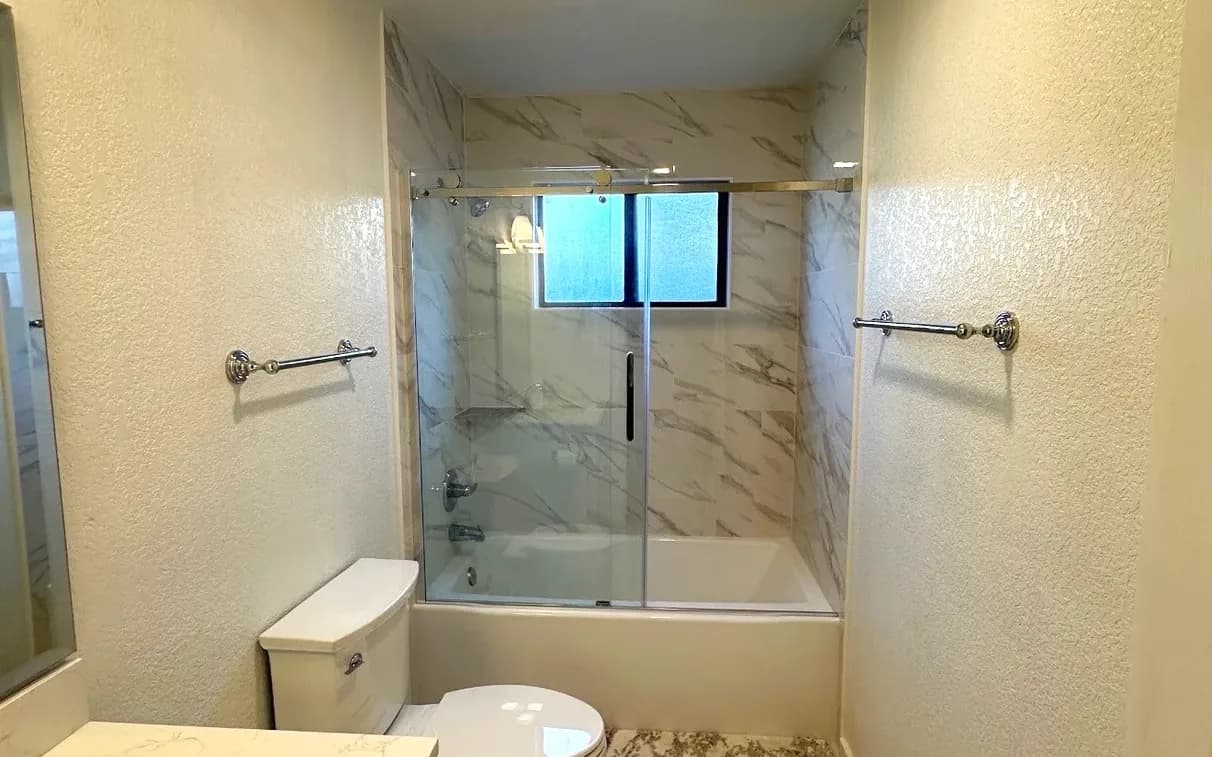
Pictured: a real Folsom project. See the full before & after
Transitional design is the answer to the question homeowners ask most often when starting a remodel: how do we make this look beautiful now without looking ridiculous in 2031? The aesthetic was developed specifically to solve this problem. It pulls established proven design elements from traditional and contemporary vocabularies and combines them in disciplined proportions that read as intentional regardless of which way design trends move over the next decade.
These twelve transitional moves are the design choices we install most often in Sacramento-region remodels where the homeowner has indicated they plan to live in the home for another 10 to 20 years. Each pick is field- tested across multiple project tiers — Folsom mid-budget, El Dorado Hills luxury, Granite Bay custom — and consistently retains both functional and aesthetic value across the full timeline. For broader style context see our best bathroom faucets guide and our master bathroom remodel service.
What transitional design actually means
Transitional sits between traditional and contemporary on a deliberate axis. Traditional features ornate molding, raised-panel cabinets, polished brass fixtures, and elaborate tile patterns. Contemporary features slab cabinets, large flat surfaces, matte black fixtures, and geometric simplicity. Transitional borrows from both: simple shaker cabinets (more refined than raised-panel, more detailed than slab), natural stone counters with classical proportions, polished nickel fixtures (less ornate than brass, more refined than chrome), and tile patterns that lean toward classic-modern rather than period-specific.
The discipline is what makes transitional work. Pulling too far toward traditional makes the bathroom feel like your grandmother's. Pulling too far toward contemporary makes the bathroom feel like a SoHo loft. The transitional sweet spot is where you cannot quite place the bathroom in a specific era — it feels both classic and current, which is exactly the goal.
1. White shaker vanity with brushed nickel hardware
The white shaker vanity is the foundational transitional move. Specify in painted hardwood (poplar or maple) with a satin or semi-gloss finish. Cabinet door styles: 5-piece flat-panel shaker with 2-inch stile width. Hardware: brushed nickel bin pulls (4 inches center to center) on drawers, brushed nickel knobs on doors. Vanity dimensions: 36 to 60 inches wide for single sink, 60 to 84 inches for double sink.
2. Honed Calacatta or Carrara marble counter
Honed (matte) marble is the transitional countertop default. Calacatta has more dramatic veining; Carrara is quieter. Either works. Specify with a 1-1/2-inch eased edge — not bullnose (too traditional), not square (too modern). Run the same stone up the wall as a 4-inch backsplash. For homes where natural marble maintenance is a concern (annual sealing, etching risk from acidic products), specify honed quartzite or a high-quality quartz with veined pattern that mimics marble.
3. 12x24-inch porcelain floor in stack-bond layout
Stack-bond layout (no offset between rows, all tiles aligned in a perfect grid) reads as more architectural than the standard 1/3 brick offset. Specify 12x24 or 24x48-inch porcelain tile in a light warm gray or cream. Use a matching grout color (not contrasting) so the grid reads as proportion rather than line work. Run the same tile in the shower floor (smaller size for slope) for visual continuity.
4. Polished nickel plumbing fixtures
Polished nickel is the most transitional plumbing finish — slightly warmer than chrome, slightly cooler than brass, and reads neither contemporary nor traditional. Specify Moen, Delta, Kohler, or Brizo fixtures with consistent polished nickel finish across faucet, showerhead, tub filler, and trim. Avoid the finish-mixing tendency to add polished nickel here and brushed nickel there — within plumbing, single-finish discipline is correct.
5. Vertical vanity sconces at eye height
Pair of vertical sconces flanking the mirror at 60 to 66 inches off the floor. Polished nickel or brushed brass finish with diffusing shades (frosted glass, fabric, or seeded glass). The sconces provide shadow- free face lighting — see our best bathroom mirrors guide for full sconce-vs-lighted-mirror analysis.
6. Frameless glass walk-in shower
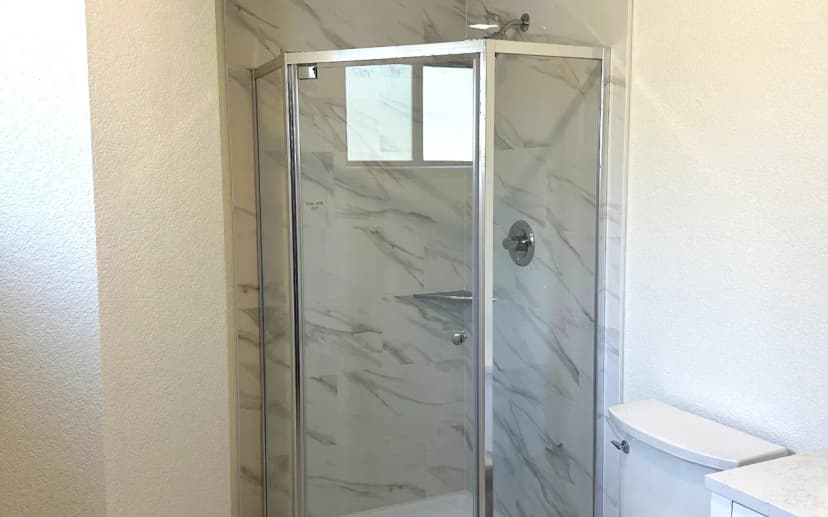
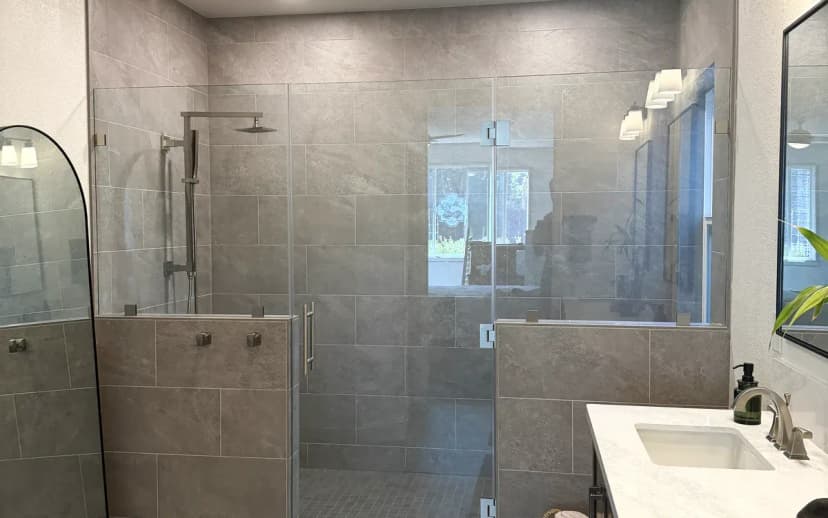
Frameless 3/8 or 1/2-inch tempered glass walk-in shower enclosure with minimal hardware. The frameless detail reads as contemporary; pairing with traditional tile inside the shower (subway, marble) keeps the transitional balance. Avoid framed enclosures (too traditional) and avoid grand commercial-style multi- panel enclosures (too contemporary).
7. Built-in linen tower beside vanity
Floor-to-ceiling linen storage tower in matching cabinetry beside the vanity is a transitional move that pulls from traditional built-in storage while accommodating modern storage volumes. Specify 18 to 24 inches wide, matching the vanity finish exactly, with one open shelf at the top for visible folded towels and closed storage below for medications and toiletries.

8. Subway tile shower with dark grout
Subway tile remains correct for transitional showers when paired with the right grout. Specify 3x6 white subway tile in horizontal offset with a medium-gray or charcoal grout — the contrast emphasizes the brick pattern without competing with the tile. Avoid white subway with white grout (too traditional) and subway with very dark tile (too contemporary). The classic 3x6 dimension is the transitional default; oversized 4x12 subway reads more contemporary.
9. Recessed LED cans + vanity pendant lighting layer
Three lighting layers minimum: ambient (4 to 6 recessed LED cans with frosted lenses for general illumination), task (vanity sconces or lighted mirror for face lighting), accent (pendant over a freestanding tub or LED toe kick under a vanity for evening mood). All fixtures at 3000K color temperature, dimmable to 10 percent minimum. Single-layer lighting (just recessed cans) reads as builder-grade.
10. Freestanding tub with floor-mount filler
The freestanding tub with a floor-mounted tub filler is one of the most transitional moves available. The tub references classical bathing forms; the floor-mount filler references modern plumbing minimalism. Specify a cast iron tub with porcelain enamel (Kohler Birthday Bath, Sunrise Specialty) or a stone resin tub for the transitional look. Avoid contemporary slipper tubs (too modern) and avoid claw-foot tubs (too traditional).
11. Pencil-tile accent trim on shower niche
A 1/2-inch pencil-tile trim around the shower niche perimeter adds the kind of subtle decorative detail that distinguishes transitional from purely contemporary. Specify in marble or natural stone matching the surrounding tile material. The trim adds visual richness without adding visual chaos.
12. Polished marble mosaic shower floor
Marble mosaic in a 2x2-inch grid for the shower floor creates the slip resistance needed in the wet zone while providing visual texture that complements the larger-format wall tile. Specify polished (not honed) marble for the shower floor specifically — the polished finish sheds water faster and is easier to keep clean. For complete waterproofing strategy see our companion guide on shower waterproofing systems.
Color palette and editing strategy
Transitional color palette: warm whites and light warm grays for walls (Benjamin Moore White Dove OC-17, Benjamin Moore Pale Oak OC-20, Sherwin-Williams Alabaster SW 7008), natural stone with warm undertones (Calacatta, Carrara, honed quartzite), polished nickel or brushed brass for hardware accents, dark gray or charcoal grout for tile contrast. The palette should read as quiet — the design works through proportions and material choices, not through color statements.
Editing strategy: use all twelve ideas in a primary bathroom (they balance each other naturally), eight to ten in a secondary bath, six in a powder room. The transitional style is less prone to over-execution than other aesthetics because the moves themselves are restrained. For broader fixture guidance see our best bathroom faucets and best medicine cabinets guides.
Designing a transitional bathroom that ages well
Oakwood Remodeling Group designs and builds transitional bathrooms across the Sacramento region. We will coordinate cabinetry, stone selection, plumbing fixtures, tile, lighting, and millwork to deliver a bathroom that reads as intentional now and will continue to read as intentional in 2036. Every remodel includes our 3-year workmanship warranty with manufacturer warranties stacking on top.
Frequently asked questions
Related Reading
12 Japandi Bathroom Ideas
Companion guide for the minimalist style alternative.
15 Modern Farmhouse Bathroom Ideas
Companion guide for the warmer rustic style.
Master Bathroom Remodel Services
Full master bathroom design and construction.
12 Best Bathroom Faucets of 2026
Polished nickel and brass faucet specification.
10 Best Bathroom Medicine Cabinets of 2026
Storage and lighting coordination for transitional vanities.
Get Your Free Estimate
Schedule your consultation today

Get a Free Estimate
Call us at (916) 907-8782 or fill out our contact form.