15 Modern Farmhouse Bathroom Ideas Beyond Subway Tile
Fifteen modern farmhouse bathroom design moves that push past the predictable subway-tile-and-shiplap formula — vintage vanity conversions, iron hardware, mixed materials, and updated detail choices we use in Sacramento-region remodels.
Looking for bathroom remodeling in Loomis? View our Loomis service area page →
In This Guide
- How modern farmhouse has evolved past the 2018 formula
- 1. Black window-pane shower glass
- 2. Soaking tub on a reclaimed wood plinth
- 3. Vintage dresser-to-vanity conversion
- 4. Penny round vintage floor tile
- 5. Apron-front vessel sink
- 6. Iron hardware in black or rust
- 7. Modernized bead-board wainscot
- 8. Open wood shelving for towels
- 9. Cedar plank ceiling
- 10. Round wood-framed mirror
- 11. Cast-iron tub with skirt
- 12. Brass pull-down hardware
- 13. Stoneware vessel soaking tub
- 14. Reclaimed wood accent wall
- 15. Industrial pendant lighting
- Editing: how to use these together
- Frequently asked questions
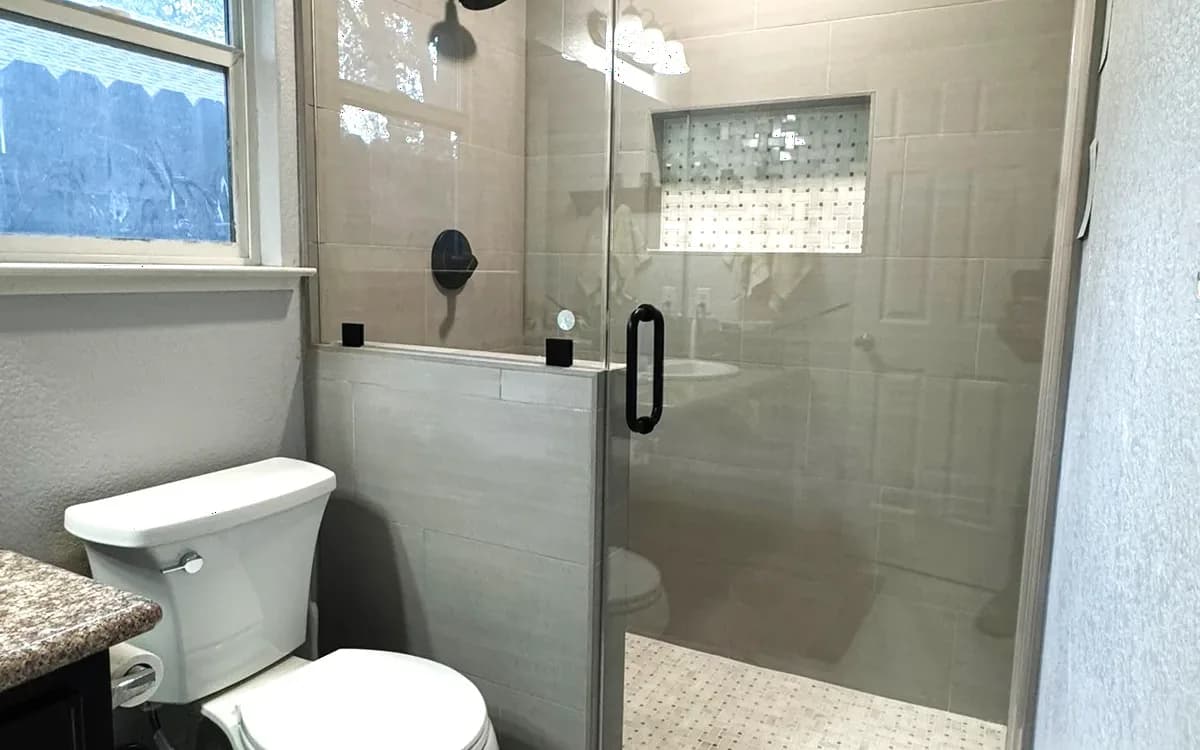
Pictured: a real Loomis project. See the full before & after
Modern farmhouse design hit peak saturation around 2020. Every other bathroom remodel featured the same predictable formula: subway tile on every wall, shiplap on at least one, a galvanized barn-light pendant, sliding barn door, and white shaker cabinets. The formula worked when it arrived in 2014 and the formula now reads as paint-by-numbers. The good news: modern farmhouse as an aesthetic is alive and well. It just needs to be done without the predictable building blocks that defined the last cycle.
These fifteen ideas are the moves we use across Sacramento-region modern farmhouse remodels — Loomis, Auburn foothills, rural Sacramento County, Vacaville, and pockets of Folsom and Granite Bay where the architecture supports the style. Each idea pushes past the 2018-era farmhouse formula while keeping the aesthetic recognizable. For deep-cuts farmhouse references see our companion guide on Loomis modern farmhouse bathroom remodels and our master bathroom remodel service.
How modern farmhouse has evolved past the 2018 formula
The 2018 farmhouse formula was easy to execute and therefore got executed everywhere. 2026 modern farmhouse is harder to do because it requires actual curation rather than checking boxes on a Pinterest list. The style now favors three things over the old formula: mixed materials (no single material covers more than 50 percent of any visible surface), vintage or vintage-feel accents (a piece that looks like it has lived elsewhere before arriving), and disciplined hardware (one or two finishes maximum, never the three-finish kitchen-meets- bath mixing that defined the previous cycle).
1. Black window-pane shower glass
Window-pane glass is frameless shower glass with thin black metal mullions overlaid in a grid pattern — the look of an old industrial window applied to a modern shower enclosure. The grid pattern provides a visual rhythm that the standard frameless shower lacks and introduces the matte black hardware finish that modern farmhouse uses for punctuation.
Specify 3/8 or 1/2-inch tempered glass with a matte black powder-coat finish on the mullion strips. The strips can be applied to the inside or outside face of the glass; outside-face installation reads more architectural and is easier to clean.
2. Soaking tub on a reclaimed wood plinth
Setting a freestanding tub directly on the tile floor is the standard installation. Setting the same tub on a low reclaimed-wood plinth (4 to 6 inches tall, finished in penetrating oil) creates a furniture-like relationship between tub and floor — the tub looks like a chosen piece sitting on a wooden hearth rather than a fixture installed in a corner.
The plinth needs proper waterproofing underneath (Schluter Kerdi membrane between subfloor and plinth) and around the tub drain. The wood itself needs marine- grade penetrating oil or two-component water-based polyurethane to handle ambient bathroom humidity.
3. Vintage dresser-to-vanity conversion
The single most resilient modern farmhouse move is converting an antique dresser into a vanity. The piece arrives in the bathroom with three decades of patina already established. No off-the-shelf vanity looks this lived-in. The conversion process: source a solid wood dresser at 32 to 48 inches wide (Sacramento has excellent antique shops; the Galt Antique Faire is a seasonal source), cut the top for a drop-in or undermount sink, notch the top drawer face for plumbing, and seal the wood with marine-grade oil.
Common pitfall: choosing a dresser that is too tall (38 inches or more) makes the vanity uncomfortable to use. Look for dressers in the 30 to 34-inch height range, which after the conversion drops to a 32 to 34-inch counter height — close to standard.
4. Penny round vintage floor tile
Penny round tile (3/4-inch round ceramic dots in a field of grout) was the dominant residential bathroom floor tile from 1900 through 1940. Reissuing the same pattern in modern bathrooms creates an instant period-correct vintage feel that subway tile cannot match — subway tile reads as 1920s mass production; penny round reads as turn-of-the-century craft.
Specify in standard white or a vintage color (cream, soft blue, pale green) with sanded grout in a slightly darker complementary tone. Sacramento-region tile suppliers stock penny round in mesh-backed sheets that install at standard porcelain tile pace.
5. Apron-front vessel sink
Apron-front sinks dominate modern farmhouse kitchen design but rarely appear in bathrooms. A small apron- front vessel sink (16 to 22 inches wide, white fireclay) sitting on a wood vanity creates a deliberate kitchen-to-bath aesthetic continuity that larger homes can amplify. The vessel-style elevation of the sink also makes the apron-front detail visible from across the room.
Pair with a tall single-hole faucet (8 to 10-inch spout height) and a wall-mount towel ring rather than a bar — the vessel install changes the proportional relationship between counter and faucet.
6. Iron hardware in black or rust
Cast-iron and wrought-iron hardware in matte black or intentionally rusted finishes carry farmhouse authenticity in a way that polished metals cannot. Specify cabinet pulls and knobs in cast iron (Anvil Marketing Iron Works, Cleveland Vintage Lighting), not polished black-finished steel which reads as contemporary rather than farmhouse.
For the rust-finish option, the most authentic source is sandblasted-and-sealed steel — actually rusted, sealed with a clear matte coating to stop additional corrosion. The finish reads as honest rather than faked.

7. Modernized bead-board wainscot
Bead-board wainscot is more authentic to American farmhouse architecture than shiplap — shiplap was primarily an exterior siding material. Specify bead-board in 1-1/2-inch board widths (period- correct), paint in semi-gloss off-white, and run the wainscot to 36 inches off the floor with a 1x4 cap rail and a 1x2 base molding. Wider 3-inch board widths read as more modern; narrower widths read as more traditional.
8. Open wood shelving for towel storage
Replace closed cabinet storage with open wood shelves above the toilet or in a recessed niche. Stack folded white towels — the visible white-on-warm-wood is a farmhouse signature. Specify reclaimed wood or new white oak with iron brackets, installed at 60 to 78 inches off the floor.
9. Cedar plank ceiling
A cedar plank ceiling instantly elevates a bathroom from generic to deliberate. Western red cedar is naturally moisture-resistant, lightweight, and the warm tone establishes the farmhouse palette overhead in a way that painted ceilings cannot. Run planks perpendicular to the room's long axis for visual width.
10. Round wood-framed mirror
A round wood-framed mirror over a rectangular vanity creates the geometric tension that modern farmhouse plays well. Specify natural-finished oak or walnut frame, 30 to 40 inches in diameter. Avoid painted frames (they erase the wood signal) and avoid metal framing (which moves the style toward industrial).
11. Cast-iron tub with skirt
Modern farmhouse accommodates skirted-front cast iron tubs (Kohler Tea-for-Two, Sunrise Specialty) better than minimalist styles. The exterior of the tub is finished as a furniture piece — wood, paneled, or high-gloss painted — rather than the bare cast iron of a traditional claw-foot tub. The skirt grounds the tub into the floor visually.
12. Brass pull-down cabinet hardware
Unlacquered brass pulls in long bin-style or simple pull-down shapes complement matte black plumbing fixtures. The combination of matte black faucets and unlacquered brass cabinet hardware is the dominant finish mix in 2026 modern farmhouse. Unlacquered brass darkens with use — that aging is intentional and part of the look.
13. Stoneware vessel soaking tub
For master baths committed to soaking-tub centrality, stoneware tubs from manufacturers like Aquatica and Native Trails read as artisanal pottery rather than standard plumbing. The material has visible texture, occasional inclusion patterns, and a hand-crafted quality that fiberglass or acrylic tubs cannot match.
14. Reclaimed wood accent wall
Replace the predictable shiplap accent wall with actual reclaimed wood — barn wood, demolition lumber, or salvaged shipping crates. The visible nail holes, weathered patina, and varied widths produce a wall that reads as story rather than treatment. Apply only to non-wet walls.
15. Industrial pendant lighting over the vanity
Pendant lighting over the vanity rather than vanity- mounted sconces — single pendant for narrow vanity, cluster of three for double vanity. Specify in matte black with milk glass shades or schoolhouse style fixtures. Avoid the predictable galvanized barn-light pendant which has reached saturation. For broader lighting strategy see lighting a master bath like a pro.
Editing: how to use these together
The trap with modern farmhouse is over-execution. Pick five to seven of these fifteen ideas rather than trying to include every one. The strongest modern farmhouse bathrooms we have completed in 2026 use roughly: one statement floor (penny round or reclaimed wood plinth), one wood detail (vanity conversion or open shelving), one ceiling treatment (cedar or beam), one hardware finish family (iron and brass), and one piece of vintage furniture. The remainder of the room is restrained.
Color palette: anchor with warm white walls (Benjamin Moore White Dove OC-17 is our most-installed), natural wood, and one accent paint color in soft sage, faded denim, or pale yellow on the vanity only. Avoid black walls — they read industrial. Avoid bright colors — they read country, not modern. For fixture coordination see our companion guide on best bathroom faucets.
Designing a modern farmhouse bathroom for your home
Oakwood Remodeling Group designs and builds modern farmhouse bathrooms across Loomis, Auburn, rural Sacramento County, and other foothill and rural Sacramento communities. We will help curate the vintage and reclaimed pieces, coordinate custom millwork, and deliver a bathroom that reads as lived-in rather than catalog-imitation. Every remodel includes our 3-year workmanship warranty.
Frequently asked questions
Related Reading
Loomis Modern Farmhouse Bathroom Remodels
Region-specific modern farmhouse case studies.
12 Japandi Bathroom Ideas
Companion style guide for the minimalist alternative.
Master Bathroom Remodel Services
Full master bathroom remodels with custom millwork.
Lighting a Master Bath Like a Pro
Layered lighting strategy for primary bathrooms.
12 Best Bathroom Faucets of 2026
Matte black and brass fixture specification.
Get Your Free Estimate
Schedule your consultation today


Get a Free Estimate
Call us at (916) 907-8782 or fill out our contact form.