Roseville Bathroom Ventilation: Preventing Mold in Sacramento Valley Homes
Sacramento Valley heat, tule fog, and hard water create the perfect storm for bathroom mold. Here is how proper ventilation stops it before it starts.
Looking for bathroom remodeling in Roseville? View our Roseville service area page →
Table of Contents
- 1. Why Roseville Bathrooms Are Vulnerable to Mold
- 2. Sacramento Valley Climate and Bathroom Moisture
- 3. Signs Your Bathroom Ventilation Is Failing
- 4. Fan Sizing: CFM Requirements for Roseville Bathrooms
- 5. Humidity-Sensing Technology and Smart Controls
- 6. Duct Routing: Where Most Installations Go Wrong
- 7. Exhaust Fan Selection for Northern California
- 8. Mold Behind the Walls: What We Find During Remodels
- 9. Ventilation and Waterproofing Work Together
- 10. California Code Requirements for Bathroom Ventilation
- 11. Cost and ROI of Proper Ventilation
- 12. Common Ventilation Mistakes in Roseville Homes
- 13. Frequently Asked Questions
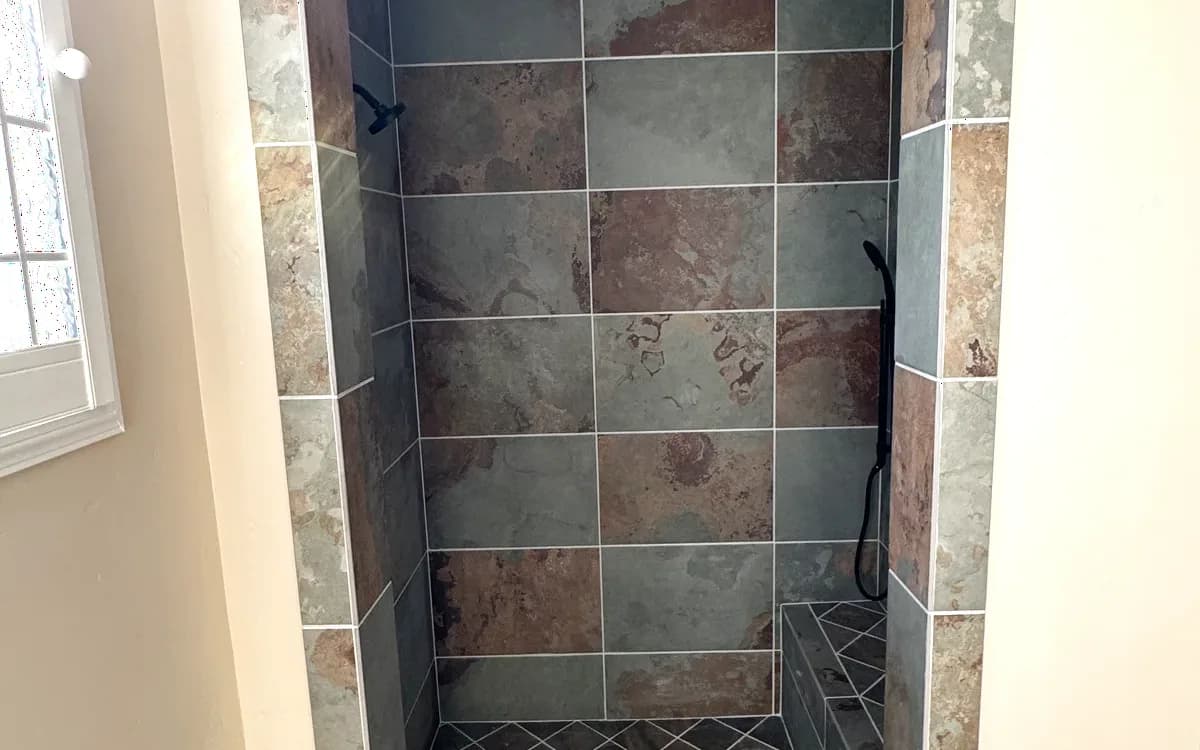
Pictured: a real Oakwood project in Elk Grove. See the full before & after
Why Roseville Bathrooms Are Vulnerable to Mold
Roseville sits in the heart of the Sacramento Valley, where geography and climate conspire to create one of the more challenging environments for bathroom moisture management in Northern California. The city's location between the Sierra Nevada foothills and the Sacramento River delta means homeowners deal with temperature extremes — triple-digit summers that drive up indoor humidity when air conditioning runs constantly, and cool, foggy winters that trap moisture inside wall cavities for weeks at a time.
Most Roseville homes were built during the city's rapid growth periods in the 1980s through 2000s. Production builders installed the minimum ventilation required by code at the time — typically a 50 CFM exhaust fan with flexible vinyl ductwork vented into the attic. These systems were undersized when they were new, and after 20 to 40 years of service, many have failed entirely. The result is bathrooms where moisture has no effective exit path, and mold finds the ideal conditions to thrive.
As Roseville's bathroom remodeling specialists, we have seen the consequences of inadequate ventilation in hundreds of local homes. This guide explains why Roseville bathrooms are particularly vulnerable, how to size and install ventilation correctly, and what proper airflow means for the longevity of your remodel. For a broader look at ventilation across the region, see our Northern California ventilation guide.
Sacramento Valley Climate and Bathroom Moisture
Understanding why Roseville bathrooms develop mold requires understanding the Sacramento Valley's unique climate patterns. The valley experiences a Mediterranean climate with distinct wet and dry seasons, but the specifics matter for bathroom design.
Summer Conditions (June through September)
Roseville averages 40 to 50 days per year above 100 degrees Fahrenheit. Outdoor relative humidity drops to 10 to 20 percent on hot afternoons, but indoor humidity tells a different story. Air-conditioned homes maintain 68 to 74 degrees — and when a hot shower generates steam in a 72-degree bathroom, the moisture has nowhere to go if the exhaust fan is undersized or ducted into a 140-degree attic. The temperature differential between the attic and the conditioned space creates condensation on duct surfaces, which drips back into the ceiling cavity.
Winter Conditions (November through February)
Sacramento Valley winters bring tule fog — dense, ground-level fog that can persist for days or weeks. Outdoor humidity during fog events often exceeds 90 percent, which means bathroom exhaust fans are pushing moist indoor air into already-saturated outdoor air. Drying times slow dramatically. Bathroom surfaces that would dry in 30 minutes during summer may stay damp for hours during winter fog events. This prolonged moisture exposure is when mold colonization typically begins.
Hard Water Compounds the Problem
Roseville receives water from the city's surface water treatment plant and supplemental groundwater. The mineral content varies by season but generally ranges from moderate to hard (120 to 200+ ppm). Hard water leaves mineral deposits on shower surfaces that create a rough, porous texture — providing additional surface area for mold spores to attach and colonize. Mineral buildup in grout lines accelerates grout deterioration, creating micro-channels where moisture penetrates deeper into the wall assembly. For more on moisture-related issues, read about hidden leak signs in Roseville showers.
Signs Your Bathroom Ventilation Is Failing
Many Roseville homeowners live with failing ventilation for years without recognizing the symptoms. Here are the warning signs that your bathroom exhaust system is not doing its job:
- Mirror fog that persists more than 15 minutes: After a standard shower, a properly ventilated bathroom should clear condensation from mirrors within 10 to 15 minutes. If fog lingers for 30 minutes or more, the exhaust rate is insufficient.
- Ceiling paint peeling or bubbling: Moisture trapped above the paint film causes loss of adhesion. This is most common directly above the shower and around the exhaust fan housing.
- Musty odor that returns after cleaning: A persistent smell despite regular cleaning indicates mold growth in locations you cannot see — inside wall cavities, behind tile, or in the ceiling above the shower.
- Dark spots on grout lines or caulk: Mold that grows on grout and silicone caulk is a visible indicator of elevated surface moisture. The mold you see on the surface is a fraction of what exists behind it.
- Fan runs but moves little air: Hold a single sheet of toilet paper near the fan grille while it runs. If the paper is not pulled firmly against the grille, the fan motor may be failing, the duct may be disconnected, or the duct may be clogged with lint and debris.
- Loud fan operation: Original 1990s exhaust fans typically operate at 3 to 5 sones — comparable to normal conversation volume. A fan that has become even louder than its original level usually has a failing motor bearing, which means reduced airflow despite the noise.
Fan Sizing: CFM Requirements for Roseville Bathrooms
The Home Ventilating Institute (HVI) publishes the industry standard for bathroom exhaust fan sizing. The baseline formula is straightforward: 1 CFM per square foot of bathroom floor area, with a minimum of 50 CFM for any bathroom.
However, the baseline formula assumes standard conditions. Roseville's climate and typical home construction call for adjustments:
| Bathroom Type | Floor Area | Minimum CFM | Recommended CFM |
|---|---|---|---|
| Powder room | 15 – 25 sq ft | 50 CFM | 50 – 70 CFM |
| Hall bathroom | 40 – 55 sq ft | 50 CFM | 70 – 90 CFM |
| Master bathroom | 80 – 120 sq ft | 80 CFM | 110 – 150 CFM |
| Master with separate shower room | 120+ sq ft | 100 CFM | 150+ CFM (or dual fans) |
The recommended column accounts for Roseville's climate factors, typical duct run lengths in local construction (often 8 to 15 feet to reach the roof), and the static pressure loss from elbows and transitions. A fan rated at 110 CFM at 0.1 inches of static pressure may only deliver 70 to 80 CFM through a 12-foot duct run with two elbows. Always size based on delivered airflow at the actual installed static pressure, not the fan's maximum rating.
The American Society of Heating, Refrigerating, and Air-Conditioning Engineers (ASHRAE) Standard 62.2 provides additional ventilation guidelines for residential buildings, including continuous and intermittent ventilation rates that apply to whole-house and bathroom-specific ventilation strategies. For a similar discussion tailored to foothills communities, see our Newcastle bathroom ventilation guide.
Humidity-Sensing Technology and Smart Controls
The single most effective upgrade for bathroom ventilation in Roseville homes is a humidity-sensing exhaust fan. These fans contain a built-in hygrometer that monitors relative humidity in real time and activates the fan automatically when moisture levels rise above a configurable threshold — typically 60 to 70 percent relative humidity.
Panasonic WhisperGreen Select fans are our standard specification for Roseville bathroom remodels. These fans offer several features that matter in Sacramento Valley conditions:
- SmartFlow technology: Automatically adjusts motor speed to compensate for duct length and static pressure, ensuring the rated CFM is actually delivered at the exhaust point.
- Pick-A-Flow selector: Allows the installer to set the fan to 50, 80, or 110 CFM at the unit, matching airflow to bathroom size without needing different fan models.
- Condensation sensor: Detects moisture on the sensor surface (not just ambient humidity) and activates immediately when condensation begins forming — faster than a standard humidity sensor.
- Ultra-quiet operation: 0.3 sones at the lowest speed setting. For comparison, a refrigerator hum is about 1.0 sone. The original exhaust fans in most Roseville homes operate at 3 to 5 sones.
- ENERGY STAR certified: Meets Title 24 requirements for California energy compliance, which is mandatory for permitted bathroom remodels.
The advantage of automated sensing over manual switches or timers is consistency. Manual systems depend on the homeowner remembering to turn the fan on before showering and leaving it on for 20 to 30 minutes afterward. In practice, most people forget — especially when rushing in the morning. A humidity sensor eliminates the human variable entirely.
Duct Routing: Where Most Installations Go Wrong
A properly sized fan connected to poorly routed ductwork delivers a fraction of its rated airflow. During Roseville bathroom remodels, we frequently find ductwork problems that render the exhaust system nearly useless:
Attic Termination (The Most Common Failure)
In many Roseville homes built during the 1980s and 1990s, the bathroom exhaust duct simply ends in the attic — no roof cap, no exterior termination. The moist air dumps directly into the attic space, where it condenses on the underside of the roof sheathing during cooler periods. Over years, this creates wood rot, staining on ceiling drywall below, and mold growth on roof framing. California Building Code requires all exhaust ducts to terminate outside the building envelope.
Flexible Vinyl Duct Problems
Flexible vinyl duct (the white corrugated type) was the standard in production home construction for decades. It sags between supports, creating low points where condensation collects. In Roseville's hot attics, the vinyl degrades over time, developing cracks and disconnections at joints. The ribbed interior surface creates turbulence that reduces airflow by 20 to 30 percent compared to smooth rigid duct.
Proper Duct Routing Standards
Every bathroom ventilation installation we complete in Roseville follows these standards: 4-inch or 6-inch rigid galvanized steel duct (or semi-rigid aluminum) with a minimum of R-6 insulation wrap to prevent condensation. The duct runs as directly as possible to the roof with no more than two 90-degree elbows. A quality roof cap with a backdraft damper prevents outdoor air, insects, and rain from entering the duct when the fan is off. Duct joints are sealed with foil tape — never screws, which create condensation collection points inside the duct.
Exhaust Fan Selection for Northern California
Not all exhaust fans are created equal. The price difference between a $30 builder-grade fan and a $200 professional-grade unit is insignificant relative to the cost of a bathroom remodel — but the performance difference is enormous. Here is what to look for:
- HVI-certified airflow rating: The HVI Certified Products Directory lists independently tested airflow and sound ratings. Never rely on manufacturer claims that are not HVI-certified — uncertified fans routinely overstate airflow by 20 to 40 percent.
- Sound rating under 1.0 sone: Quiet fans get used more often. If a fan is loud enough to be annoying, homeowners turn it off before it finishes the job. Modern fans in the 0.3 to 0.7 sone range are barely audible.
- ENERGY STAR certification: Required by Title 24 for permitted work in California. ENERGY STAR fans use 60 percent less energy than standard models while delivering equal or better airflow.
- Brushless DC motor: Longer lifespan (typically 30,000+ hours vs. 10,000 hours for shaded-pole motors), lower energy consumption, and more consistent airflow as the motor ages.
- Built-in LED lighting: Many modern exhaust fans include integrated LED light modules, which eliminates the need for a separate shower light fixture and simplifies electrical routing.
For bathroom remodeling projects in Roseville, we standardize on Panasonic WhisperGreen Select and WhisperCeiling DC series because they consistently deliver rated airflow at real-world static pressures, include humidity sensing as a module option, and carry a manufacturer warranty that covers residential installations.
Mold Behind the Walls: What We Find During Remodels
When we open up bathroom walls in Roseville homes during remodels, the connection between poor ventilation and mold growth becomes unmistakable. Here is what we typically find:
In bathrooms with undersized or non-functioning exhaust fans, moisture migrates through grout lines and behind tile into the wall cavity. On the back side of greenboard or paper-faced drywall, we find dark mold colonies — sometimes covering entire wall sections. The paper facing on standard drywall is an ideal food source for mold once moisture reaches it. In severe cases, the bottom plate and lower studs show wood rot that compromises the structural framing.
Ceiling cavities above showers are another common trouble zone. Moisture from inadequately vented showers rises into the ceiling, condenses on the drywall back or on HVAC ductwork in the ceiling cavity, and creates a persistently damp environment. We have removed ceiling drywall in Roseville homes and found mold growth across the entire surface that was completely invisible from below — the only clue was a faint musty smell.
This is why every bathroom remodel we complete includes a ventilation assessment and upgrade as part of the scope — not as an optional add-on. Putting new tile over old mold conditions, or installing beautiful fixtures without addressing the ventilation deficiency that caused the damage, means the same problems will return within a few years.
Ventilation and Waterproofing Work Together
Proper bathroom moisture management requires two complementary systems: waterproofing that prevents liquid water from reaching the wall cavity, and ventilation that removes water vapor from the air before it can condense on cooler surfaces.
Modern waterproofing membranes — whether sheet-applied systems like Schluter Kerdi or liquid-applied products like RedGard — create a continuous vapor barrier behind the tile surface. But these membranes address liquid water and direct splash. They do not eliminate the need for ventilation because they do not address airborne moisture. A sealed shower still generates steam that fills the bathroom, condenses on non-waterproofed surfaces (mirrors, ceiling, vanity, toilet tank), and migrates into wall and ceiling cavities through gaps around light fixtures, exhaust fan housings, and electrical boxes.
The strongest mold prevention strategy combines a complete waterproofing membrane system with a properly sized, humidity-sensing exhaust fan ducted to the exterior. Neither system alone is sufficient in Roseville's climate. Together, they create a bathroom environment where mold simply cannot establish — because neither liquid water nor persistent airborne moisture reaches the surfaces mold needs to grow.
California Code Requirements for Bathroom Ventilation
Any permitted bathroom remodel in Roseville must comply with current California Building Code ventilation requirements. Here is what the code requires:
- Mechanical exhaust required: All bathrooms must have mechanical exhaust ventilation. An operable window alone does not satisfy the requirement for permitted remodel work.
- Exterior termination: All exhaust ducts must terminate outside the building envelope. Termination into an attic, soffit, crawl space, or garage is a code violation.
- ENERGY STAR certification: Title 24 (California Energy Code) requires bathroom exhaust fans to be ENERGY STAR certified for all new construction and permitted remodel work.
- Sound level limits: For fans designed for continuous operation, the sound rating must not exceed 1.0 sone. Intermittent-use fans have a 3.0 sone maximum, but we install fans well below this threshold for livability.
- Airflow rating: Fans must be HVI-certified at the airflow rate specified on the permit application. The installer must verify rated airflow is achievable with the actual duct routing.
The City of Roseville Building Department enforces these requirements during the rough and final inspections. We handle the complete permit process for every bathroom remodel, including ventilation specifications on the permit application and ensuring the installation passes inspection the first time.
Cost and ROI of Proper Ventilation
Here are realistic costs for bathroom ventilation upgrades in Roseville, based on our actual project experience:
| Ventilation Upgrade | Cost Range |
|---|---|
| Fan replacement only (existing ductwork) | $350 – $600 |
| Fan + new rigid ductwork + roof cap | $600 – $1,200 |
| Humidity-sensing fan + ductwork + roof termination | $800 – $1,500 |
| Dual-fan system for large master bath | $1,200 – $2,200 |
| Ventilation as part of full bathroom remodel | $400 – $800 (incremental) |
Compare these costs to the alternative: professional mold remediation in a Roseville bathroom typically costs $2,000 to $6,000, and that does not include the cost of repairing or replacing the damaged tile, drywall, and framing that the mold compromised. A $1,000 ventilation upgrade that prevents a $5,000+ mold remediation job delivers a return that no other bathroom component can match.
Additionally, most tile, grout, and waterproofing manufacturers require adequate ventilation as a warranty condition. Skipping the ventilation upgrade to save $800 can void warranties worth thousands of dollars in material coverage.
Common Ventilation Mistakes in Roseville Homes
Over the years of remodeling bathrooms across Roseville, we have documented the same ventilation mistakes repeatedly. Knowing what to avoid is just as important as knowing what to install:
- Relying on a window instead of a fan: An operable window provides some air exchange, but it depends on wind direction, outdoor temperature, and whether the homeowner actually opens it. During Roseville's winter fog or summer heat, opening a window is impractical. Mechanical exhaust is the only reliable solution.
- Installing a fan without verifying duct condition: Replacing a fan while leaving the old flexible vinyl duct in place is a common shortcut. The new fan may be rated at 110 CFM, but if it connects to a sagging, partially collapsed 15-year-old flex duct, actual delivered airflow may be 40 to 60 CFM.
- Oversizing the fan without matching duct diameter: A 150 CFM fan connected to a 4-inch duct creates excessive static pressure and noise. High-CFM fans need 6-inch duct runs to deliver their rated airflow at acceptable sound levels.
- Placing the fan too far from the moisture source: The exhaust fan should be positioned directly above or adjacent to the shower — the primary moisture source. A fan on the opposite side of the bathroom captures ambient moisture but misses the concentrated steam plume from the shower.
- Using a timer instead of a humidity sensor: Timers require the homeowner to estimate how long the fan should run. Too short leaves moisture in the air; too long wastes energy. Humidity sensors eliminate the guesswork by responding to actual conditions in real time.
Frequently Asked Questions
Protect Your Roseville Bathroom Investment
Oakwood Remodeling Group includes properly sized, humidity-sensing ventilation in every Roseville bathroom remodel. We do not cut corners on airflow because cutting corners on ventilation means mold — and mold means redoing the work. Every project includes a detailed ventilation plan, proper duct routing, and a system that keeps your bathroom dry for decades.
Related Reading
Northern California Bathroom Ventilation Guide
Region-wide ventilation and mold prevention strategies.
Newcastle Bathroom Ventilation & Mold Prevention
Ventilation solutions for foothills homes.
Bathroom Remodeling in Roseville, CA
Our full service area page for Roseville homeowners.
Hidden Leak Signs in Roseville Showers
How to spot moisture problems before they spread.
Bathroom Remodeling Services
Our complete bathroom remodeling process and services.
Get Your Free Estimate
Schedule your consultation today

Get a Free Estimate
Call us at (916) 907-8782 or fill out our contact form.