12 Mediterranean Bathroom Ideas with Tile, Plaster & Warmth
Twelve Mediterranean bathroom design moves that bring the warmth of Spanish, Italian, and Moroccan architectural traditions to Sacramento-region homes — Tadelakt plaster, terra cotta tile, arched niches, hand-painted talavera, wrought iron, and brass detail.
Looking for bathroom remodeling in El Dorado Hills? View our El Dorado Hills service area page →
In This Guide
- Why Mediterranean works in Sacramento-region homes
- 1. Tadelakt or Venetian plaster walls
- 2. Terra cotta hexagon floor tile
- 3. Arched doorways and wall niches
- 4. Hand-painted talavera backsplash
- 5. Wrought-iron mirror frame
- 6. Heavy wood vanity with visible joinery
- 7. Brass cup pulls and round knobs
- 8. Hand-hammered brass pendants
- 9. Limestone apron-front vessel sink
- 10. Hand-cast stone soaking tub
- 11. Exposed wood beam ceiling
- 12. Geometric star-pattern mosaic floor
- Color palette and material specifications
- Frequently asked questions
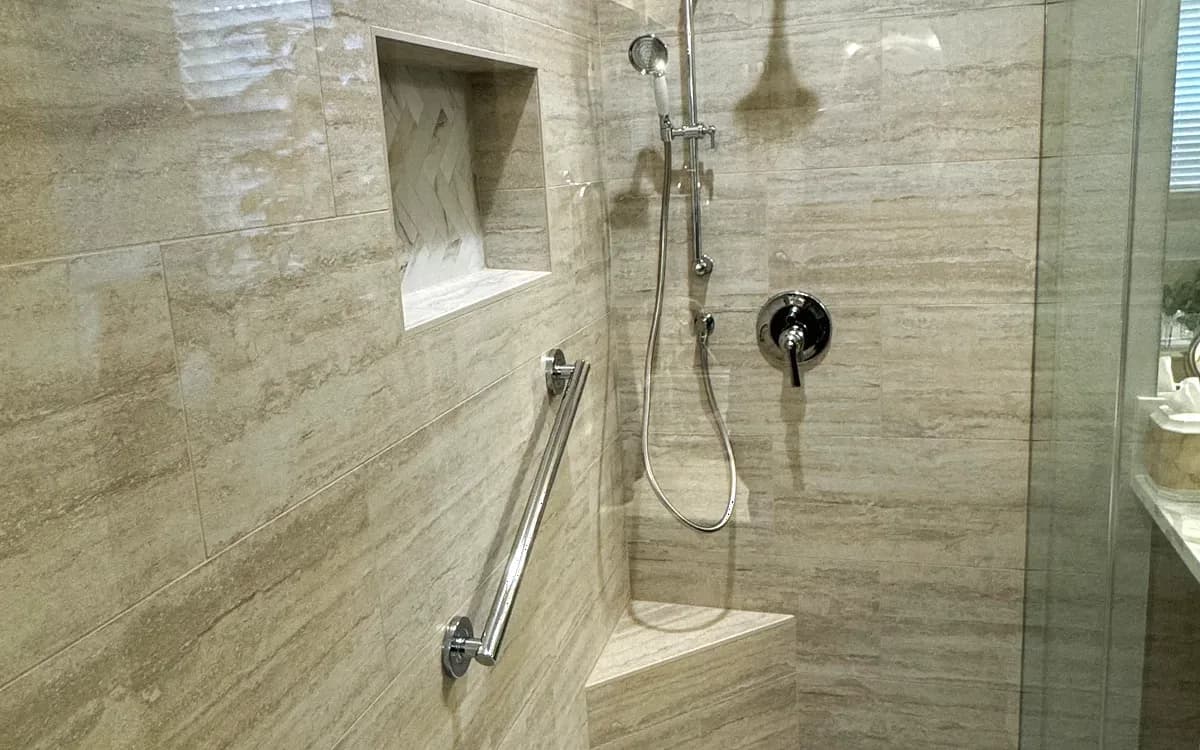
Pictured: a real El Dorado Hills project. See the full before & after
Mediterranean design is the bathroom style that turns water and warmth into architecture. Spanish, Italian, Moroccan, and southern French bathing traditions all converge on the same material vocabulary: lime-based plaster walls (cooler in summer, warmer in winter), terra cotta floors (radiant in foot-feel), hand-painted decorative tile (the indulgence that survives every style cycle), and brass or wrought iron hardware that deepens with age. The result is a bathroom that feels Mediterranean because it borrows the same climate response the original Mediterranean did.
Sacramento Valley summers and mild winters mirror the Mediterranean climate closely enough that these materials behave in California much as they do in Andalusia or Tuscany. These twelve ideas are tuned for Sacramento-region homes with existing Mediterranean, Spanish revival, or California ranch architecture where the style can be applied without fighting the surrounding house. For broader style strategy see our master bathroom remodel service and our companion guide on Japandi bathroom ideas for the minimalist alternative.
Why Mediterranean works in Sacramento-region homes
The Sacramento Valley climate matches the Mediterranean climate more closely than most other regions of the United States. Both feature warm summers, mild winters, low humidity, and a similar light quality. Materials developed for Mediterranean homes — lime plaster, terra cotta tile, hand-thrown clay basins, brass fixtures — perform exceptionally well in Sacramento Valley climates because they were originally developed for the same conditions.
The architectural fit is also strong. Many Sacramento- region homes from the 1920s through 1970s carry Mediterranean or Spanish revival exterior details — red tile roofs, stucco walls, arched windows, exposed wood beams. Bringing Mediterranean interior design into a Mediterranean-exterior home produces total architectural coherence in a way that most style choices cannot. El Dorado Hills, Granite Bay, Folsom, and Loomis have particularly strong Mediterranean architectural stock to work with.
1. Tadelakt or Venetian plaster walls
Tadelakt is the traditional Moroccan lime plaster technique — multiple thin coats of lime plaster pigmented and polished with smooth stones, then sealed with olive oil soap. The result is a continuous waterproof wall surface with subtle color variation and visible trowel marks. Moroccan hammams (steam baths) have used Tadelakt for over 1,000 years. Venetian plaster uses similar lime-based chemistry with marble dust additives, polished to higher gloss.
Specify Tadelakt on shower walls (waterproof when properly executed) and the wall behind the freestanding tub. Color choices that work: warm cream, soft ochre, pale terra cotta. Installation requires skilled artisans — Sacramento has a small group of plasterers trained in traditional Tadelakt and Venetian plaster technique. Plan $25 to $45 per square foot installed.
2. Terra cotta hexagon floor tile
Terra cotta hexagon tile, ideally hand-cast Saltillo or Spanish-imported terra cotta, anchors Mediterranean bathroom floors with the warm clay tone that no other floor material delivers. 8-inch hexagons are the classic dimension; 6-inch reads more cottage and 12-inch reads more contemporary. Specify with sand-color or warm-gray grout (not white, which fights the warm clay tone).
Terra cotta requires sealing every 2 to 3 years to prevent water absorption and staining. The maintenance is part of the aesthetic — the patina that develops over time is part of what makes Mediterranean bathrooms feel lived-in rather than catalog-new.
3. Arched doorways and wall niches
The arch is the defining geometric element of Mediterranean architecture. In bathrooms, arches appear in doorways (entry to the bath, doorway between vanity area and tub zone in larger primary baths) and in wall niches (above the vanity for towel display, inside the shower for product storage). Arch profile: classical semicircular (Romanesque) reads as more traditional Italian; segmented or pointed (Moorish) reads as more Spanish revival or Moroccan.
4. Hand-painted talavera backsplash
Talavera tile is the Spanish and Mexican hand-painted ceramic tradition. Each tile is hand-painted with geometric or floral patterns in cobalt blue, deep green, yellow, or terra cotta on a cream base. Use as a backsplash strip above the vanity (6 to 12 inches tall), in an accent inset within a larger plain tile field, or as a feature wall behind the freestanding tub. Avoid using talavera over more than 30 percent of any visible wall — the pattern is intentionally busy and needs negative space to balance.
5. Wrought-iron mirror frame
A heavy wrought-iron mirror frame — actual hand-forged iron, not powder-coated steel — provides the gothic- Mediterranean detail that connects the bathroom to the historic Spanish and Moroccan architectural tradition. The frame should be substantial (1-1/2 to 2-1/2-inch iron sections) with visible forge marks. Source from architectural salvage or commission from a local blacksmith — Sacramento has multiple working blacksmiths who produce iron mirror frames.
6. Heavy wood vanity with visible joinery
Solid hardwood vanity in walnut, weathered oak, or chestnut with visible mortise-and-tenon or finger-jointed corners reads as Mediterranean craftsman. The vanity should be substantial — 1-1/4 to 1-1/2-inch panel thickness, deep apron front, raised- panel doors with hand-applied hardware. Avoid shaker cabinets (too contemporary), painted finishes (too modern farmhouse), and slab-front cabinets (too modern). The wood's grain and joinery should be visible as the main decorative element.
7. Brass cup pulls and round knobs
Brass hardware in cup-pull and round-knob forms with unlacquered finish that patinas naturally over time. Avoid polished brass (too contemporary) and bright matte brass (looks fake). Unlacquered brass darkens with age — at year 5 the hardware has a deep chestnut-honey tone that reads as authentic. Source from House of Antique Hardware, Liz's Antique Hardware, or direct-from-manufacturer at Williams- Sonoma or Restoration Hardware.

8. Hand-hammered brass pendant lights
Hand-hammered brass pendant lights with seeded-glass or perforated-brass shades provide the Mediterranean lighting move. The hand-hammered texture catches light irregularly, creating the warm mood-light quality that Mediterranean bathrooms depend on. Specify single pendant over the freestanding tub or a cluster of three over double vanities. Source from Hudson Valley Lighting, Visual Comfort, or direct-from-artisan in the West Sacramento and Auburn metalwork communities.
9. Limestone apron-front vessel sink
A limestone or travertine apron-front vessel sink elevates the entire vanity into Mediterranean territory. The hand-carved stone sink reads as sculpture — the material's natural variation in color and surface texture provides visual richness that ceramic sinks cannot match. Specify with proper waterproofing and sealing; natural stone in vessel form requires more maintenance than ceramic but delivers significantly more design impact.
10. Hand-cast stone soaking tub
Hand-cast stone tubs (Native Trails, Stone Forest, Mansfield) bring sculptural Mediterranean weight to the master bath. The tub is heavy enough to be a permanent architectural element rather than a removable fixture — typical hand-cast stone tubs weigh 600 to 1,200 pounds and require floor structural verification before installation. Specify with floor-mounted tub filler in unlacquered brass.
11. Exposed wood beam ceiling
Reclaimed wood ceiling beams reference the timber-frame construction of historic Mediterranean architecture. For new installation in Sacramento bathrooms, specify reclaimed barn beams or new beams stained to look aged. Two to four beams across a typical 10-foot ceiling width is the right density. Avoid faux-wood foam beams — they read as theatrical rather than architectural.
12. Geometric star-pattern mosaic floor
For master baths committed to full Mediterranean execution, a geometric mosaic floor pattern (8-point star, hex-and-cross, or zellige-style mosaic) creates the floor centerpiece that defines the room. The pattern should run only in a feature area (under the freestanding tub, in the entry foyer of the bath) with simpler floor tile in the remaining 70 percent of the room. Full-floor mosaic reads as overwhelming. For broader tile guidance see our companion guide on best grout types for showers.
Color palette and material specifications
Mediterranean color palette: walls in cream, warm beige, terra cotta cream, pale ochre (Benjamin Moore Manchester Tan HC-81, Benjamin Moore Bleeker Beige HC-80, Sherwin-Williams Macadamia SW 6142). Floor and accent tile in deep terra cotta, warm rust, sand, burnt sienna. Decorative accents in cobalt blue, deep green, mustard yellow used sparingly through tile patterns. The palette references sun-baked plaster and fired clay — anchored in warm undertones.
Hardware: unlacquered brass (primary), wrought iron (accent), copper (occasional). Plumbing: brass or oil-rubbed bronze finish on faucets, showerheads, tub fillers. Lighting: 2700K warm white with hand-hammered brass fixtures. Avoid mixing more than three metal finishes — Mediterranean tolerates more layering than minimal styles but still requires discipline to read as designed rather than eclectic.
Designing a Mediterranean bathroom for your home
Oakwood Remodeling Group designs and builds Mediterranean bathrooms across the Sacramento region for homeowners with Spanish revival, Mediterranean, or California ranch architecture. We coordinate with specialty plasterers, blacksmiths, and stone artisans to deliver authentic Mediterranean craftsmanship rather than catalog-imitation. Every remodel includes our 3-year workmanship warranty.
Frequently asked questions
Related Reading
12 Japandi Bathroom Ideas
Companion guide for the minimalist alternative.
15 Modern Farmhouse Bathroom Ideas
Companion guide for warm rustic American aesthetic.
Master Bathroom Remodel Services
Full master bathroom design and construction.
10 Best Grout Types for Bathroom Showers
Grout selection for terra cotta and mosaic tile.
12 Best Bathroom Faucets of 2026
Brass faucet specification for Mediterranean fixture suites.
Get Your Free Estimate
Schedule your consultation today


Get a Free Estimate
Call us at (916) 907-8782 or fill out our contact form.