Lincoln Tub-to-Shower Conversion: The Most Popular Upgrade
The bathtub you never use is taking up prime real estate in your master bathroom. Here is why Lincoln homeowners are converting tubs to walk-in showers — and exactly how the process works.
Looking for bathroom remodeling in Lincoln? View our Lincoln service area page →
Table of Contents
- 1. Why Tub-to-Shower Is Lincoln's Most Requested Upgrade
- 2. Which Tub Should You Convert?
- 3. Three Types of Tub-to-Shower Conversions
- 4. The Conversion Process Step by Step
- 5. Working with Lincoln's Slab Foundations
- 6. Waterproofing the New Shower
- 7. Design Options for Your New Shower
- 8. Glass Enclosure Choices
- 9. Fixtures, Showerheads, and Controls
- 10. Cost Ranges for Lincoln Conversions
- 11. Resale Impact and Home Value
- 12. Timeline, Permits, and Planning
- 13. Frequently Asked Questions

Why Tub-to-Shower Is Lincoln's Most Requested Upgrade
Walk into a typical Lincoln master bathroom — in Twelve Bridges, Lincoln Crossing, Cresleigh Ranch, or Joiner Ranch — and you will find the same layout: a soaking tub on one side, a separate shower stall on the other, dual vanity, and a toilet compartment. The soaking tub was a selling feature when the home was new. A decade or two later, it is the least-used fixture in the house.
The math is straightforward. Most adults shower daily and bathe rarely — if ever. The soaking tub occupies 15 to 25 square feet of prime bathroom space, gets cleaned but never used, and represents a design priority from the early 2000s that does not reflect how people actually live. Converting that unused tub space to a larger, better-designed walk-in shower is the single most impactful upgrade in a Lincoln master bathroom.
As Lincoln's bathroom remodeling specialists, tub-to-shower conversions account for more than half of our Lincoln projects. This guide covers every aspect of the conversion — from planning through completion — specific to Lincoln homes and their construction. For detailed service information, visit our tub-to-shower conversion service page.
Which Tub Should You Convert?
Not every tub should be converted. The decision depends on which bathroom the tub is in and how many bathrooms your home has:
- Master bathroom soaking tub: Best candidate for conversion. This tub is almost always underutilized, and the master shower benefits most from the additional space. Converting the master tub while keeping the hall bath tub preserves resale value.
- Master bathroom tub-shower combo: Also a strong candidate, especially in smaller Lincoln floor plans where the combo is the only master shower. Converting to a standalone walk-in shower transforms the daily shower experience.
- Hall or guest bathroom tub: Generally should stay. This is the tub families use for bathing children, and it is the tub real estate agents look for during resale. If your home has 3+ bathrooms with 2+ tubs, you have more flexibility.
The rule of thumb: keep at least one bathtub in the home, and it should be in the bathroom most likely used by children — typically the hall bath closest to the secondary bedrooms. This preserves both function and resale value. For more on how tub conversions affect home value, see our post on tub-to-shower conversions and home value.
Three Types of Tub-to-Shower Conversions
Type 1: Same-Footprint Conversion
The bathtub is removed and a walk-in shower is built in the same 30x60-inch footprint. The existing drain location is reused (or only slightly modified), minimizing slab work. The shower gets a mortar bed or foam pan floor, cement board walls with waterproof membrane, custom tile, and a glass enclosure. This is the most cost-effective conversion option at $12,000 to $18,000.
Type 2: Expanded Conversion (Tub Area Absorbed Into Shower)
In master bathrooms with a separate tub and shower, the dividing wall between them is removed and the tub space is absorbed into an expanded shower. The result is a large walk-in shower (often 60x48 to 60x60 inches or larger) with room for a built-in bench, dual showerheads, and generous tile niches. This type requires more slab work for drain relocation and costs $18,000 to $28,000, but delivers the most dramatic transformation.
Type 3: Curbless Conversion
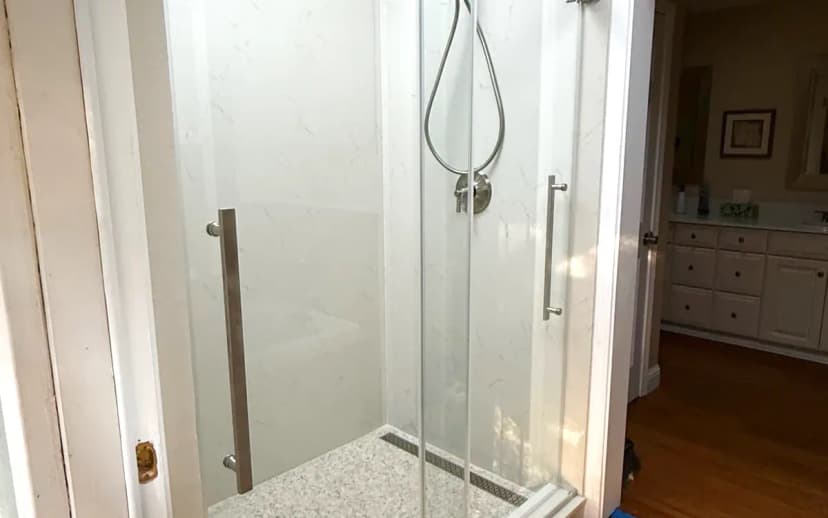
Any of the above conversions can be built as a curbless (barrier-free) shower by channeling the concrete slab to create a gentle slope to a linear drain at the shower entry. Curbless conversions cost $2,000 to $4,000 more than curbed designs due to the slab work and linear drain system, but they provide a contemporary, spa-like aesthetic and full accessibility. This option is particularly popular in Sun City Lincoln Hills and with homeowners planning long-term aging-in-place design. Read our detailed comparison of linear drains vs. center drains for curbless showers.
The Conversion Process Step by Step
Here is exactly what happens during a tub-to-shower conversion in a Lincoln home, from day one to completion:
- Protection and preparation: We protect flooring, walls, and fixtures outside the work area with floor coverings and plastic sheeting. A dust barrier is installed at the bathroom doorway to contain demolition debris.
- Tub demolition: The bathtub, tub surround (tile or fiberglass), and any dividing walls are removed. The tub drain and overflow are disconnected. All debris is hauled out and disposed of.
- Inspection and repair: With the tub area exposed, we inspect the subfloor (slab), framing, plumbing, and any existing waterproofing. Damaged or inadequate framing is repaired or reinforced.
- Plumbing rough-in: The shower drain is installed or relocated, the shower valve and supply lines are positioned, and any additional connections (handheld, body sprays) are roughed in. If slab work is needed, it happens at this stage.
- Shower pan and waterproofing: A mortar bed shower pan (or foam pan for curbless designs) is installed with proper slope to the drain. Cement board goes on the walls. The entire wet area receives a waterproof membrane — Schluter Kerdi or liquid-applied RedGard.
- Tile installation: Shower floor tile (mosaic for slope), wall tile (large-format porcelain), niches, bench surfaces, and any accent details are set, grouted, and sealed.
- Glass and fixtures: The frameless glass panel or enclosure is measured, fabricated (typically 5 to 7 days lead time), and installed. The showerhead, valve trim, and accessories are installed.
- Final details: Caulking, touch-up paint, final cleaning, and walkthrough inspection with the homeowner.
For a broader look at the full remodeling process, see our guide on converting a bathtub to a modern spa in 3 weeks.
Working with Lincoln's Slab Foundations
Lincoln homes sit on concrete slab foundations — either standard slabs or post-tensioned slabs reinforced with steel cables. The slab type affects how drain relocation is handled:
Standard slabs (most Lincoln Crossing and newer communities): Drain relocation involves cutting a trench in the concrete with a concrete saw, rerouting the ABS drain line to the new location with proper slope (1/4 inch per foot minimum), and patching the trench with new concrete. This is straightforward work for experienced contractors and adds $2,000 to $4,000 to the project depending on the distance of the drain move.
Post-tensioned slabs (some Twelve Bridges phases and custom homes): These slabs contain steel cables under tension that cannot be cut. Before any slab work, the cables must be located using ground-penetrating radar (GPR) or x-ray imaging. The trench is then planned to avoid all cables. This adds $500 to $1,200 for the scanning and requires more precise routing. In rare cases, a drain cannot be moved to the desired location because a cable is in the way — in which case we adjust the design to work with the available path.
The most cost-effective approach — regardless of slab type — is to locate the new shower drain at or near the existing tub drain. The tub drain is typically centered at 15 inches from the back wall, which works well for a center drain or can be connected to a linear drain at the shower entry with a short run.
Waterproofing the New Shower
Waterproofing is the most critical element of any tub-to-shower conversion. A bathtub is self-contained — water stays inside the tub. A walk-in shower relies entirely on the waterproof membrane behind the tile to contain water. If the waterproofing fails, water reaches the framing and subfloor, causing mold, rot, and structural damage that is far more expensive to repair than the original conversion cost.
We use two proven waterproofing systems for Lincoln tub-to-shower conversions:
- Schluter Kerdi membrane system: A bonded polyethylene sheet installed over cement board with thin-set mortar. The Kerdi membrane, Kerdi-Band at seams, and Kerdi-Drain at the drain connection create a continuous waterproof envelope. This system is especially well-suited for curbless designs because the membrane integrates with the Kerdi-Line linear drain for a seamless waterproof connection.
- Liquid-applied membrane (RedGard or Laticrete Hydroban): A paint-on membrane applied in two coats over cement board. Reinforcing fabric is embedded at all seams, corners, and transitions. This system is cost-effective and reliable for standard curbed shower configurations. Full cure time is 24 to 48 hours before tile installation begins.
Both systems meet or exceed TCNA and IAPMO waterproofing standards. We flood-test every shower pan before tile installation to verify that the waterproofing is performing correctly — water sits on the membrane for 24 hours, and the drain level is checked to confirm zero leakage.
Design Options for Your New Shower
A tub-to-shower conversion is an opportunity to design the shower you actually want — not the one the builder selected for you. Here are the most popular design features Lincoln homeowners choose:
- Built-in bench: A tiled bench seat (17 to 19 inches high, 15 inches deep) built into the shower wall. Useful for shaving legs, resting while showering, or holding products. The bench is framed, waterproofed, and tiled to match the shower walls.
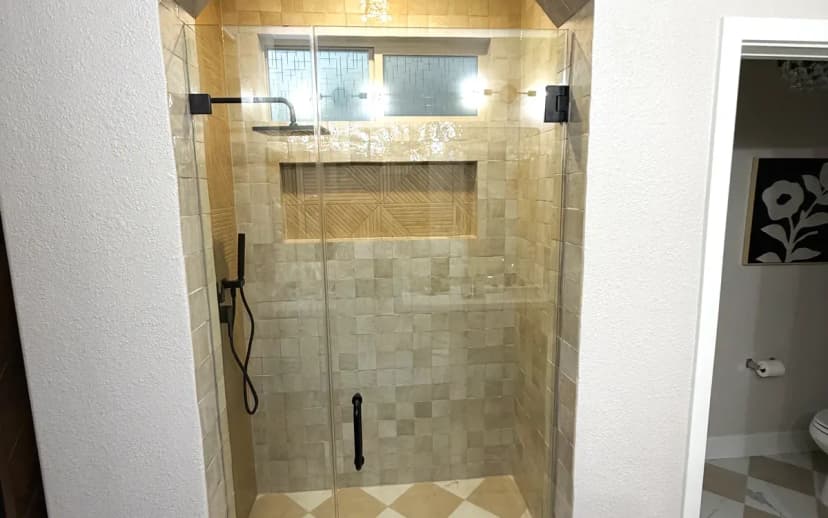
- Tiled niches: Recessed storage niches (typically 12x24 or 12x36 inches) built between studs for shampoo, soap, and supplies. Niches eliminate the need for shower caddies and corner shelves that collect mold and fall down.
- Accent tile: A vertical accent strip, niche liner, or feature wall in a contrasting mosaic or decorative tile adds visual interest without overwhelming the design. Popular choices include linear glass mosaics, marble pencil liners, and hexagonal accents.
- Large-format floor-to-ceiling tile: Extending the same large-format tile from floor to ceiling creates a seamless, spa-like look that makes the shower feel larger. Minimal grout lines mean less maintenance and a cleaner visual.
- Linear drain: A linear drain at the shower entry (instead of a center point drain) allows the shower floor to slope in one direction and accommodates large-format tile on the shower floor without cutting it into small pieces.
Glass Enclosure Choices
The glass enclosure defines the shower visually and practically. Lincoln homeowners have three primary options:
Frameless Glass Panel (Most Popular)
A single fixed panel of 3/8-inch or 1/2-inch tempered glass, typically 30 to 36 inches wide and 72 to 84 inches tall. The panel defines the shower zone and contains most water spray without creating a barrier. One end of the shower remains open for entry. Cost: $800 to $1,500 installed. This is the most popular option in Lincoln conversions because it provides an open, modern aesthetic.
Frameless Glass Enclosure with Door
A full glass enclosure with a hinged or pivot door, typically in 3/8-inch tempered glass with minimal hardware. This option fully contains water within the shower and is necessary for smaller shower footprints where spray would reach the vanity or bathroom floor. Cost: $2,500 to $5,000 installed depending on size and complexity.
Glass Panel with Return
An L-shaped glass configuration with a main panel and a short return panel (12 to 18 inches) that wraps around the shower entry. This provides more water containment than a single panel while maintaining an open feel. Cost: $1,200 to $2,200 installed. A good compromise between the open feel of a single panel and the full containment of an enclosed design.
All glass options are available with protective coatings (like EnduroShield or ShowerGuard) that resist water spots and mineral deposits — a worthwhile upgrade in Lincoln's hard-water environment. The coating adds $150 to $300 and significantly reduces cleaning frequency.
Fixtures, Showerheads, and Controls
The fixtures you choose determine the shower experience. Here are the components of a modern Lincoln shower system:
- Thermostatic shower valve: The upgrade from a standard pressure-balancing valve. A thermostatic valve maintains your set water temperature regardless of pressure changes in the house (flushing a toilet, running the dishwasher). It also allows separate temperature and volume controls — set the temperature once and simply turn the volume on and off.
- Rain showerhead: A large overhead showerhead (8 to 12 inches in diameter) mounted on a ceiling arm or high wall arm. Provides a drenching, rainfall-style water delivery. Most popular in brushed nickel or matte black finishes.
- Handheld showerhead: Mounted on a vertical slide bar on the shower wall. Essential for rinsing, cleaning the shower, and seated use if a bench is present. The slide bar allows height adjustment from seated to standing positions.
- Diverter valve: Allows switching between the rain head and handheld (or operating both simultaneously on high-flow systems). Integrated diverter trims are available from all major brands in matching finishes.
For fixtures, we recommend WaterSense-certified products — especially important in drought-prone Northern California. Modern low-flow showerheads deliver excellent pressure at 2.0 GPM or less, down from the 2.5 GPM standard. The water savings are significant over years of daily use. For more detail on costs, see our tub-to-shower conversion cost guide.
Cost Ranges for Lincoln Conversions
Here are realistic cost ranges for tub-to-shower conversions in Lincoln, based on our 2026 project data:
| Conversion Type | Cost Range | Timeline |
|---|---|---|
| Same-footprint conversion (30x60) | $12,000 – $18,000 | 2 – 3 weeks |
| Expanded conversion (tub + shower combined) | $18,000 – $25,000 | 3 – 4 weeks |
| Expanded with premium tile and fixtures | $22,000 – $28,000 | 3 – 4 weeks |
| Curbless conversion (add to any type above) | + $2,000 – $4,000 | + 2 – 3 days |
These ranges include demolition, plumbing, waterproofing, cement board, tile (material and installation), glass enclosure, fixtures, permits, and disposal. They do not include work outside the shower conversion scope (vanity replacement, floor tile outside the shower, lighting upgrades). Many homeowners combine the tub-to-shower conversion with a full master bathroom remodel — see our tub-to-shower conversion cost guide for detailed breakdowns.
Resale Impact and Home Value
The question every homeowner asks: will removing the bathtub hurt my home's resale value? The answer is nuanced but generally positive.
According to the National Association of Realtors, a walk-in shower in the master bathroom is now a top-requested feature among home buyers. The soaking tub has fallen to a much lower priority, particularly among buyers in the 35 to 65 age range who make up the majority of Lincoln's home-buying market.
The critical factor is maintaining at least one bathtub in the home. Lincoln homes with 2 to 4 bathrooms can easily convert the master tub while keeping the hall bath tub. This configuration — walk-in shower in the master, tub in the hall bath — is what most buyers prefer and what real estate agents recommend.
In the Lincoln market specifically, homes with updated master bathrooms featuring walk-in showers sell faster and closer to asking price than comparable homes with original builder-grade tub-and-shower configurations. The conversion signals to buyers that the home has been thoughtfully maintained and upgraded — which positively influences their perception of the entire property. For detailed resale data, see our post on tub-to-shower conversions and home value.
Timeline, Permits, and Planning
Tub-to-shower conversions in Lincoln require building permits from the City of Lincoln Building Department because they involve plumbing modifications. The permit process for residential bathroom projects in Lincoln typically takes 5 to 10 business days.
Total project timeline from initial consultation to completion:
- Consultation and design (1 week): In-home assessment, design discussion, material selection, and scope finalization.
- Material ordering (1–2 weeks): Tile, fixtures, glass measurements, and specialty items ordered. We do not begin demolition until all materials are on hand or confirmed for delivery.
- Permit processing (1–2 weeks): Plans submitted to the City of Lincoln. This runs concurrently with material ordering.
- Construction (2–4 weeks): Demolition through final walkthrough, depending on conversion type and complexity.
Total elapsed time from consultation to completed shower: 4 to 8 weeks. The master bathroom is only out of service during the construction phase (2 to 4 weeks). We provide a detailed day-by-day schedule before work begins so you know exactly when each trade will be in your home and when the bathroom will be available again.
Frequently Asked Questions
Ready to Convert Your Lincoln Bathtub to a Walk-In Shower?
Oakwood Remodeling Group has completed more tub-to-shower conversions in Lincoln than any other single project type. We know these homes — the slab types, the plumbing configurations, and the designs that work best in Twelve Bridges, Lincoln Crossing, and Sun City Lincoln Hills. Every project includes a detailed scope, fixed pricing, and a timeline you can count on.
Related Reading
Bathroom Remodeling in Lincoln, CA
Our full service area page for Lincoln homeowners.
Tub-to-Shower Conversion Service
Our tub-to-shower conversion service page.
Tub-to-Shower Conversions and Home Value
How conversions affect resale value.
Tub-to-Shower Conversion Cost Guide
Detailed cost breakdown for conversions.
Convert Your Bathtub to a Modern Spa
The full conversion process explained.
Get Your Free Estimate
Schedule your consultation today
Related Articles

Get a Free Estimate
Call us at (916) 907-8782 or fill out our contact form.