Granite Bay Heated Bathroom Floors: Worth the Cost?
Cold tile on a December morning is the one thing every Granite Bay homeowner notices. Radiant heated floors solve it permanently. Here is what the systems cost, how they work, and whether the investment makes sense for your bathroom remodel.
Looking for bathroom remodeling in Granite Bay? View our Granite Bay service area page →
Table of Contents
- 1. Why Granite Bay Homeowners Want Heated Floors
- 2. Electric Radiant Floor Systems Explained
- 3. Hydronic Systems: When They Make Sense
- 4. Best Flooring Materials for Radiant Heat
- 5. Installation Process During a Bathroom Remodel
- 6. Thermostat and Controls
- 7. Energy Costs and Efficiency
- 8. Heated Floors Under Showers
- 9. Cost Breakdown by Bathroom Size
- 10. ROI and Home Value Impact
- 11. Common Concerns and Misconceptions
- 12. The Verdict: Is It Worth It in Granite Bay?
- 13. Frequently Asked Questions

Why Granite Bay Homeowners Want Heated Floors
Granite Bay sits in the Sacramento Valley foothills, where winter mornings regularly drop to the mid-30s and low 40s. Step out of a warm bed onto a stone or tile bathroom floor in December, and the cold shock through bare feet is an unwelcome start to any day. This is not a minor inconvenience — it is the single most common complaint we hear from homeowners during bathroom remodel consultations.
Radiant heated floors solve this problem permanently. A thin electric heating element installed beneath the tile raises the floor surface temperature to a comfortable 80 to 85 degrees Fahrenheit — warm enough to feel genuinely pleasant underfoot but not hot enough to be noticeable through shoes. The system activates before you wake up and shuts off when you leave for the day, operating on a programmable schedule that requires no daily interaction.
In Granite Bay's luxury home market, heated bathroom floors have transitioned from a rare luxury to an expected feature in high-end remodels. Buyers in this price range recognize and value the upgrade — making it both a comfort investment and a resale asset. For more on our luxury remodeling approach, see the Granite Bay luxury bathroom remodel guide.
Electric Radiant Floor Systems Explained
Electric radiant floor heating is the system of choice for bathroom remodels. It uses a thin heating cable — either loose cable or pre-attached to a mesh mat — installed in the thin-set mortar layer directly beneath the tile. When energized, the cable converts electrical energy to heat, warming the mortar bed and the tile above it.
The two most common configurations:
- Heating mats: Pre-spaced heating cable bonded to a fiberglass mesh in standard widths (typically 12, 18, or 24 inches). Mats roll out over the substrate and are embedded in thin-set mortar. Installation is straightforward for rectangular rooms. Leading brands include Schluter Ditra-Heat, Nuheat, and WarmlyYours.
- Loose cable: Individual heating cable that is manually routed and secured to the substrate. Loose cable allows custom spacing and coverage in irregular-shaped rooms, around obstacles, and in tight spaces where pre-made mats do not fit. More labor-intensive to install but more flexible in application.
Both configurations add only 1/8 to 3/16 inch of height to the floor assembly — thin enough that they do not affect door clearances or transitions to adjacent rooms. The heating element is completely embedded in the mortar and tile, with no moving parts and nothing to maintain. Quality systems carry 15 to 25-year manufacturer warranties.
Hydronic Systems: When They Make Sense
Hydronic radiant floor heating circulates heated water through flexible PEX tubing embedded in or under the floor. The water is heated by a dedicated boiler or the home's water heater. Hydronic systems are the industry standard for whole-house radiant floor heating — common in new construction luxury homes and custom builds throughout Granite Bay.
However, hydronic systems are rarely the right choice for bathroom-only installations during a remodel. Here is why:
- Cost: A hydronic system for a single bathroom costs $2,500 to $5,000 installed — two to three times the cost of an electric system — because it requires PEX tubing, a circulation pump, a mixing valve, and connection to a heat source.
- Floor height: Hydronic tubing requires 1/2 to 3/4 inch of additional floor height, which creates transition issues at doorways and adjacent rooms. Electric systems need only 1/8 inch.
- Complexity: Hydronic installation involves plumbing work (connecting to a heat source), controls integration, and air bleeding the system. Electric installation involves laying a mat and connecting two wires to a thermostat.
The exception: if your Granite Bay home already has a hydronic heating system (some newer custom builds do), extending it to a bathroom during a remodel can be cost-effective because the infrastructure is already in place. For everyone else, electric is the practical choice. For more on luxury bathroom features, see our master bathroom remodel services.
Best Flooring Materials for Radiant Heat
Not all flooring materials conduct radiant heat equally. The ideal floor covering for a heated bathroom transfers heat efficiently from the heating element to your feet while retaining warmth between heating cycles. Here is how common bathroom flooring materials rank:
| Material | Heat Conduction | Heat Retention | Rating |
|---|---|---|---|
| Natural stone (marble, travertine) | Excellent | Excellent | Best |
| Porcelain tile | Excellent | Good | Excellent |
| Ceramic tile | Good | Good | Very good |
| Luxury vinyl plank (LVP) | Moderate | Low | Acceptable |
| Engineered wood | Poor | Moderate | Not recommended |
Natural stone is the premium pairing for heated bathroom floors. Marble and travertine have high thermal mass — they absorb heat slowly but retain it for hours after the system cycles off. This means the floor stays warm between heating cycles, reducing energy consumption while maintaining comfort. For a detailed look at stone options, see our Granite Bay luxury bathroom guide.
Installation Process During a Bathroom Remodel
Installing heated floors during a bathroom remodel adds minimal time to the project because the heating element is installed as part of the tile substrate preparation — work that happens regardless of whether heated floors are included. Here is how the installation integrates into the remodel sequence:
- Subfloor preparation: After demolition, we level the subfloor and install cement backer board. The substrate must be flat to within 1/8 inch over 10 feet — the same requirement for tile installation without heated floors.
- Electrical rough-in: A dedicated 20-amp circuit runs from the electrical panel to the thermostat location (typically at switch height near the bathroom entry). A conduit run connects the thermostat location to the floor area where the heating cable begins.
- Heating mat layout: The heating mat or cable is dry-laid on the prepared substrate to confirm coverage and routing. The mat covers the open floor area — it does not go under the vanity, toilet, or any permanent fixture.
- Resistance testing: We test the heating cable resistance with a multimeter before, during, and after installation to confirm the cable is intact. A damaged cable discovered after tile installation requires removing the tile to repair — testing eliminates this risk.
- Thin-set embedding: The mat is embedded in modified thin-set mortar. For Schluter Ditra-Heat systems, the uncoupling membrane integrates both the heating element and the tile substrate into one layer.
- Tile installation: Tile installs directly over the embedded heating mat using standard thin-set procedures. No additional steps or special techniques are required.
- Thermostat installation and commissioning: After the tile grout cures (typically 7 to 14 days), the thermostat is installed and the system is activated for the first time. We program the initial schedule with the homeowner.
Total added time to the remodel: approximately half a day for the heating mat installation. The electrical rough-in happens concurrently with other electrical work. This is why adding heated floors during a remodel is dramatically less expensive and disruptive than retrofitting them later.
Thermostat and Controls
The thermostat is the brain of the heated floor system — and the interface you interact with daily. Modern radiant floor thermostats offer programmable scheduling, floor temperature sensing, and smart home integration.
We install thermostats with dual sensors: an in-floor sensor that measures the actual tile temperature and an ambient air sensor that reads the room temperature. The floor sensor is the primary control — it prevents the system from overheating the floor even if the air sensor reads cold. This protects both the heating element and temperature-sensitive flooring materials.
Programmable scheduling is the most valuable feature. A typical Granite Bay homeowner's schedule might be: heat on at 5:30 AM (floor warm by 6:00 AM wake-up), off at 8:00 AM when the house empties, on again at 8:30 PM for the evening routine, off at 10:30 PM. This schedule runs the system approximately 4.5 hours per day — keeping energy costs reasonable while ensuring the floor is warm exactly when it matters.
Wi-Fi-enabled thermostats from Schluter, Nuheat, and WarmlyYours connect to smartphone apps for remote control and schedule adjustment. They also integrate with major smart home platforms — Alexa, Google Home, and Apple HomeKit — allowing voice control and automation triggers. A premium smart thermostat adds $150 to $300 to the project cost.
Energy Costs and Efficiency
Energy cost is the primary concern homeowners raise about heated bathroom floors. Here are the actual numbers for Granite Bay, based on current PG&E rates and typical bathroom sizes:
An 80-square-foot master bathroom with an electric radiant floor system draws approximately 12 watts per square foot, or 960 watts total. Running 4 to 5 hours per day at PG&E's current average residential rate of approximately $0.30 per kWh:
- Daily cost: 0.96 kW x 4.5 hours x $0.30 = $1.30 per day
- Monthly cost (winter): Approximately $39 per month when running daily
- Annual cost: Approximately $160 to $200 per year (assuming 5 months of use, November through March)
A 50-square-foot guest bathroom costs proportionally less — approximately $0.80 per day or $24 per month during winter use. Many homeowners only heat the guest bathroom floor when visitors are expected, further reducing annual energy costs.
An important efficiency note: heated floors warm objects (your feet) rather than air. This focused heating is inherently more efficient than forced-air HVAC systems that heat the entire room volume. Some homeowners find they can lower their HVAC thermostat by 2 to 3 degrees when heated floors are active, partially offsetting the radiant system's energy cost. For more on the cost considerations of Granite Bay bathroom remodels, see our dedicated cost guide.
Heated Floors Under Showers
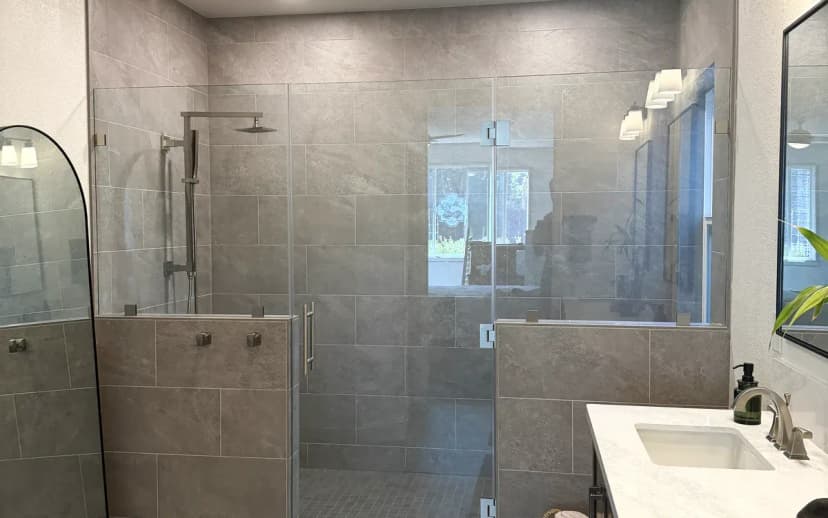
Extending the heated floor into the shower enclosure is increasingly popular in Granite Bay master bathrooms — and it is the upgrade that surprises homeowners the most. A warm shower floor eliminates the cold-tile sensation when you step in and helps water evaporate faster from the shower floor between uses, reducing moisture-related issues.
The Schluter Ditra-Heat system is specifically designed for this application. The Ditra-Heat membrane serves triple duty: it is an uncoupling membrane that prevents tile cracking, a waterproof membrane that eliminates the need for a separate waterproofing layer, and a heating cable substrate that locks the cable in position. This integrated approach simplifies installation and provides a certified waterproof heated shower floor.
Requirements for heated shower floors: the heating cable must be UL-listed for wet locations, connected to a GFCI-protected circuit (required by California Electrical Code for all bathroom circuits), and installed under a continuous waterproof membrane. The thermostat floor sensor should be placed in the shower area to accurately control the shower floor temperature independently if desired. For more on luxury shower features, see our heated floors guide.
Cost Breakdown by Bathroom Size
Here are installed costs for electric radiant floor heating in Granite Bay bathrooms, including materials, electrical work, thermostat, and labor:
| Bathroom Type | Heated Area | Installed Cost |
|---|---|---|
| Powder room (half bath) | 15 – 25 sq ft | $400 – $700 |
| Guest / hall bathroom | 30 – 45 sq ft | $600 – $1,000 |
| Standard master bathroom | 50 – 80 sq ft | $900 – $1,600 |
| Large Granite Bay master bathroom | 80 – 150 sq ft | $1,400 – $2,800 |
| Add: heated shower floor | 15 – 30 sq ft | $350 – $700 |
These costs are in addition to the tile installation cost (which is required regardless of heated floors). A smart Wi-Fi thermostat adds $150 to $300. The dedicated electrical circuit typically adds $300 to $600 if one does not already exist at the bathroom location.
ROI and Home Value Impact
Heated bathroom floors occupy a unique position in the remodeling ROI landscape. There is no standardized data tracking the specific resale value of radiant floor heating because it is typically bundled with the overall bathroom remodel valuation. However, real estate professionals in Granite Bay consistently report that heated floors are a notable selling feature.
In practical terms, the ROI calculation for heated floors in Granite Bay works like this: the system costs $1,000 to $2,000 on top of a $50,000 to $80,000 master bathroom remodel — representing 1% to 4% of the total project cost. During home showings, warm bathroom floors create an immediate positive impression that influences the buyer's perception of the entire bathroom investment. Real estate agents report that heated floors are mentioned in listing descriptions and highlighted during open houses as a luxury amenity.
The daily-life ROI is more straightforward: 5 months of warm bathroom floors for $160 to $200 per year in energy costs. Over a 10-year ownership period, the total cost (installation plus energy) is approximately $3,000 to $4,000 — less than $1 per day for a luxury feature you experience every morning.
Common Concerns and Misconceptions
We hear the same concerns from Granite Bay homeowners considering heated floors. Here are the facts:
- "What if the heating cable fails?" Quality electric radiant systems have failure rates below 1% over their warranty period (15 to 25 years). The cable is a solid resistive element with no moving parts — there is nothing to wear out or break down. If a cable is damaged during installation (which is why we test three times), it can be repaired before tile goes down. Post-installation failures are extremely rare.
- "Can I repair it without removing tile?" In the rare event of a cable failure after tile installation, a thermal imaging camera can locate the break point. A small section of tile is removed, the cable is repaired, and the tile is replaced. You do not need to remove the entire floor.
- "Will it crack my tile?" No. The temperature differential created by radiant heating (ambient to 85 degrees) is well within the thermal tolerance of tile and stone. The Schluter Ditra-Heat system includes an uncoupling membrane that allows the tile to expand and contract independently of the substrate, providing additional crack protection.
- "Is it safe in a wet bathroom?" Yes. UL-listed radiant floor systems are tested and certified for wet-area installation. When connected to a GFCI-protected circuit (required by code in all bathrooms), the system is as safe as any other bathroom electrical fixture.
- "Does it really make a difference?" Yes — and it is noticeable immediately. We have never had a Granite Bay homeowner regret adding heated floors. The difference between a 55-degree tile floor and an 82-degree tile floor on a cold morning is dramatic and unmistakable.
The Verdict: Is It Worth It in Granite Bay?
For most Granite Bay homeowners remodeling their bathroom, heated floors are one of the clearest yes-or-no decisions in the project. Here is the case:
The cost is modest: $1,000 to $2,000 added to a remodel that already costs $40,000 to $80,000. This is 1% to 4% of the total project budget for a feature you will use every day for the life of the floor.
The timing is critical: Adding heated floors during a remodel — when the tile is already being installed — costs a fraction of retrofitting them later. Later means demolishing the tile, installing the heating system, and reinstalling tile. There is no "we will add it later" option that makes financial sense.
The climate justifies it: Granite Bay's winter mornings are cold enough that unheated tile and stone floors are genuinely uncomfortable. This is not a marginal comfort upgrade in a mild climate — it is a meaningful quality-of-life improvement for five months of the year.
The market expects it: In Granite Bay's luxury home market, heated bathroom floors are a recognized amenity that buyers appreciate. Not having them in a high-end remodel feels like an oversight rather than a cost-saving decision.
Our recommendation: if you are remodeling a bathroom in Granite Bay with tile or stone flooring, include heated floors. The regret of not adding them far outweighs the modest additional cost.
Frequently Asked Questions
Add Heated Floors to Your Granite Bay Bathroom Remodel
Oakwood Remodeling Group includes heated floor consultation in every Granite Bay bathroom remodel. We help you choose the right system for your bathroom size and flooring material, handle the electrical and installation work, and program your thermostat schedule for maximum comfort with minimum energy cost. The best time to add heated floors is during your remodel — before the tile goes down.
Related Reading
Bathroom Remodeling in Granite Bay, CA
Our full service area page for Granite Bay homeowners.
Heated Floors: Affordable Luxury
Our complete guide to radiant floor heating in bathrooms.
Master Bathroom Remodel Services
Our master bathroom remodeling service offerings.
Granite Bay Luxury Bathroom Remodel Guide
Complete guide to luxury bathroom remodeling in Granite Bay.
Granite Bay Bathroom Remodel Cost Guide
Detailed pricing for Granite Bay bathroom projects.
Get Your Free Estimate
Schedule your consultation today
Related Articles


Get a Free Estimate
Call us at (916) 907-8782 or fill out our contact form.