Folsom Tub-to-Shower Conversion: The Most Requested Job We Do
That builder-grade soaking tub or fiberglass combo taking up space in your Folsom bathroom? Here is everything you need to know about converting it to the walk-in shower you actually want.
Looking for bathroom remodeling in Folsom? View our Folsom service area page →
Table of Contents
- 1. Why Folsom Homeowners Are Converting Tubs to Showers
- 2. When to Keep the Tub vs. When to Convert
- 3. The Conversion Process Step by Step
- 4. Plumbing: What Changes and What Stays
- 5. Waterproofing the New Shower
- 6. Design Options: Curbed, Curbless, and Low-Threshold
- 7. Tile Choices for Converted Showers
- 8. Glass Enclosure Options and Costs
- 9. Shower Features: Niches, Benches, and Multi-Head Systems
- 10. Cost Breakdown for Folsom Conversions
- 11. Resale Impact and Home Value
- 12. Permits, Timeline, and Scheduling
- 13. Frequently Asked Questions
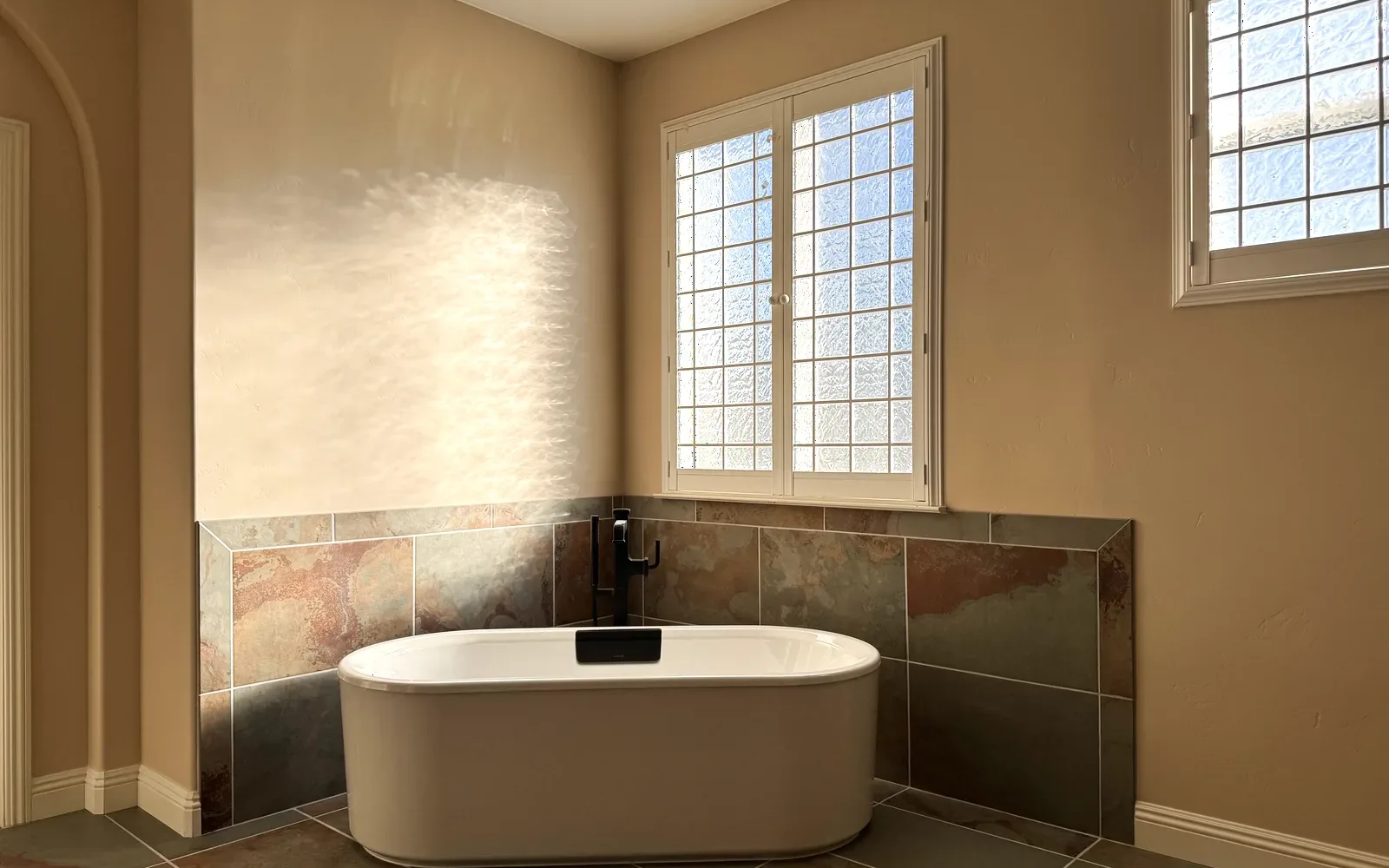
Pictured: a real Oakwood project in Elk Grove. See the full before & after
Why Folsom Homeowners Are Converting Tubs to Showers
Tub-to-shower conversions are the single most requested bathroom project in Folsom — and across the Sacramento region. The reason is straightforward: most Folsom homes built between 1990 and 2010 have bathtubs that their owners rarely use, occupying valuable floor space that would serve them better as a walk-in shower.
In master bathrooms throughout Empire Ranch, Broadstone, and Natoma Station, we see the same setup — a large soaking tub positioned under a window or in a corner, used a handful of times per year if at all. Meanwhile, the shower stall next to it is a cramped 36x36-inch fiberglass box with a framed glass door. The homeowner uses the small shower daily and ignores the tub.
Converting that tub space to an expanded walk-in shower — or combining the tub and shower areas into one generous shower — transforms the entire room. As Folsom's tub-to-shower specialists, we complete these conversions every week. Here is exactly how it works.
When to Keep the Tub vs. When to Convert
Before committing to a conversion, there is one critical question: is this the only bathtub in the home? If yes, think carefully before removing it.
Convert When
- You have at least one other bathtub in the home (hall bath, guest bath, or kids' bath)
- The tub is used fewer than a dozen times per year
- You want a larger, more functional daily shower
- Accessibility is a current or future concern — walk-in showers are easier to enter and exit
- Your existing shower stall is cramped or the fiberglass base is failing
Keep the Tub When
- It is the only tub in the home — homes with zero bathtubs are harder to sell
- You have young children who need a tub for bathing
- You use the tub regularly and enjoy soaking baths
- You plan to sell within 1 to 2 years in a family-heavy neighborhood
The "keep one tub" rule is well-established in the Folsom real estate market. As long as one bathtub remains elsewhere in the home, converting the master bath tub to a shower is consistently rated as a positive upgrade by local agents and appraisers.
The Conversion Process Step by Step
A tub-to-shower conversion follows a specific sequence. Here is what happens from start to finish:
- Demolition (day 1): Remove the tub, surrounding tile or surround panels, and any damaged substrate. Disconnect plumbing. Inspect the subfloor and framing for water damage.
- Plumbing rough-in (day 1 to 2): Modify the drain to accommodate the new shower configuration. Install or reposition the shower valve. Add supply lines for additional showerheads if specified.
- Framing and substrate (day 2 to 3): Frame any new walls or half-walls. Install cement board on all wet-area surfaces. Build the shower curb if applicable.
- Waterproofing (day 3 to 4): Apply the waterproof membrane system to all shower surfaces — floor, walls, curb, and niches. Allow proper cure time (24 hours minimum for liquid-applied membranes).
- Tile installation (day 4 to 8): Install shower floor tile with proper slope to the drain (1/4 inch per foot minimum). Install wall tile. Build and tile niches. Grout and caulk all joints.
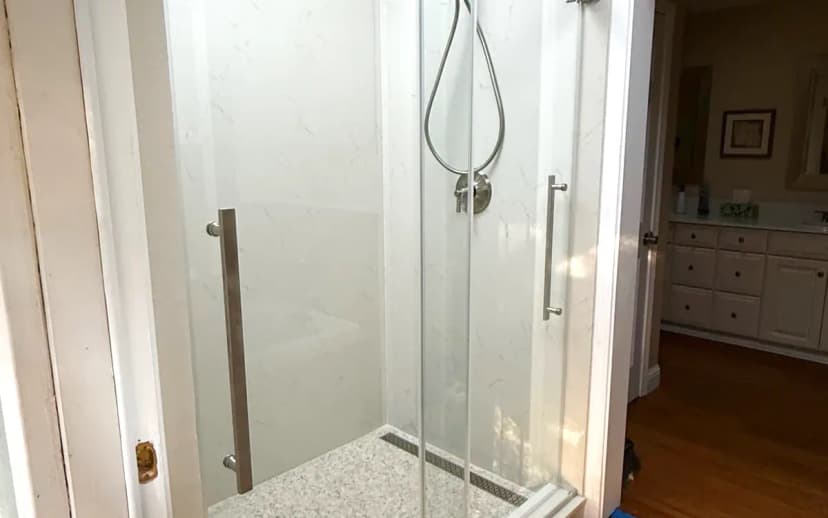
- Glass installation (day 9 to 10): Measure, fabricate, and install the glass enclosure. Frameless glass is typically custom-measured after tile is complete.
- Fixture trim-out (day 10 to 11): Install the showerhead, hand shower, valve trim, and accessories. Connect the drain assembly. Test for leaks.
- Final inspection (day 11 to 12): City inspector verifies code compliance. Walkthrough with the homeowner.
Total construction time is 7 to 14 days depending on tile complexity and glass lead time. Read more about the full process in our tub-to-shower conversion service page.
Plumbing: What Changes and What Stays
One of the most common questions about tub-to-shower conversions is how much plumbing work is involved. The answer depends on whether you keep the drain in the same location:
Same-Location Drain (Most Common)
The existing tub drain serves as the shower drain. The tub drain is typically a 1.5-inch line that connects to a 2-inch branch — which meets code for a shower. The drain fitting is replaced with a new shower drain assembly, but the line beneath the slab stays in place. This eliminates concrete work entirely and keeps plumbing costs in the $800 to $1,500 range.
Relocated Drain
If you want the drain centered in a different position — for example, to accommodate a linear drain along the back wall — the existing slab must be cut and a new drain line routed. In Folsom homes with concrete slab foundations (which includes most of Empire Ranch, Broadstone, and Natoma Station), this adds $2,000 to $4,500 to the project. It is the right choice when the drain location matters for the shower design, but it is not required for most conversions.
Supply Line Modifications
The existing tub faucet supply lines are repurposed for the new shower valve. If you are adding a second showerhead, hand shower, or body sprays, additional supply lines are run through the wall framing — a straightforward modification that costs $300 to $800 per additional connection point. Current California Plumbing Code requires a thermostatic or pressure-balancing valve with anti-scald protection on all shower valves.
Waterproofing the New Shower
Waterproofing is the most critical step in any tub-to-shower conversion. A shower directs water at walls and floors with far more force and frequency than a bathtub — making a proper waterproof membrane essential rather than optional.
We use two proven systems for Folsom conversions:
- Schluter Kerdi system: A polyethylene sheet membrane bonded to cement board with unmodified thinset. The Kerdi membrane, Kerdi-Band for seams, and Kerdi-Drain assembly create a complete waterproof system from drain to ceiling. Best for curbless designs and complex geometries.
- Liquid-applied membrane (RedGard or Laticrete Hydroban): A roller-applied waterproofing that coats cement board surfaces. Two coats minimum, with fabric reinforcement at all seams, corners, and penetrations. Cost-effective for standard curbed shower designs.
Both systems meet TCNA standards for shower waterproofing. The key difference is installation method — sheet membrane is faster but requires precise fitting, while liquid-applied membrane is more forgiving but requires proper cure time between coats. For a detailed comparison, see our tub-to-shower conversion cost guide.
Design Options: Curbed, Curbless, and Low-Threshold
The shower entry design affects both aesthetics and cost. Here are the three approaches we offer for Folsom tub conversions:
Standard Curbed Shower
A 3 to 4-inch tile-covered curb at the shower entry. This is the most reliable water containment method and the least expensive to build. The curb is constructed from cement board over a wood or foam frame, waterproofed, and tiled to match the shower floor. Ideal for most conversions where accessibility is not a primary concern.
Low-Threshold (2-Inch Curb)
A compromise between standard and curbless. The 2-inch curb is easy to step over but still provides a physical barrier for water containment. This option works well with both center drains and linear drains and costs roughly the same as a standard curb.
Curbless (Zero-Threshold)
No curb at all — the bathroom floor transitions seamlessly into the shower floor. This requires precise engineering: the shower floor must slope toward the drain while the surrounding bathroom floor remains level or slopes slightly away from the shower opening. A linear drain along the shower entry is typically used to capture water before it reaches the bathroom floor. Curbless showers add $1,500 to $3,000 compared to a standard curb design. Learn more in our bathtub-to-spa conversion guide.
Tile Choices for Converted Showers
Tile selection for a converted shower needs to balance aesthetics, performance, and maintenance — especially given Folsom's hard water conditions. Here are the best performers:
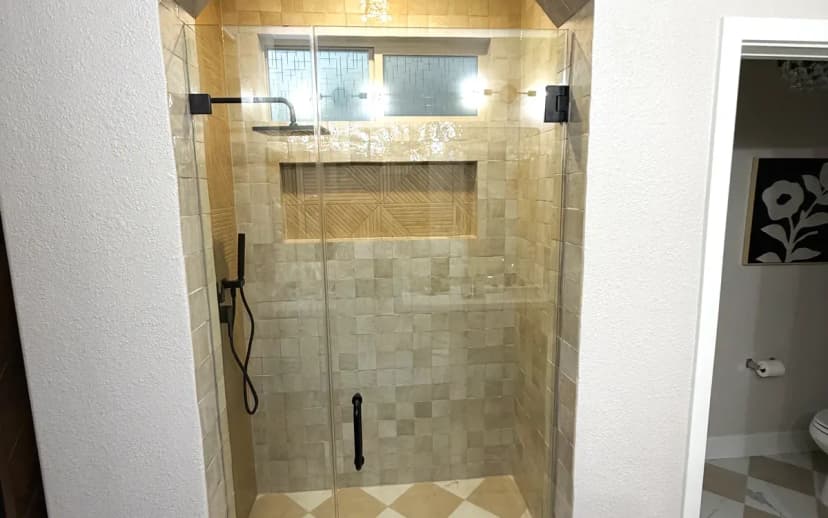
- Shower walls: Large-format porcelain (12x24, 24x24, or 24x48) in a vertical stack or offset pattern. Fewer grout joints mean less maintenance and a cleaner look. Porcelain resists hard water staining better than natural stone.
- Shower floor: 2x2 mosaic porcelain or hexagonal tile. Smaller tile sizes allow proper slope to the drain (1/4 inch per foot minimum). The tile must have a DCOF rating of 0.42 or higher for slip resistance.
- Accent features: Niche interiors, a feature wall, or a horizontal accent band in contrasting tile — natural stone, glass mosaic, or a different-format porcelain — adds visual interest without requiring high maintenance across the entire shower.
- Grout: Epoxy grout for shower floors and lower wall areas. Epoxy grout does not absorb water, resists staining, and does not require sealing. Standard sanded grout works for upper walls with a quality grout sealer applied after curing.
Glass Enclosure Options and Costs
The glass enclosure completes the conversion and has a significant impact on both the look and the budget. Here are the options available for Folsom conversions:
| Glass Type | Cost Range | Best For |
|---|---|---|
| Fixed frameless panel | $1,200 – $2,200 | Walk-in showers with open entry |
| Frameless panel + return | $1,800 – $3,000 | Corner showers needing splash control |
| Frameless door + panel | $2,500 – $4,500 | Enclosed showers for maximum containment |
| Semi-frameless sliding | $1,800 – $3,200 | Alcove conversions with limited clearance |
All shower glass is 3/8-inch or 1/2-inch tempered safety glass per California building code. We recommend glass with a protective coating (like EnduroShield or Diamon-Fusion) that repels water and reduces hard water buildup — especially important in the Folsom area. The coating adds $150 to $300 and significantly reduces cleaning frequency.
Shower Features: Niches, Benches, and Multi-Head Systems
One advantage of a tub-to-shower conversion is the opportunity to add features that make the shower more functional and comfortable than a standard stall:
- Recessed niches ($300 to $600 each): Built into the wall framing and waterproofed before tiling. One niche at standing height for shampoo and one lower for shaving supplies is the standard configuration. Triple-niche designs work well in larger converted showers.
- Built-in bench ($800 to $1,800): A tiled bench seat built into the corner or along the back wall. The bench is framed, waterproofed, and tiled as part of the shower. Floating (wall-mounted) designs save floor space compared to full-depth bench seats.
- Rain showerhead ($200 to $800 for the fixture): A ceiling-mounted or wall-mounted overhead showerhead that delivers a wide, gentle spray pattern. Requires a dedicated supply line from the valve.
- Hand shower on slide bar ($150 to $500): A secondary showerhead on a vertical bar that adjusts from waist to overhead height. Essential for versatility and makes shower cleaning easier.
- Thermostatic valve system ($400 to $1,200): Controls water temperature precisely and independently from volume. Allows you to preset your preferred temperature and adjust flow without affecting heat.
Cost Breakdown for Folsom Conversions
Here is what a tub-to-shower conversion costs in Folsom, broken down by component:
| Component | Cost Range |
|---|---|
| Demolition and disposal | $600 – $1,200 |
| Plumbing modifications | $800 – $2,500 |
| Framing and substrate | $500 – $1,200 |
| Waterproofing | $800 – $1,500 |
| Tile (materials and labor) | $3,500 – $8,000 |
| Glass enclosure | $1,200 – $4,500 |
| Fixtures (valve, showerhead, drain) | $600 – $2,500 |
| Permits and inspections | $300 – $600 |
| Total standalone conversion | $12,000 – $22,000 |
These ranges reflect mid-range to premium material selections. Budget-level materials (basic porcelain tile, standard fixtures, semi-frameless glass) can bring the total closer to $10,000 to $14,000. Ultra-premium conversions with natural stone, custom glass, and multi-function shower systems can reach $25,000 to $30,000. For broader pricing context, see our tub-to-shower conversion cost guide.
Resale Impact and Home Value
The impact of a tub-to-shower conversion on Folsom home values depends on context. According to the National Association of Realtors, bathroom remodels recover 73.7% of cost at resale nationally — and walk-in showers are among the most desired features for today's buyers.
In the Folsom market specifically, walk-in showers are now expected in master bathrooms at the $650,000+ price point. A master bathroom with only a tub-shower combo or an undersized shower stall is viewed as a deficiency rather than a neutral feature. Folsom agents report that updated master bathrooms with walk-in showers are among the top three features that drive buyer interest and competitive offers.
The key caveat remains: keep at least one bathtub in the home. A home with three or four bathrooms and zero bathtubs narrows your buyer pool. For more on this topic, read our tub-to-shower conversion and home value guide.
Permits, Timeline, and Scheduling
A tub-to-shower conversion requires a building permit from the City of Folsom because it involves plumbing modifications. The permit process typically adds 1 to 2 weeks before construction begins. Inspections are required at the rough plumbing stage and at project completion.
Total project timeline from initial consultation to completion:
- Consultation and design: 1 week
- Material ordering and permit processing: 1 to 3 weeks (glass lead time is typically the longest item)
- Construction: 7 to 14 days
- Total: 3 to 6 weeks from first meeting to final walkthrough
The best time to schedule a conversion in Folsom is fall (September through November) or late winter (January through February). Spring and summer are peak construction season, and lead times for both labor and materials extend by 1 to 2 weeks during these months.
Frequently Asked Questions
Ready to Convert Your Folsom Bathtub to a Walk-In Shower?
Oakwood Remodeling Group completes tub-to-shower conversions throughout Folsom every week. From Empire Ranch to Natoma Station, we know what these homes need and how to deliver a conversion that looks great and performs for decades. Every project includes fixed pricing and a clear timeline.
Related Reading
Bathroom Remodeling in Folsom, CA
Our full service area page for Folsom homeowners.
Tub-to-Shower Conversion Services
Our dedicated tub conversion service page.
Tub-to-Shower Conversion & Home Value
How conversions affect resale in the Sacramento area.
Tub-to-Shower Conversion Cost Guide
Detailed pricing for conversion projects.
Convert Your Bathtub to a Modern Spa
Design inspiration for tub conversion projects.
Get Your Free Estimate
Schedule your consultation today
Related Articles

Get a Free Estimate
Call us at (916) 907-8782 or fill out our contact form.