Walk-In Shower Installation in Roseville: Design Guide
Every decision in a walk-in shower matters — from the drain system under the floor to the glass that contains the water. Here is what Roseville homeowners need to know before choosing a design.
Looking for bathroom remodeling in Roseville? View our Roseville service area page →
Table of Contents
- 1. Why Walk-In Showers Dominate Roseville Remodels
- 2. Curbed vs. Curbless: The Core Decision
- 3. Drainage Systems: Center Drain vs. Linear Drain
- 4. Waterproofing for Walk-In Showers
- 5. Tile Selection for Roseville Water Conditions
- 6. Glass Enclosure Options
- 7. Fixture and Showerhead Configuration
- 8. Sizing and Layout for Roseville Floor Plans
- 9. Accessibility and Aging-in-Place Design
- 10. Built-In Benches and Shower Niches
- 11. Cost Ranges for Roseville Walk-In Showers
- 12. Permits, Timeline, and Installation Process
- 13. Frequently Asked Questions
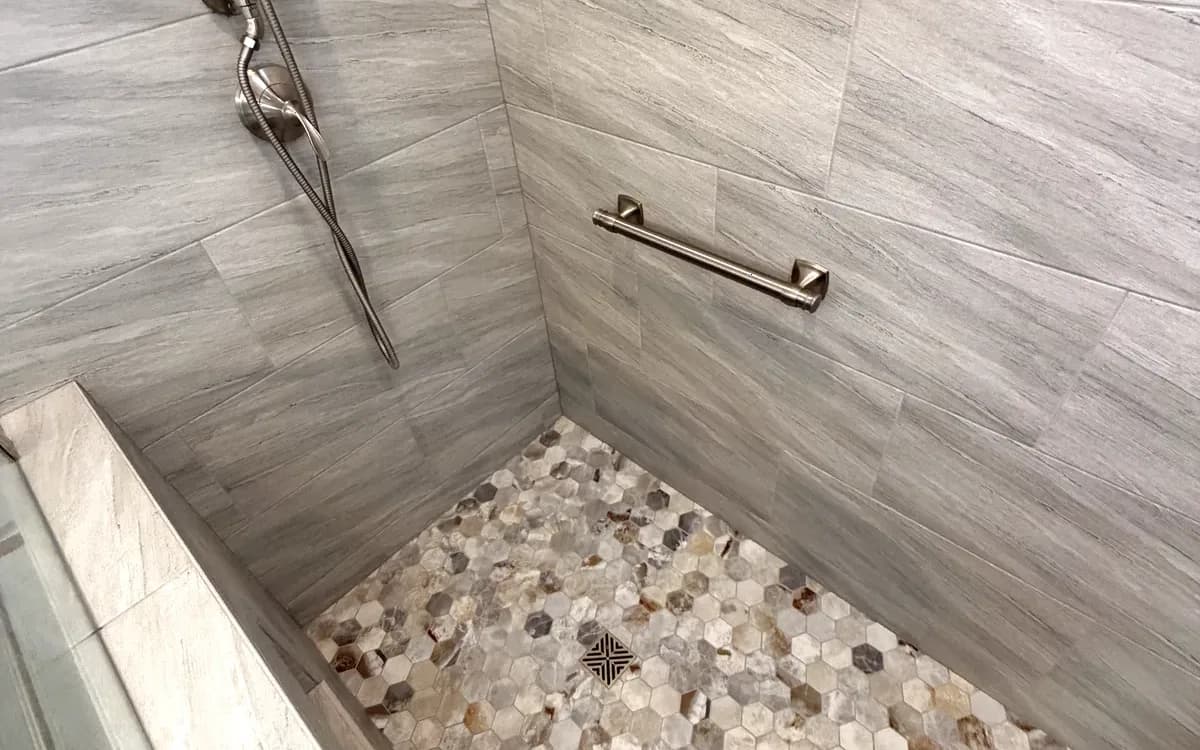
Pictured: a real Oakwood project in Citrus Heights. See the full before & after
Why Walk-In Showers Dominate Roseville Remodels
Walk-in showers have become the most requested feature in Roseville bathroom remodels. According to the National Kitchen and Bath Association (NKBA), walk-in showers now appear in over 80% of master bathroom renovations nationwide — and in our Roseville projects, that number is closer to 90%.
The reasons are practical. Roseville homeowners are replacing undersized builder shower stalls (36x36 or 36x48 inches), converting rarely-used master bathtubs into larger showers, and planning ahead for aging-in-place accessibility. A walk-in shower with a low or zero threshold, a built-in bench, and grab bar blocking is functional for every stage of life — from a young family to retirement.
As Roseville's walk-in shower specialists, we install walk-in showers across every neighborhood — from newer West Roseville communities to established areas near Sierra Vista and older homes near downtown. This guide covers every design decision you will need to make, with specific guidance for Roseville homes and local conditions.
Curbed vs. Curbless: The Core Decision
The first and most important design decision is whether your walk-in shower will have a curb (a raised threshold at the entry) or be curbless (flush with the bathroom floor). Each has distinct advantages and requirements. For a deep comparison, see our curbed vs. curbless walk-in shower guide.
Curbed Walk-In Showers
A curbed shower has a raised threshold — typically 3 to 5 inches high — that contains water within the shower pan. This is the more traditional approach and remains the most common installation in Roseville homes. Curbed showers are simpler to waterproof because the curb acts as a physical water barrier. They work well in any size, including compact layouts, and cost 15% to 25% less than curbless designs. The curb is built from 2x4 lumber wrapped in cement board and waterproofing membrane, then tiled to match the shower.
Curbless Walk-In Showers
A curbless (zero-threshold) shower has no raised edge — the bathroom floor transitions directly into the shower floor at the same level. This creates a seamless, spa-like aesthetic and provides barrier-free access for wheelchair users, walkers, or anyone with mobility limitations. However, curbless showers are more complex to build because the shower floor must slope toward the drain within a very limited vertical space — typically 3/4 to 1 inch of total fall from the bathroom floor to the drain. This requires precision subfloor work and a linear drain positioned along one wall.
In Roseville homes with slab foundations, creating the slope for a curbless shower often requires recessing the drain into the slab — which means cutting concrete. In homes with raised floors or second-story bathrooms, the subfloor can be modified more easily. The foundation type of your Roseville home directly affects the feasibility and cost of a curbless design.
Drainage Systems: Center Drain vs. Linear Drain
The drain system is the foundation of any walk-in shower — it determines the floor slope, tile layout, and overall water management. For a detailed comparison, read our linear drain vs. center drain guide.
Center Drain (Point Drain)
A center drain sits in the middle of the shower floor (or offset toward the back) with the floor sloping toward it from all four directions. This creates a cone-shaped depression in the floor that requires smaller tiles (2x2 or smaller) to follow the compound slope. Center drains are proven, cost-effective ($50 to $150 for the drain), and work well with curbed showers. They are not ideal for curbless designs because the multi-directional slope is harder to blend seamlessly into the bathroom floor.
Linear Drain (Channel Drain)
A linear drain runs along one wall of the shower — typically the wall opposite the glass or the wall farthest from the shower entry. The shower floor slopes in a single direction toward the drain channel, creating a uniform plane that can accept large-format tile without cutting into multiple slopes. This is essential for curbless designs and strongly preferred for any shower using tiles larger than 4x4 inches on the floor.
Quality linear drains cost $400 to $1,200 for the drain unit and include grate options in brushed nickel, matte black, and tile-insert styles. Tile-insert grates allow the floor tile pattern to continue over the drain, creating a nearly invisible drain line. Brands we use include Schluter Kerdi-Line, Infinity Drain, and QuickDrain — all designed to integrate with bonded waterproofing systems.
Waterproofing for Walk-In Showers
Waterproofing is the most critical and most invisible component of any walk-in shower. The waterproofing system creates a continuous barrier behind the tile that prevents water from reaching the framing, subfloor, and slab. Without proper waterproofing, a walk-in shower will develop mold, substrate failure, and structural damage — sometimes within 3 to 5 years. For a full comparison, see our waterproofing systems guide.
We use two waterproofing systems depending on the project requirements:
- Schluter Kerdi system: A bonded polyethylene sheet membrane applied over cement board with unmodified thin-set mortar. The membrane, pre-formed corners, curb covers, and drain flange create a continuous waterproof envelope. This is our preferred system for curbless showers and any design using a linear drain — because Schluter's Kerdi-Line drain integrates directly with the Kerdi membrane for a leak-proof connection.
- Liquid-applied membrane (RedGard or Laticrete Hydroban): A paint-on waterproofing applied directly to cement board in two coats with reinforcing fabric at seams, corners, and fastener heads. This is effective for curbed showers with standard center drains and costs less than the Schluter system. Both products meet TCNA and ANSI standards for shower waterproofing.
Regardless of system, waterproofing coverage must be 100% — every square inch of shower wall (floor to ceiling recommended) and floor must be protected. The shower curb is waterproofed on all three sides. Pre-formed inside and outside corners eliminate the most common failure point in shower waterproofing.
Tile Selection for Roseville Water Conditions
Roseville's water supply, sourced from Folsom Lake and treated by the City of Roseville Environmental Utilities, is moderately hard. Hard water leaves mineral deposits (calcium and magnesium) on shower surfaces — and the tile you select determines how much maintenance those deposits require.
Shower Wall Tile
Large-format porcelain tile (12x24 minimum, with 24x48 and even 48x48 gaining popularity) is the best performer for Roseville walk-in shower walls. Porcelain has near-zero water absorption (under 0.5% per ASTM C373), resists mineral deposits, and wipes clean with a squeegee. The larger format means fewer grout lines — and grout is where hard water deposits accumulate fastest. A 12x24 tile layout has 60% fewer linear feet of grout than a 3x6 subway tile layout covering the same area.
Shower Floor Tile
Shower floor tile must provide slip resistance. The industry standard is a Dynamic Coefficient of Friction (DCOF) rating of 0.42 or higher, as measured by the DCOF AcuTest. For center-drain showers, 2x2 mosaic porcelain is standard — the small tile size conforms to the compound slope. For linear-drain showers, larger tiles (up to 12x24) can be used on the floor because the slope is in a single direction. Hexagonal mosaics are a popular alternative that adds visual interest while maintaining slip resistance.
Natural Stone Considerations
Marble, travertine, and slate create stunning showers but require significantly more maintenance in Roseville. Hard water deposits etch marble surfaces and penetrate the stone's pores unless sealed every 6 to 12 months. If you choose natural stone, use a penetrating sealer (not a topical sealer) and plan for regular reapplication. Most Roseville homeowners who want a marble look opt for marble-look porcelain tile — which provides the aesthetic without the maintenance burden.
Glass Enclosure Options
The glass enclosure defines the visual character of a walk-in shower. There are three main categories, each with distinct advantages. For a detailed comparison, see our frameless vs. semi-frameless shower glass guide.
Frameless Glass
Frameless glass uses 3/8-inch or 1/2-inch tempered glass panels with minimal hardware — typically polished stainless steel or brushed nickel clips and hinges. There is no metal frame around the glass edges, creating a clean, open look that showcases the tile work behind it. Frameless glass is custom-measured and templated after tile installation is complete, ensuring a precise fit. Cost: $1,800 to $3,500 installed for a standard walk-in shower configuration.
Semi-Frameless Glass
Semi-frameless glass has a metal frame on the outer edges of the enclosure (the top, bottom, and sides where the glass meets the wall or curb) but no frame on the door panel itself. This uses thinner 5/16-inch glass, which reduces cost while still providing a relatively clean appearance. Semi-frameless is a strong value option for curbed walk-in showers. Cost: $800 to $1,400 installed.
Fixed Panel (No Door)
A fixed glass panel — also called a splash panel or glass partition — is a single pane of glass mounted to the wall with no door. The walk-in entry remains open, relying on the shower's size and the showerhead position to control water spray. Fixed panels work best with larger walk-in showers (48 inches wide or more) and are especially popular in curbless designs. Cost: $600 to $1,500 for a single fixed panel. This is the most popular option in our Roseville master bathroom projects.
Fixture and Showerhead Configuration
Walk-in showers offer more flexibility for fixture placement than enclosed shower stalls. Here are the most common configurations we install in Roseville homes:
- Single showerhead: A wall-mounted showerhead on an adjustable arm. The simplest and most common configuration. Uses a single valve and supply connection.
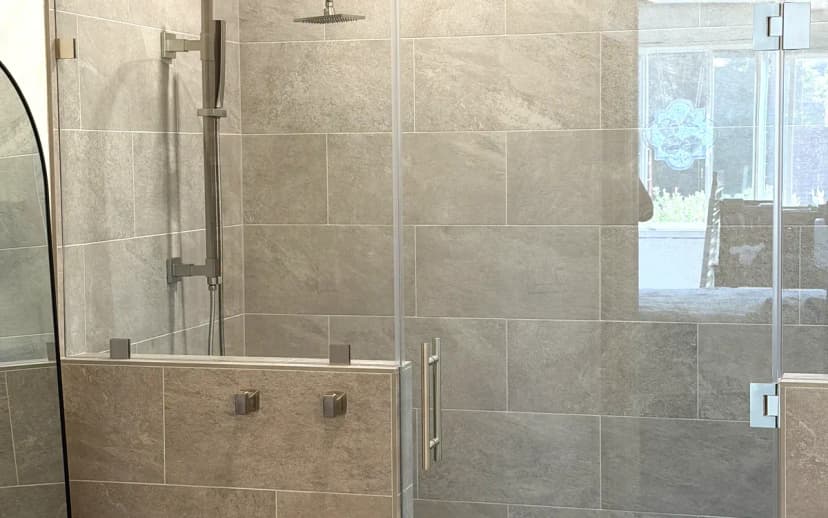
- Rain head and handheld combo: An overhead rain showerhead (typically 8 to 12 inches) paired with a handheld shower on a slide bar. Requires a diverter valve or thermostatic valve with two outlets. This is the most popular upgrade in our Roseville walk-in shower projects.
- Multi-outlet system: Rain head, handheld, and body sprays or a wall-mounted secondary head. Requires a thermostatic valve with volume controls for each outlet and potentially a larger water heater. Cost premium: $1,500 to $4,000 over a single showerhead.
All shower fixtures installed in Roseville must carry the WaterSense label, limiting flow to 2.0 gallons per minute (GPM) for showerheads. California's water efficiency requirements are among the strictest in the nation. Modern low-flow showerheads use pressure-compensating technology that delivers strong spray patterns at 1.8 to 2.0 GPM — a significant improvement over the water-wasting 2.5+ GPM heads of past decades.
Sizing and Layout for Roseville Floor Plans
Walk-in shower sizing depends on available space, design goals, and whether you are converting a bathtub or replacing an existing shower. Here are the common size ranges and what they offer:
| Shower Size | Best For | Design Notes |
|---|---|---|
| 36" x 36" | Compact bathrooms, hall baths | Minimum comfortable size; curbed with door |
| 36" x 48" | Standard replacement, guest baths | Good for tub replacement in same footprint |
| 36" x 60" | Master baths, tub conversion | Room for bench seat; ideal for curbless |
| 48" x 60" or larger | Premium master baths | Dual showerheads, open entry with fixed panel |
In typical Roseville master bathrooms from the 1990s and 2000s, the most common conversion is removing the soaking tub and expanding into that space — creating a 36x60 or 48x60-inch walk-in shower. This is the project type where our walk-in shower installation service delivers the most dramatic transformation.
Accessibility and Aging-in-Place Design
Roseville has a significant population of homeowners planning to stay in their homes through retirement — including the entire Sun City Roseville community. Walk-in showers are the single most impactful accessibility upgrade in a bathroom. Here is how to design one that works for every stage of life:
- Zero-threshold entry: A curbless design eliminates the step that becomes a trip hazard with age. If a curbed design is chosen, keep the curb height to 3 inches maximum and bevel the entry edge.
- Grab bar blocking: Install solid blocking (2x6 or plywood) between studs at 34 and 48 inches from the finished floor. This allows grab bars to be installed at any point in the future without opening walls. Cost to add during construction: $100 to $300.
- Built-in bench: A tiled bench seat at 17 to 19 inches high provides a seated shower option. Benches should be at least 15 inches deep and structurally supported to hold 250+ pounds.
- Handheld showerhead on slide bar: Adjustable height from 48 to 72 inches allows seated or standing use. The slide bar should be mounted on blocking for potential use as a grab bar.
- Non-slip flooring: Mosaic tile with high DCOF rating (0.60 or higher for enhanced slip resistance) on the shower floor.
Adding these accessibility features during a walk-in shower installation costs 5% to 10% more than a standard design. Retrofitting them later costs significantly more because it requires opening finished walls and potentially remodeling the shower floor. Think of accessibility as an insurance policy — inexpensive to include now, expensive to add later.
Built-In Benches and Shower Niches
Built-in features elevate a walk-in shower from functional to enjoyable. Two features that Roseville homeowners request most are shower niches and bench seats.
Shower Niches
A recessed niche provides storage for shampoo, soap, and razors without protruding into the shower space. Standard niche sizes are 12x24 inches (single) or 12x36 inches (double shelf). Niches are framed between studs (standard 14.5-inch cavity on 16-inch centers) and waterproofed with the same membrane system as the rest of the shower. Pre-formed niches from Schluter (Kerdi-Board-SN) or Noble Company ensure consistent waterproofing at the niche opening — the most common failure point.
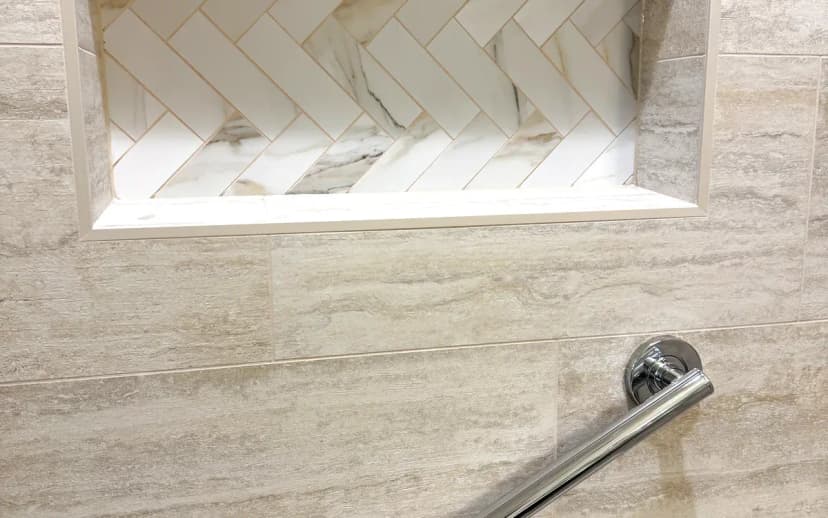
Placement: Install the niche on an interior wall (not an exterior wall, where insulation complicates construction). Position the bottom shelf at 48 to 54 inches from the floor for comfortable standing reach. Accent tile inside the niche adds a design detail that draws the eye. Cost: $400 to $800 per niche including framing, waterproofing, and tile.
Built-In Benches
A shower bench can be built as a floating bench (cantilevered from the wall) or a full-height bench that extends from floor to seat height. Floating benches are more visually sleek but require structural blocking in the wall. Full-height benches are more common and structurally simpler — they are built from 2x4 framing, wrapped in cement board, waterproofed, and tiled. Bench height should be 17 to 19 inches (the same as a standard chair seat) and at least 15 inches deep for comfortable seating.
Corner benches work well in 36x60-inch and larger showers, using the corner space that is naturally less functional. A triangular corner bench adds seating without significantly reducing standing room. Cost: $600 to $1,200 including framing, waterproofing, and tile.
Cost Ranges for Roseville Walk-In Showers
Here are realistic cost ranges for walk-in shower installations in Roseville, based on our project data:
| Configuration | Cost Range | Includes |
|---|---|---|
| Standard curbed (36x48) | $8,000 – $13,000 | Porcelain tile, center drain, semi-frameless glass |
| Mid-range curbed (36x60) | $12,000 – $17,000 | Premium tile, niche, bench, frameless glass |
| Curbless with linear drain | $14,000 – $22,000 | Linear drain, Schluter Kerdi, large-format tile, fixed panel |
| Premium custom (48x60+) | $18,000 – $28,000 | Natural stone or premium porcelain, dual outlets, bench, multiple niches |
These costs are for the shower installation only — they include demolition, plumbing, waterproofing, tile, glass, and fixtures for the shower area. If the walk-in shower is part of a full bathroom remodel that includes vanity, flooring, toilet, and lighting, the total project cost will be higher.
Permits, Timeline, and Installation Process
Walk-in shower installations in Roseville require a building permit from the City of Roseville Building Division when plumbing is modified or relocated. Here is the typical process:
- Design and material selection (1 – 2 weeks): Finalize shower size, tile, glass type, fixtures, and drain configuration.
- Permit application (1 – 2 weeks): Submit scope to the City of Roseville. Processing averages 5 to 10 business days.
- Demolition (1 day): Remove existing shower or tub, tile, and substrate. Inspect framing and subfloor.
- Plumbing rough-in (1 – 2 days): Install or relocate drain, supply lines, and shower valve. Schedule rough inspection.
- Substrate and waterproofing (2 – 3 days): Install cement board, apply waterproofing membrane, and allow cure time.
- Tile installation (3 – 5 days): Shower floor, walls, niche, and bench. Includes setting, grouting, and caulking.
- Glass measurement and installation (5 – 10 days): Glass is templated after tile is complete. Fabrication and installation follow.
- Fixture trim and final (1 day): Install showerhead, handle trim, and accessories. Final inspection.
Total time from demolition to usable shower averages 10 to 14 days, with an additional 5 to 10 days for glass fabrication and installation after tile is complete. During the glass wait period, the shower is functional with a temporary curtain if needed.
Frequently Asked Questions
Ready to Design Your Walk-In Shower?
Oakwood Remodeling Group designs and installs walk-in showers across Roseville — from compact curbed designs in guest bathrooms to spa-scale curbless showers in master suites. Every installation includes proper waterproofing, code-compliant drainage, and a lifetime of reliable performance. We will help you choose the right configuration for your space, your budget, and your goals.
Related Reading
Walk-In Shower Installation Services
Our walk-in shower design and installation service page.
Curb vs. Curbless Walk-In Shower Guide
Detailed comparison of shower threshold options.
Linear Drain vs. Center Drain
Drainage system comparison for walk-in showers.
Frameless vs. Semi-Frameless Glass
Shower glass enclosure options compared.
Waterproofing Systems Guide
Schluter vs. traditional waterproofing comparison.
Get Your Free Estimate
Schedule your consultation today
Related Articles

Get a Free Estimate
Call us at (916) 907-8782 or fill out our contact form.