Granite Bay Guest Bathroom: Impress Without Overspending
Your guest bathroom is the first private space visitors see. In Granite Bay, it needs to match the quality of your home without demanding master-bathroom pricing. Here is how to get maximum impact from a smart budget.
Looking for bathroom remodeling in Granite Bay? View our Granite Bay service area page →
Table of Contents
- 1. The Granite Bay Guest Bathroom Challenge
- 2. Budget Strategy: Where to Invest and Where to Save
- 3. Tile Choices That Look Premium at Mid-Range Prices
- 4. Vanity Selection for Guest Bathrooms
- 5. Fixture Strategy: The Details Guests Notice
- 6. Tub or Shower: The Guest Bathroom Decision
- 7. Small Space Design That Feels Spacious
- 8. Lighting and Mirrors That Elevate the Space
- 9. Accessories and Finishing Touches
- 10. Cost Breakdown by Scope
- 11. ROI and Resale Impact
- 12. Timeline and What to Expect
- 13. Frequently Asked Questions

The Granite Bay Guest Bathroom Challenge
Granite Bay homes set a high standard. When visitors walk through your front door, they see quality finishes, thoughtful design, and attention to detail throughout the main living spaces. Then they step into the guest bathroom — and if it still has builder-grade fixtures, yellowed fiberglass, and a vanity from the 1990s, the contrast is jarring.
The challenge is specific to this community: the guest bathroom needs to feel like it belongs in a Granite Bay luxury home, but it does not need — and should not have — the same $60,000 to $90,000 investment as a master bathroom. Guests do not need heated floors, dual showerheads, or book-matched marble slabs. They need a clean, beautiful, well-appointed bathroom that reflects the quality of your home.
That is the sweet spot this guide targets: how to create a guest bathroom that impresses everyone who uses it without overbuilding for a space that sees intermittent use. Smart material selection, strategic splurges, and knowing exactly where to save are the keys.
Budget Strategy: Where to Invest and Where to Save
The secret to an impressive guest bathroom on a reasonable budget is understanding what guests actually notice versus what they never think about. Here is the hierarchy:
Invest in (guests notice immediately):
- Fixtures: Faucets, showerheads, and towel bars are at eye level and hand level — guests interact with them directly. Quality fixtures in a current finish (matte black or brushed nickel) instantly signal a thoughtfully remodeled bathroom.
- Mirror and lighting: The mirror is the visual focal point of any bathroom. A well-framed or LED-backlit mirror with proper flanking lights transforms the space more than any other single element.
- Tile pattern and layout: How tile is arranged matters more than how much it costs. A $10/sq ft porcelain tile installed in a herringbone pattern with matching grout looks more sophisticated than a $30/sq ft tile installed in a basic grid.
Save on (guests never notice):
- Tile material: Premium porcelain that looks like marble costs $8 to $15 per square foot versus $40 to $100 for actual marble. In a guest bathroom, the visual difference is negligible.
- Vanity construction: A well-designed stock vanity at $800 to $1,500 looks nearly identical to a $3,000 custom vanity when paired with a quality countertop and undermount sink.
- Behind-the-wall systems: Use standard (not premium) waterproofing, standard plumbing fittings, and efficient electrical layouts. The systems behind the tile should be code-compliant and durable, but they do not need the premium treatment of a master bathroom.
Tile Choices That Look Premium at Mid-Range Prices
Tile is the largest visual surface in any bathroom, and it is where smart material selection has the biggest budget impact. Modern porcelain tile technology has advanced to the point where mid-range tiles can convincingly replicate marble, travertine, concrete, and terrazzo — surfaces that cost three to five times more in natural form.
For Granite Bay guest bathrooms, we recommend these approaches:
- Floor: Large-format porcelain in a marble-look or concrete-look finish. A 24x24-inch tile at $10 to $14 per square foot creates a clean, expansive floor with minimal grout lines. Light colors (white, cream, light gray) make the room feel larger.
- Tub surround walls: The same large-format tile used on the floor, installed floor-to-ceiling. Extending the tile to the ceiling costs $300 to $500 more in material but eliminates the painted-drywall-to-tile transition where mold grows — and it makes the room look taller and more finished.
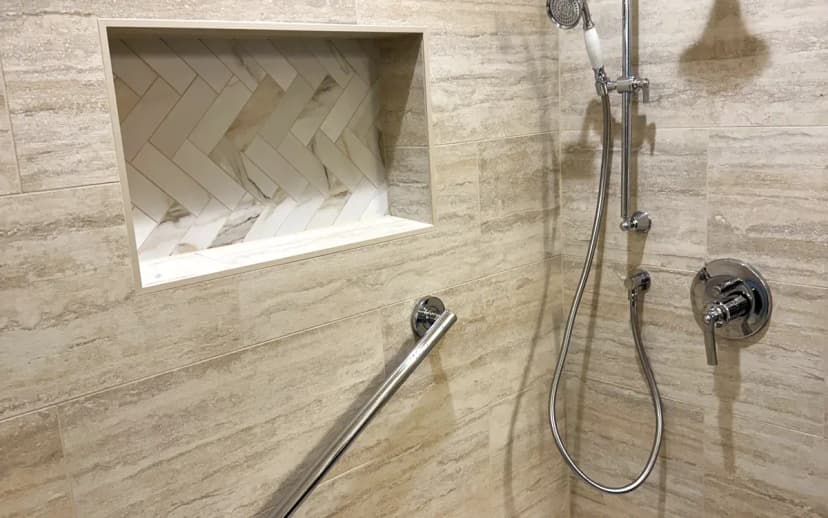
- Accent feature: A single accent stripe, niche liner, or feature wall in a contrasting mosaic or patterned tile adds visual interest without tiling the entire bathroom in expensive material. A 2x6-foot accent zone costs $200 to $400 in tile but transforms the look of the entire room.
For more on choosing between natural stone and porcelain, see our 2026 bathroom fixture and finish trends guide.
Vanity Selection for Guest Bathrooms
The vanity is the furniture piece of the bathroom — it sets the style tone and provides all the storage. In a guest bathroom, a single-sink vanity is standard, typically 30 to 42 inches wide. The right vanity delivers luxury impact at a fraction of a custom piece.
Floating (wall-mounted) vanities are our top recommendation for Granite Bay guest bathrooms. They show the floor underneath, making the room feel larger. They simplify floor tile installation (tile runs wall-to-wall without cutting around a cabinet base). And they read as more modern and intentional than a traditional floor-standing cabinet.
A 36-inch floating vanity with a quartz top, undermount sink, and soft-close drawers costs $1,200 to $2,500 installed — substantially less than a custom-built vanity at $3,000 to $5,000. Premium brands like Restoration Hardware and West Elm offer bathroom vanities that look custom but arrive ready to install. For comparison, see our small bathroom remodel cost guide.
Pair the vanity with a quartz countertop in a marble-look pattern. Quartz costs $40 to $70 per square foot fabricated and installed for a small guest bathroom vanity top — roughly the same as marble but with zero maintenance requirements. No sealing, no etching risk, no hard water concerns.
Fixture Strategy: The Details Guests Notice
Fixtures are the jewelry of the bathroom — small in cost relative to tile and vanity, but disproportionately impactful on the overall impression. In a Granite Bay guest bathroom, coordinated, quality fixtures in a current finish elevate the entire space.
A complete fixture package for a guest bathroom includes the faucet, showerhead, tub spout (if applicable), towel bar, toilet paper holder, robe hook, and shower curtain rod or glass hardware. Using the same finish and brand family across all fixtures creates a coordinated, intentional look. A mismatched collection of chrome, brushed nickel, and brass fixtures — common in bathrooms updated piecemeal over the years — immediately signals a disjointed approach.
Budget-friendly brands like Delta, Moen, and Kohler offer complete fixture collections in matte black and brushed nickel at mid-range prices. A full guest bathroom fixture package from these brands costs $600 to $1,200 — delivering design-magazine aesthetics without designer pricing. For premium options, Brizo and Watermark offer architecturally inspired designs at $1,500 to $3,000 for a complete package. Learn more about current trends in our 2026 fixture finish guide.
Tub or Shower: The Guest Bathroom Decision
This is the most consequential design decision in a guest bathroom remodel — and in Granite Bay, the answer is almost always: keep the tub.
If your master bathroom has already been converted to a walk-in shower (the most popular master bath upgrade in the area), the guest bathroom should retain a bathtub. Every home needs at least one tub for families with young children — both for daily use and for resale value. Real estate agents in Placer County consistently report that homes without any bathtub face buyer resistance, particularly from families relocating from the Bay Area.
The most effective guest bathroom tub configuration is a new alcove tub with a tile surround and a combination tub-shower valve. Replace the old fiberglass unit with a quality acrylic or cast iron alcove tub (60 inches is standard). Tile the surround from the tub deck to the ceiling with large-format porcelain — this creates a clean, modern look that is easy to clean and resistant to mold. A curved shower curtain rod adds 6 inches of elbow room inside the tub and makes the enclosure feel more spacious than a flat rod.
For more on small bathroom remodeling strategies, see our dedicated service page.
Small Space Design That Feels Spacious
Most Granite Bay guest bathrooms are compact — typically 5x8 to 6x9 feet. That is 40 to 54 square feet of floor space, and every design decision either expands or contracts how the room feels. Here are the strategies that work:
- Large-format floor tile: A 24x24-inch tile has one-quarter the grout lines of a 12x12 tile covering the same area. Fewer grout lines mean fewer visual interruptions, which makes the floor — and the room — feel larger.
- Continuous color palette: Walls, tile, and vanity in the same light-neutral family (whites, warm grays, or soft creams) eliminate visual boundaries between surfaces. Contrast creates the perception of smaller spaces.
- Floating vanity: Showing 8 to 10 inches of floor below the vanity visually extends the floor area and creates a sense of openness that floor-standing cabinets eliminate.
- Full-height mirror: A mirror that extends from the vanity backsplash to the ceiling — or even a full wall mirror — doubles the perceived depth of the room. Mirrors are the most cost-effective space-expanding tool in a small bathroom.
- Recessed storage: Built-in niches in the shower surround and a recessed medicine cabinet over the vanity provide storage without protruding into the limited floor space.
Lighting and Mirrors That Elevate the Space
Lighting and mirrors work together as the most impactful design upgrade in a guest bathroom — and they are surprisingly affordable relative to their visual impact.
LED backlit mirrors have become the standard in updated Granite Bay bathrooms. A round or rectangular LED mirror with a frosted backlight perimeter provides even, shadow-free illumination for the vanity zone while serving as a design statement. Quality LED mirrors with anti-fog, color temperature adjustment, and touch-dimming cost $300 to $800 — less than a single natural stone accent panel.
For general illumination, two to three 4-inch LED recessed cans on a dimmer circuit provide flexible ambient lighting. A dedicated waterproof recessed light in the shower or tub area ensures safe, adequate lighting without wall-mounted fixtures in the wet zone. The total electrical cost for a guest bathroom lighting upgrade is typically $600 to $1,200 including fixtures, wiring, and dimmer switches.
The combination of an LED mirror and properly placed recessed lighting transforms a dark, dated guest bathroom into a bright, welcoming space — often the single change that gets the most positive guest reactions.
Accessories and Finishing Touches
The finishing touches in a guest bathroom communicate care and attention to detail. These are the elements guests interact with directly, and they cost very little relative to their impact:
- Coordinated accessories: Towel bar, toilet paper holder, robe hook, and any shelf hardware should be the same brand and finish. A coordinated set from Delta or Moen costs $150 to $300 and takes an hour to install.
- Quality towels: Thick, white hotel-quality towels folded on a towel bar or shelf instantly elevate the guest experience. This is a $50 investment that makes a $500 impression.
- Toilet upgrade: An elongated-bowl, comfort-height toilet with a soft-close seat replaces the round-bowl, standard-height builder toilet. The upgrade costs $300 to $600 and dramatically improves comfort — guests notice this immediately.
- Exhaust fan: A quiet (1.0 sone or less) exhaust fan with a humidity sensor protects your investment in tile and finishes while sparing guests the embarrassment of a noisy fan that announces bathroom use to the entire house.
- Door hardware: Replace the original hollow-core door and cheap knob with a solid-core door and a quality lever handle that matches the bathroom fixtures. This is the first thing guests interact with — before they even see the bathroom.
Cost Breakdown by Scope
Here are realistic cost ranges for guest bathroom remodels in Granite Bay, organized by project scope:
| Scope | Cost Range | Timeline |
|---|---|---|
| Cosmetic refresh (fixtures, paint, accessories) | $5,000 – $10,000 | 3 – 5 days |
| Standard full remodel (tile, vanity, fixtures, tub) | $18,000 – $24,000 | 2 – 3 weeks |
| Premium full remodel (upgraded tile, custom vanity) | $25,000 – $35,000 | 2 – 3 weeks |
| Powder room (half bath) update | $8,000 – $15,000 | 1 – 2 weeks |
These ranges include all materials, labor, permits, demolition, disposal, and cleanup. For detailed pricing across all bathroom types, see our small bathroom remodel cost guide.
ROI and Resale Impact
In the Granite Bay real estate market, where homes sell in the $900,000 to $2.5 million range, an outdated guest bathroom creates a disproportionate negative impression during showings. Buyers in this price range evaluate every room — and a dated guest bath suggests deferred maintenance throughout the home.
According to the National Association of Realtors 2025 Remodeling Impact Report, a midrange bathroom remodel recovers approximately 74% of cost at resale. But in a luxury market like Granite Bay, the real value is defensive — preventing your home from being discounted relative to comparable properties with updated bathrooms.
A $20,000 guest bathroom remodel on a $1.2 million Granite Bay home is a 1.7% investment. Failing to make that investment can result in a 3% to 5% reduction in offers when buyers notice that the bathrooms have not been updated — a $36,000 to $60,000 difference. The math strongly favors remodeling. For more ROI analysis specific to the area, see our Granite Bay bathroom ROI data.
Timeline and What to Expect
A guest bathroom remodel moves faster than a master bathroom because the space is smaller and the scope is typically more straightforward. Here is the typical timeline:
- Design and material selection (1 week): We select tile, vanity, fixtures, and accessories together. Most guest bath designs finalize in a single design meeting.
- Permit application (1–2 weeks): Submitted to Placer County. Processing averages 5 to 10 business days.
- Demolition (1 day): Remove existing tub/shower, vanity, toilet, tile, and drywall in wet areas. Inspect framing, plumbing, and subfloor.
- Rough plumbing and electrical (1–2 days): Upgrade supply lines, shower valve, drain connections, and lighting circuits.
- Waterproofing and substrate (1–2 days): Install cement board and waterproof membrane in wet areas.
- Tile installation (3–4 days): Floor tile, tub surround, and accent features. Includes grouting and caulking.
- Fixture installation (1 day): Vanity, toilet, tub, mirror, lighting, and accessories.
- Final inspection and cleanup (1 day): Code inspection and detailed walkthrough.
Total construction time: 10 to 14 business days. The guest bathroom is typically out of service for 2 to 3 weeks from demolition to final walkthrough — a manageable disruption for a space that is not used daily.
Frequently Asked Questions
Ready to Update Your Granite Bay Guest Bathroom?
Oakwood Remodeling Group specializes in guest bathroom remodels that match the quality of Granite Bay's finest homes — without the master bathroom price tag. We help you invest smartly, choose materials that deliver maximum impact, and create a guest bathroom your visitors will remember. Every project includes detailed pricing, a clear timeline, and no surprises.
Related Reading
Bathroom Remodeling in Granite Bay, CA
Our full service area page for Granite Bay homeowners.
Small Bathroom Remodel Services
Our small bathroom remodeling service offerings.
Small Bathroom Remodel Cost Guide
Detailed pricing for small bathroom projects.
Best Fixture Finishes for 2026 Bathrooms
Current trends in bathroom fixture finishes.
Bathroom ROI Data: Granite Bay
Remodeling return on investment for Granite Bay homes.
Get Your Free Estimate
Schedule your consultation today


Get a Free Estimate
Call us at (916) 907-8782 or fill out our contact form.