Folsom Walk-In Shower: Zero-Threshold and Curbless Designs
The open, barrier-free shower is the most requested design in Folsom master bathrooms. Here is how zero-threshold and curbless showers work, what they cost, and what your Folsom home needs to support one.
Looking for bathroom remodeling in Folsom? View our Folsom service area page →
Table of Contents
- 1. What Is a Zero-Threshold Walk-In Shower?
- 2. Why Folsom Homeowners Want Curbless Showers
- 3. Curbed vs. Curbless: Which Is Right for You?
- 4. Engineering a Curbless Shower on a Concrete Slab
- 5. Linear Drains: The Key to Curbless Design
- 6. Waterproofing Systems for Zero-Threshold Showers
- 7. Glass Enclosure Options for Walk-In Showers
- 8. Tile Selection for Walk-In and Curbless Showers
- 9. Accessibility Features and Aging-in-Place Design
- 10. Cost Breakdown for Folsom Walk-In Showers
- 11. Walk-In Shower Considerations by Folsom Neighborhood
- 12. Permits, Timeline, and Installation Process
- 13. Frequently Asked Questions
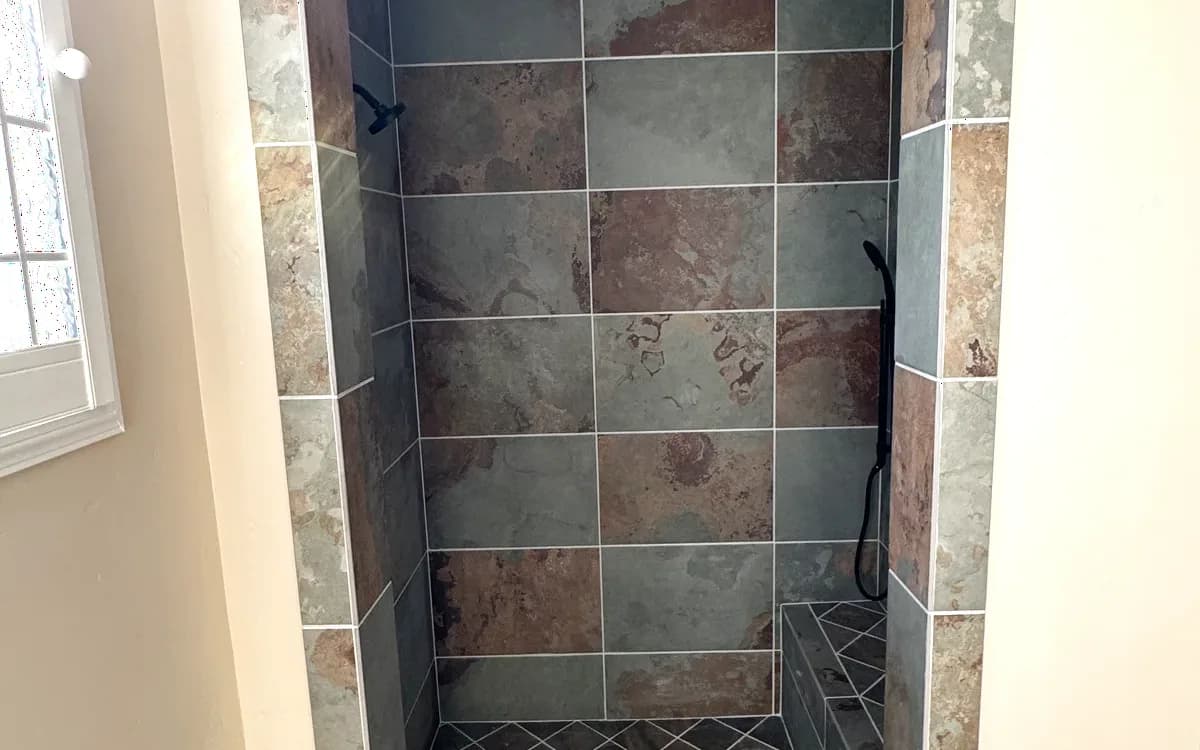
Pictured: a real Oakwood project in Elk Grove. See the full before & after
What Is a Zero-Threshold Walk-In Shower?
A zero-threshold walk-in shower — also called a curbless shower or barrier-free shower — has no raised curb, step, or lip at the entry. The bathroom floor transitions directly into the shower floor at the same level, creating a seamless, uninterrupted surface. Water containment relies on precise floor slope and a strategically positioned drain rather than a physical barrier.
This design has become the most requested shower style in Folsom bathroom remodels for three reasons: it looks dramatically more open and modern than a traditional curbed shower, it provides barrier-free access for aging-in-place planning, and it makes the entire bathroom feel significantly larger. The tradeoff is that it requires more engineering precision than a standard shower — which is why choosing an experienced installer matters.
Walk-in showers come in three configurations: standard curbed (with a low step-over), low-threshold (with a 1 to 2-inch curb), and fully curbless (zero-threshold). This guide covers all three, with specific attention to the engineering and cost implications of curbless designs in Folsom homes.
Why Folsom Homeowners Want Curbless Showers
The demand for curbless showers in Folsom reflects several converging trends:
- Aging-in-place planning: Many Folsom homeowners in Empire Ranch, Broadstone, and Natoma Station purchased in their 30s and 40s. Now in their 50s and 60s, they want a bathroom that will serve them comfortably for the next 20+ years. A curbless shower eliminates a trip hazard and allows for wheelchair or walker access if ever needed.
- Aesthetic preference: The clean, minimal look of a curbless shower — especially with large-format tile and a linear drain — has become the dominant design language in high-end bathrooms. Folsom homeowners see this style in design media and want it in their homes.
- Space perception: Removing the curb and using continuous flooring from bathroom into shower makes even moderately sized bathrooms feel substantially larger. In 2000s Folsom homes where master bathrooms are 100 to 140 square feet, this visual expansion is significant.
- Resale value: Walk-in showers with modern design elements are now expected in homes at Folsom price points ($650,000+). A curbless shower positions the home as contemporary and move-in ready.
Curbed vs. Curbless: Which Is Right for You?
The decision between curbed and curbless depends on your priorities, budget, and bathroom configuration. Here is a direct comparison from our guide on curb vs. curbless walk-in showers:
| Factor | Curbed Shower | Curbless Shower |
|---|---|---|
| Water containment | Excellent — physical barrier | Good — relies on slope and drain |
| Accessibility | Requires stepping over curb | Barrier-free entry |
| Visual impact | Traditional, defined space | Seamless, expansive feel |
| Installation complexity | Standard | Higher — requires precision slope work |
| Additional cost | Baseline | +$1,500 – $3,000 |
| Best drain type | Center or linear | Linear (typically required) |
A practical middle ground is the low-threshold design — a 1 to 2-inch curb that provides water containment security while being easy to step over and visually minimal. This option works well for homeowners who want the look of a curbless shower with the water-management confidence of a curb.
Engineering a Curbless Shower on a Concrete Slab
Most Folsom homes — including Empire Ranch, Broadstone, Natoma Station, and Prairie City — are built on concrete slab foundations. This is the primary engineering challenge for curbless shower installations because the shower floor must slope toward the drain while the bathroom floor remains level at the threshold.
There are two approaches to creating slope on a slab:
Recess the Slab
The concrete in the shower area is cut and lowered to create a recessed pocket. The shower floor is then built up with a sloped mortar bed that drains toward the linear drain while meeting the surrounding bathroom floor at level. This is the cleanest approach and produces the most reliable results. Cost for slab recessing is $2,000 to $4,000 depending on the area and depth required.
Build Up the Bathroom Floor
Instead of lowering the shower, the surrounding bathroom floor is raised slightly (1/2 to 3/4 inch) using a self-leveling compound or thin mortar bed, while the shower floor slopes down from that level to the drain. This works when the slab cannot be easily recessed or when the slope requirement is minimal. The transition is handled at the bathroom doorway with a tapered threshold.
Second-floor bathrooms in two-story Folsom homes offer more flexibility because the subfloor can be modified from below to create slope without concrete cutting. This typically reduces the curbless shower premium by $1,000 to $1,500.
Linear Drains: The Key to Curbless Design
Linear drains are essential to most curbless shower designs. Unlike a traditional center drain that requires the floor to slope from all four sides, a linear drain allows the floor to slope in a single direction — making it possible to create a seamless transition at the shower entry.
Placement Options
- At the shower entry (threshold position): The linear drain sits at the edge of the shower where it meets the bathroom floor. Water flows toward the entry and is captured before it can escape. This is the most popular placement for curbless designs.
- Against the back wall: The drain sits along the wall opposite the entry. The entire shower floor slopes from the entry toward the back wall. This keeps the drain hidden and allows large-format tile with a single plane of slope.
- Along a side wall: The drain runs along one side of the shower. The floor slopes from the opposite side toward the drain. Good for narrow showers where front-to-back slope is more practical.
Linear Drain Costs
Quality linear drain assemblies (from manufacturers like Schluter Kerdi-Line, Infinity Drain, or QuickDrain) cost $300 to $1,000 for the drain body, grate, and connecting components. Installation adds $500 to $1,500 depending on whether slab work is required. The grate finish should match your shower fixtures — brushed nickel, matte black, and tile-insert (where the grate is covered with matching tile) are the most popular options.
Waterproofing Systems for Zero-Threshold Showers
Curbless showers demand more rigorous waterproofing than standard curbed showers because there is no physical barrier to contain water at the entry. The waterproof membrane must extend beyond the shower perimeter and integrate seamlessly with the linear drain assembly.
For curbless installations, we strongly recommend the Schluter Kerdi system because its components are engineered to work together as an integrated waterproof assembly:
- Schluter Kerdi-Board or Kerdi membrane: Waterproof substrate for walls and bench surfaces
- Schluter Kerdi-Drain or Kerdi-Line: Drain assemblies with integrated bonding flanges for the membrane
- Schluter Kerdi-Band: Waterproof seam tape for all corners, joints, and penetrations
- Schluter Kerdi shower tray: Pre-sloped foam trays for the shower floor that eliminate the need for a mortar bed
The entire system creates a continuous waterproof envelope from drain to ceiling with no gaps or unsealed transitions. This is critical for curbless designs where water has a potential path to the bathroom floor. Both TCNA and IAPMO approve these systems for residential wet-area applications.
Glass Enclosure Options for Walk-In Showers
Walk-in showers use glass primarily for splash containment rather than full enclosure. The open, airy feel is the whole point — so the glass should be minimal and visually transparent. Here are the options we install most frequently in Folsom homes, with more detail in our frameless vs. semi-frameless shower glass guide:
- Single fixed panel ($1,200 to $2,200): One piece of frameless tempered glass, typically 30 to 36 inches wide, mounted perpendicular to the showerhead wall. Contains splash while leaving one side of the shower open for entry. The most popular choice for walk-in designs.
- Fixed panel with return ($1,800 to $3,200): A main panel plus a shorter return panel that wraps around the corner. Provides better splash containment for showerhead placement on the side wall.
- Full frameless enclosure ($3,000 to $5,500): Fixed panels with a hinged door. Full water containment for smaller walk-in showers or when the shower is adjacent to fixtures that need protection from splash.
- No glass (wet room style, $0): The shower area is defined only by the floor slope and drain, with no glass at all. Works in larger bathrooms where the shower is recessed or positioned away from fixtures. Requires excellent ventilation.
All shower glass in California must be tempered safety glass. We recommend 3/8-inch or 1/2-inch thickness for stability and a premium feel. Protective coatings (EnduroShield, Diamon-Fusion) are strongly recommended for Folsom's hard water — they repel mineral deposits and reduce cleaning to a weekly wipe-down.
Tile Selection for Walk-In and Curbless Showers
Tile selection for walk-in showers — especially curbless designs — requires balancing aesthetics with engineering requirements:
Shower Floor
For showers with a center drain, 2x2 mosaic tile is standard because it conforms to the multi-directional slope. For showers with a linear drain and single-direction slope, large-format tile (12x24 or larger) can work on the floor because the slope is consistent in one plane. The tile must have a DCOF rating of 0.42 or higher for wet-area slip resistance. Matte and textured finishes provide better grip than polished surfaces.
Shower Walls
Large-format porcelain tile (12x24, 24x24, or 24x48) is the top choice for walk-in shower walls. Fewer grout joints mean less maintenance and a cleaner appearance. Vertical stack patterns are the current dominant trend in Folsom — they elongate the walls and create a modern, linear aesthetic. Porcelain with a low water absorption rate (under 0.5%) handles Folsom's seasonal temperature swings without damage.
Transition Tile
In curbless designs, the tile often continues seamlessly from the bathroom floor into the shower. Using the same tile on both surfaces — or closely coordinating the bathroom floor tile with the shower tile — reinforces the open, continuous look that makes curbless showers visually impactful. The grout joint alignment across the threshold is critical to achieving a truly seamless appearance.
Accessibility Features and Aging-in-Place Design
One of the strongest arguments for a curbless shower is future accessibility. Even if you do not currently need barrier-free access, designing for it now avoids a costly second remodel later. Here are the accessibility features we recommend for Folsom homeowners planning to age in place:
- Grab bars ($150 to $400 each installed): Install blocking in the framing during construction so grab bars can be mounted to studs at any time. Even if you do not install the bars now, the blocking costs almost nothing during a remodel but is expensive to add later.
- Built-in bench ($800 to $1,800): A tiled seat inside the shower for seated showering. The bench should be 17 to 19 inches high (standard chair height) and at least 15 inches deep.
- Hand shower on slide bar ($200 to $600): Allows the showerhead to be positioned at any height — essential for seated showering and for users of different heights.
- Non-slip tile with DCOF 0.42+: Mandatory for all shower floors, but especially critical in barrier-free designs where the shower floor is at the same level as the bathroom floor.
- Wider shower entry (36 inches minimum): Allows wheelchair or walker access. Standard walk-in shower entries are 24 to 30 inches — expanding to 36 inches requires minimal additional cost during initial construction.
These features add $1,000 to $3,000 to a walk-in shower project when included during initial construction. Retrofitting them later — especially grab bar blocking and bench framing — can cost two to three times as much because tile and waterproofing must be disturbed.
Cost Breakdown for Folsom Walk-In Showers
Here are current cost ranges for walk-in shower installations in Folsom, based on our project data:
| Shower Type | Cost Range | Timeline |
|---|---|---|
| Standard curbed walk-in (porcelain tile) | $8,000 – $15,000 | 10 – 12 days |
| Low-threshold walk-in (2-inch curb) | $10,000 – $18,000 | 10 – 14 days |
| Curbless zero-threshold (linear drain) | $15,000 – $25,000 | 14 – 18 days |
| Luxury curbless with premium materials | $22,000 – $35,000 | 16 – 20 days |
These ranges cover the shower installation only — they do not include vanity, toilet, or other bathroom modifications. When a walk-in shower is part of a full bathroom remodel, the combined project cost includes these elements plus the shower. For full remodel pricing, see our walk-in shower service page.
Walk-In Shower Considerations by Folsom Neighborhood
The feasibility and cost of a curbless shower vary by neighborhood based on home construction:
- Empire Ranch (2001 to 2006): Concrete slab foundations. Master bathrooms are typically 100 to 120 square feet with enough room for a generous walk-in shower. Slab recessing is straightforward in these foundations. Original shower stalls are undersized and frequently converted.
- Broadstone (2003 to 2007): Similar slab construction with larger floor plans. Master bathrooms often 120 to 150 square feet. The extra space allows for wider shower entries and more flexible linear drain placement. Some Broadstone models have second-floor master baths with wood-frame subfloors — easier for curbless conversion.
- Natoma Station (2004 to 2008): Mix of slab and raised foundation depending on the specific tract. Raised foundations make curbless conversions simpler and less expensive because the subfloor can be modified from below.
- Prairie City (2005 to 2009): Mostly slab foundations with standard 2000s-era master bathroom layouts. Similar considerations to Empire Ranch for walk-in shower installations.
- Folsom Ranch (2016 to present): Newer construction with better original materials. Some homes already have walk-in showers. Upgrades typically focus on glass and fixtures rather than complete shower reconstruction.
Permits, Timeline, and Installation Process
Walk-in shower installations require a building permit from the City of Folsom because they involve plumbing modifications and, for curbless designs, potential structural work on the slab. The permit process typically takes 1 to 2 weeks.
The installation process follows these phases:
- Demolition (1 to 2 days): Remove existing shower or tub, tile, and substrate. Inspect framing and subfloor.
- Slab work if needed (1 to 2 days): Recess the slab for curbless designs or modify the drain location.
- Plumbing rough-in (1 to 2 days): Install the linear drain assembly, shower valve, and supply lines. Schedule rough plumbing inspection.
- Framing and substrate (1 to 2 days): Install cement board or Kerdi-Board on walls. Build the shower floor with a pre-sloped tray or mortar bed.
- Waterproofing (1 to 2 days): Apply the complete membrane system. Allow cure time.
- Tile installation (3 to 5 days): Floor tile, wall tile, niches, and bench. Grout and caulk.
- Glass and fixtures (1 to 2 days): Install glass panels, showerhead, valve trim, and accessories.
- Final inspection (1 day): City inspection and homeowner walkthrough.
Total construction time is 10 to 20 days depending on whether slab work is required and the complexity of the tile design.
Frequently Asked Questions
Ready for a Walk-In Shower in Your Folsom Home?
Oakwood Remodeling Group specializes in walk-in and curbless shower installations throughout Folsom. From standard curbed designs to precision zero-threshold builds, we engineer every shower for performance and visual impact. Every project includes fixed pricing, a detailed scope, and a timeline you can count on.
Related Reading
Bathroom Remodeling in Folsom, CA
Our full service area page for Folsom homeowners.
Walk-In Shower Installation Services
Our dedicated walk-in shower service page.
Walk-In Shower Guide: Curb vs. Curbless
Detailed comparison of curbed and curbless designs.
Linear Drain vs. Center Drain
Drain options for curbless shower installations.
Frameless vs. Semi-Frameless Shower Glass
Glass enclosure comparison for walk-in showers.
Get Your Free Estimate
Schedule your consultation today
Related Articles
Folsom Luxury Shower Upgrades: Rain Heads, Body Jets, and Steam Systems
El Dorado Hills Shower Remodel: From Builder-Grade to Custom Design

Shower Waterproofing Systems: Schluter vs. Traditional Pan — What Actually Prevents Leaks
Get a Free Estimate
Call us at (916) 907-8782 or fill out our contact form.